
Every year each taxpayer makes one decision before any others: take the standard deduction, or add up the individual ones and claim those instead.
It is a straightforward comparison and it is made after the year has closed, which is precisely why it goes wrong. You cannot make it without the figures, and the figures only exist if somebody kept the records during the year.
This covers how the comparison works, what can be itemised, what was removed by earlier reform, how the claim is made, and why keeping the records matters even in a year you expect not to itemise.
Standard Deduction vs. Itemizing: The Basic Decision
Every taxpayer chooses between the standard deduction and itemizing. You pick whichever results in a larger deduction (and therefore less taxable income). You cannot take both.
| Filing Status | 2025 Standard Deduction |
|---|---|
| Single | $15,000 |
| Married Filing Jointly | $30,000 |
| Married Filing Separately | $15,000 |
| Head of Household | $22,500 |
| Additional for age 65+ or blind (single) | +$2,000 |
| Additional for age 65+ or blind (MFJ, per spouse) | +$1,600 |
Keep the records even in a year you expect to take the standard deduction. The decision is made after the year has closed and you cannot make it without the figures, and some of the same items feed a state return that may follow different rules entirely.
Anu Gupta, CA, EA, B.Tech · LinkedInShould You Itemize? The Test
Add up all your potential itemized deductions. If the total exceeds your standard deduction, itemizing saves more tax. If not, take the standard deduction.
Taxpayers most likely to benefit from itemizing:
- Homeowners with large mortgages (significant mortgage interest deduction)
- High-income taxpayers in high-tax states (though SALT cap limits this)
- Taxpayers with large charitable contribution histories
- Taxpayers with significant uninsured medical expenses
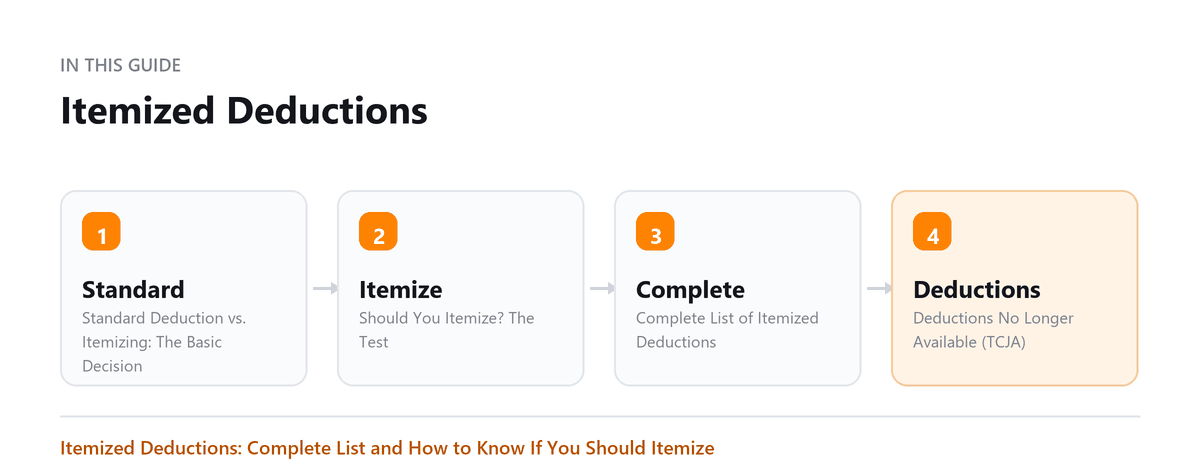
Complete List of Itemized Deductions
1. State and Local Taxes (SALT), Capped at $10,000
You can deduct state and local income taxes (or sales taxes in states without income tax) plus property taxes. The TCJA capped the total SALT deduction at $10,000 per return ($5,000 for married filing separately) through at least 2025.
2. Mortgage Interest
Deductible mortgage interest on:
- Your primary residence and one second home
- Acquisition debt: loans used to buy, build, or substantially improve the home
- Debt limit: $750,000 for loans originated after December 15, 2017 ($375,000 if MFS)
- Loans originated before December 16, 2017: $1,000,000 limit still applies
- Home equity loans: interest deductible only if proceeds used to buy, build, or improve the home
The lender reports interest paid on Form 1098.
3. Charitable Contributions
- Cash contributions to qualified 501(c)(3) organizations
- Property donations (deduct fair market value; special rules for appreciated property)
- Vehicle donations: deduct actual sale price if sold by charity
- Documentation: receipt required for any cash donation; written acknowledgment required for $250+
- Limit: generally 60% of AGI for cash to public charities; lower limits for other types
- Carryforward: excess contributions carry forward 5 years
4. Medical and Dental Expenses
- Deductible only to the extent they exceed 7.5% of your Adjusted Gross Income
- Qualifying expenses: doctors, dentists, hospitals, prescriptions, long-term care insurance premiums, medical equipment
- Not deductible: cosmetic surgery (unless medically necessary), over-the-counter drugs (except insulin), health club dues
- Example: AGI of $100,000, medical expenses of $12,000, deductible amount = $12,000 - $7,500 = $4,500
5. Casualty and Theft Losses
TCJA restriction: casualty losses are only deductible if they occur in a federally declared disaster area. Personal casualty losses outside of federal disaster declarations are no longer deductible through 2025.
6. Gambling Losses
Gambling losses are deductible only up to the amount of gambling winnings. You cannot deduct net losses. Winnings must be reported as income.
Deductions No Longer Available (TCJA)
- Unreimbursed employee business expenses (suspended through 2025)
- Investment advisory fees and other investment expenses (suspended)
- Tax preparation fees (suspended)
- Alimony paid (for divorce agreements after December 31, 2018)
How to Claim Itemized Deductions
Complete Schedule A (Itemized Deductions) and attach it to your Form 1040. Your tax software handles this automatically.
Pro Tip: Even if you take the standard deduction most years, track potential itemized deductions. If you have a year with high medical expenses, a large charitable gift, or a major casualty loss, itemizing that year may save significantly.
Book a free consultation and we will take the return off your desk.
Frequently Asked Questions
Can I itemize on my federal return and take the standard deduction on my state return?
Some states decouple from federal treatment. In those states, you can make independent elections. Check your state's instructions.
How do I deduct a non-cash charitable donation over $500?
You must complete Form 8283 (Noncash Charitable Contributions). For donations over $5,000, a qualified appraisal is generally required.
Does itemizing affect my Alternative Minimum Tax (AMT)?
Yes. SALT deductions (state/local taxes) are not allowed for AMT purposes. High-income taxpayers who itemize primarily because of SALT deductions may find that itemizing triggers AMT. Run both calculations.
What records support these if the return is examined?
Documentation for each item claimed, kept for the year in question: receipts, statements, acknowledgements from charities, and for anything substantial the paperwork establishing what it was and what it cost. Charitable giving has its own documentation requirements which vary with the size and nature of the gift, and a claim without the required acknowledgement can fail on that alone however genuine the donation.
Is it worth tracking these even in a year we do not itemise?
Often yes, because the decision is made after the year has ended and you cannot make it without the figures. It also matters because some of the same items feed a state return that may follow different rules, so a year that does not itemise federally can still itemise elsewhere. Keeping the records costs little; discovering in February that they were not kept costs the deduction.

Written by
Anu Gupta, CA, EA, B.Tech
Anu works with US businesses on tax and entity questions at Profitjets, from choosing a structure to the filings that follow it. She writes about the decisions owners make once and then live with for years. Connect on LinkedIn
Free consultation
Want the Filing Handled?
Book a free consultation and we will take the return off your desk.