
Outsourced Accounting + Fractional CFO: The Combined Finance Function
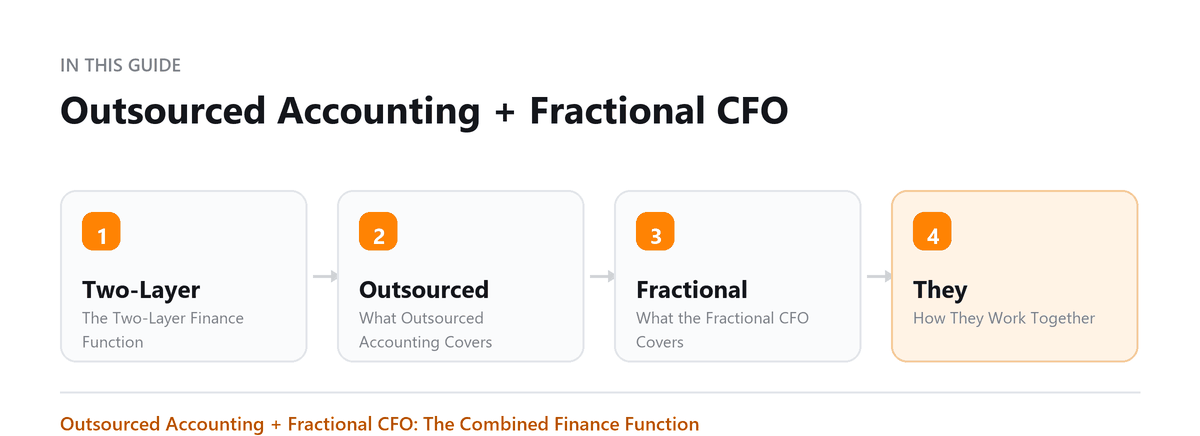
The Two-Layer Finance Function, What Outsourced Accounting Covers, and What the Fractional CFO Covers
Most growing businesses end up buying finance in two layers, and the value comes from how cleanly those layers are separated.
One produces reliable numbers on a schedule. The other uses them to decide things. When the second spends its time repairing the first, the business is paying senior rates for operational work and getting neither properly.
This covers what each layer covers, how they work together, the stage at which the model fits best, what it costs, and the signs that it is breaking down.
The Two-Layer Finance Function
Growing companies need two things from finance: accurate data and smart decisions. Outsourced accounting provides the data, clean books, closed month, financial statements. The fractional CFO uses that data to drive decisions, fundraising, hiring, pricing, capital allocation.
These are distinct roles that work best together. Trying to collapse them into one person leads to either poor accounting or poor strategy, rarely both done well at the same price.
The two layers only work together when the handoff is defined. If the senior person is reworking the numbers before they can use them, you are paying the higher rate for the lower job, and that is the signal the model has slipped.
Abhinav Gupta, CPA, CA, MBA · LinkedInWhat Outsourced Accounting Covers
- Monthly bookkeeping and close (accounts payable, accounts receivable, payroll journal entries)
- Bank and credit card reconciliation
- Financial statement preparation (P&L, balance sheet, cash flow)
- Payroll processing coordination
- Sales tax filings
- Accounts payable processing
- Equity compensation accounting (ASC 718)
- Audit support and tax return coordination
What the Fractional CFO Covers
- Financial modeling and scenario planning
- Board and investor reporting and narrative
- Fundraising: data room preparation, investor Q&A support
- Cash flow forecasting and runway management
- Pricing and unit economics analysis
- Hiring plan financial impact modeling
- Vendor and customer contract financial review
- Banking and credit relationships
- M&A and exit preparation
How They Work Together
The workflow is sequential and interdependent. The accounting team closes the books by the 10th of the month. The fractional CFO reviews the financials, updates the forecast model, prepares the board deck, and flags strategic issues, all before the board meeting on the 15th.
Pro Tip: The best fractional CFO relationships include a monthly review call with the accounting team lead to discuss variances before the board package is finalized.
Ideal Stage: Series A ($5M-$20M Revenue)
The combined model is most common at companies that:
- Have raised a Series A and have institutional board members
- Generate $1M-$20M in annual revenue
- Are 12-36 months from the next fundraise
- Have 10-75 employees
- Cannot yet justify a $200,000+ VP Finance hire
Cost Comparison
| Option | Typical Annual Cost |
|---|---|
| In-house Controller + VP Finance | $280,000 - $420,000 (salary + benefits + equity) |
| Outsourced accounting + Fractional CFO bundle | $48,000 - $144,000 per year |
| Outsourced accounting only | $24,000 - $72,000 per year |
| Fractional CFO only (no accounting) | $36,000 - $96,000 per year |
Warning Signs the Model Is Breaking Down
- Books are consistently late and the CFO cannot trust the numbers
- The CFO is spending time on reconciliation instead of strategy
- The accounting team does not understand the business model
- Investor Q&A during diligence reveals accounting errors
What the Combined Model Asks of the Business
The two-layer arrangement only works if the company holds up its side, and the requirements are specific enough to be worth stating. They are not onerous, but each one is a common point of failure.
The first is a single point of contact inside the business. Two external layers asking questions of four different people produces contradictory answers and duplicated work, and the company ends up coordinating its own suppliers. One person who holds the relationship, even part-time, removes most of that.
The second is a fixed calendar. Both layers are working to a monthly rhythm, and everything downstream slips when the inputs arrive late. Agreeing the date documents are provided, the date the close completes and the date the reporting pack is discussed turns a set of dependencies into a routine. The third is that somebody in the business reads the output and asks questions about it, because an unread board pack is an expensive artefact.
- Name one internal owner of the relationship before either layer starts
- Put the monthly dates in a shared calendar rather than in an email thread, and treat them as commitments on both sides
- Book the review conversation in advance, every month, so it happens whether or not anything looks unusual
- Escalate a missed date the first time it happens, since the second and third become the new normal
Book a free consultation and we will put senior eyes on your numbers.
Frequently Asked Questions
Should the fractional CFO and accounting firm be from the same company?
Often yes, bundled providers coordinate better and share context. Some companies prefer separate vendors to avoid concentration risk or to get best-of-breed in each function.
At what revenue does the combined model become insufficient?
Most companies transition to in-house finance leadership at $20M-$30M revenue or after a Series B, when the volume and complexity of transactions justifies a dedicated hire.
How many hours does a fractional CFO work per month?
Typically 20-40 hours per month for a Series A company, more during fundraising sprints or audit season.
How do we avoid paying two providers for overlapping work?
Write down who owns each deliverable before either starts. The reconciliation and the monthly close belong to one layer; the forecast, the board pack and the analysis belong to the other. Overlap creeps in through analysis, where both can reasonably produce a version, and through queries, where the question goes to whoever answers first. A single list of outputs with one name against each removes most of it.
Should both layers come from the same firm?
There are arguments either way and neither is wrong. One firm is simpler, the handover between layers is somebody else's problem, and the context is shared. Two firms give you a second pair of eyes on the numbers and make it easier to change one without disturbing the other. The deciding question is usually how much you value that independent read against the coordination it costs you.

Written by
Abhinav Gupta, CPA, CA, MBA
Abhinav works with business owners across the US on industry-specific bookkeeping, from dental practices and restaurants to construction and e-commerce. He writes about what each trade's books actually need. Connect on LinkedIn
Free consultation
Want CFO-Level Clarity?
Book a free consultation and we will put senior eyes on your numbers.