
The invoice approval workflow is where most small business AP grinds to a halt, and not easily apparent that the problem even exists. Cash is available, the invoice is legitimate, there are no disputes, and the invoice is just waiting in someone's inbox for a ninety-second decision.
That delay has costs, not least of which are the early payment discounts that vanish into thin air because the invoice approval process takes longer than the specified period, say 2/10 Net 30; those represent a 37% annualised interest rate, and a business that takes twelve days on average to approve invoices will never see those discounts, regardless of its cash position. In addition, invoice approval processes that take too long to resolve cause month-end closes to accumulate unpaid invoices, creating accruals for the bookkeeper.
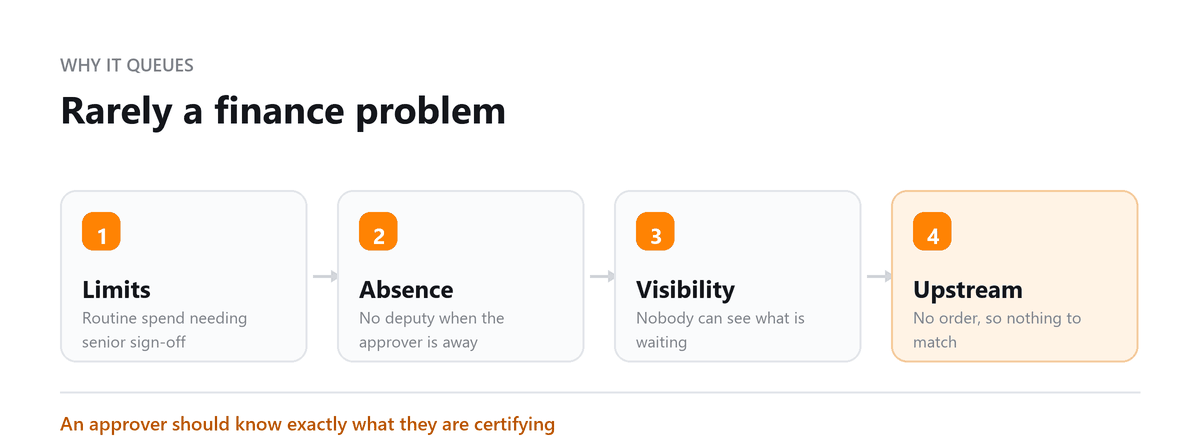
Improving accounts payable approval processes is not primarily about investing in new software; it's about establishing who approves what and when, imposing a deadline on their decision-making, and ensuring that no invoice can languish in one set of hands without being visible to others.
Owners look at slow approvals as an efficiency problem and price it in staff hours, which is the smallest part of it. The real cost is that you lose the ability to choose when you pay. Once approval takes twelve days, every invoice gets paid at whatever point it happens to clear, and you've given up the working capital decision entirely, you're not managing payment timing any more, you're just watching it happen.
Ankit Sagatani, MBA, B.Com · LinkedInThe following seven reasons explain what these improvements can deliver, what invoice approval fraud can make inaccessible, and why two common recommendations don't go far enough in automating the process.
What Is an Invoice Approval Workflow?
An invoice approval workflow is the route an invoice travels from arrival to payment authorisation. At minimum: received, checked for accuracy, coded to the right GL account, routed to whoever has authority to approve it, approved, scheduled.
Manually, that happens over email and a spreadsheet, and it works fine until someone is on leave. In an automated setup, the platform routes the invoice, chases the approver, and escalates when nobody acts. The difference isn't speed so much as it is that nothing goes missing.
At minimum it includes: invoice received → reviewed for accuracy → coded to the correct GL account → routed to the appropriate approver → approved → scheduled for payment. In a manual process these steps happen via email, spreadsheet, or paper routing. In an automated process, the platform handles routing, reminders, and escalations automatically.
Signs Your Invoice Approval Process Needs Help
- Invoices go out late even though the cash was sitting there, that's an approval bottleneck, not a liquidity problem
- Approvers routinely say they never received something
- Month-end AP close takes more than two or three days
- A duplicate invoice got close to being paid before someone caught it
- Early payment discounts are consistently missed, because approval takes longer than the discount window
- You can't answer "what's currently awaiting approval and with whom" without asking around
That last one is the tell. If nobody can see the queue, there is no workflow, there's a set of habits.
7 Reasons to Improve Your Invoice Approval Workflow in 2026
1. Eliminate Late Payment Penalties
Most supplier agreements include late payment clauses typically 1.5-2% per month on overdue invoices. A single $50,000 invoice paid 30 days late costs $750-$1,000 in penalties. Across a year of invoices, these amounts accumulate significantly. An automated approval workflow with due-date reminders and escalations virtually eliminates late payment.
2. Capture Early Payment Discounts
Suppliers offering 2/10 Net 30 terms (2% discount if paid within 10 days) are effectively offering a 37% annualised return on the discount. Most businesses miss these discounts because the approval process takes longer than 10 days. Streamlined approval makes the discount window achievable.
3. Reduce Processing Time by Up to 80%
Automation reduces invoice processing time by 50-80% compared to manual workflows, cutting the average from 15+ days to 3-7 days. This means more invoices processed with the same headcount, faster close cycles, and improved supplier satisfaction.
4. Improve Fraud Prevention
Invoice fraud including fictitious invoices, duplicate submissions, and bank account change fraud is a significant risk in businesses with weak approval controls. Structured approval workflows with segregation of duties (the person who codes the invoice does not also approve and pay it) are the primary defence.
5. Scale Without Adding Headcount
A manual AP process scales linearly with invoice volume double the invoices, double the AP workload. An automated approval workflow can handle 50 or 500 invoices per month with the same configuration, enabling business growth without proportional headcount increases.
6. Produce a Clean Audit Trail
Every approval action who approved, when, the amount, and any notes is logged automatically in an AP automation platform. This audit trail is essential for financial statement audits, tax authority inquiries, and internal compliance reviews. Manual email approvals leave no reliable audit trail.
7. Reduce AP Close Time
Month-end financial close depends on AP being complete and accurate. Slow approval workflows mean invoices are still being processed when the close deadline arrives, either the close is delayed or invoices are accrued as estimates. A streamlined workflow with same-day approval SLAs allows the AP close to complete in 1-2 days rather than a week.
Best Practices for Streamlining Invoice Approval
- Define approval thresholds in writing and enforce them in the system, not via email
- Set approval SLAs: 24 hours for routine invoices; same-day for urgent payments
- Automate escalations: if an approver does not act within the SLA, the invoice automatically escalates to their manager
- Build in duplicate detection: the system should flag any invoice with the same vendor + amount + date combination before routing for approval
- Require a $10,000+ threshold for dual approval, two independent approvers reduces fraud risk on high-value payments
Book a free consultation and we will find where they sit.
Frequently Asked Questions
What tools can automate invoice approval?
BILL, Tipalti, Stampli, SAP Concur, and the AP features built into QuickBooks all handle approval routing. The right choice comes down to volume, what accounting system you need it to sync with, and budget. Most offer trials, and it's worth running one with real invoices rather than test data routing problems only surface when the invoices are messy.
How long should invoice approval take?
Routine invoices should clear within 24 hours of receipt. Anything needing multiple approvers or a dispute to resolve might reasonably take three to five days. Past seven days you're looking at a process problem rather than a complexity problem, and adding approvers will make it worse rather than better.
Do small businesses really need a formal approval workflow?
If one person both approves and pays, and that person owns the business, then formal routing adds little. What still helps is a visible queue and a time limit, so invoices don't sit unnoticed. The moment a second person is involved in approving or paying, you need something written down that's the point where "I assumed you'd handled it" starts costing money.
What's the difference between invoice approval and the three-way match?
The match is a verification step: does the invoice agree with what was ordered and what arrived. Approval is an authorisation step: does someone with the authority to spend this money agree it should be paid. A matched invoice can still be wrong to pay, the service might have been cancelled, or the budget spent elsewhere. Run both.
Can approval be too strict?
Yes, and it's a common overcorrection. When thresholds are set so low that routine small invoices need senior sign-off, approvers start batch-approving without looking, which is worse than no control because it produces a clean audit trail for decisions nobody actually made. Set the lowest band so that most of your invoice volume falls beneath it, and reserve real scrutiny for the amounts that justify it.

Written by
Ankit Sagatani, MBA, B.Com
Ankit works with business owners across the US on industry-specific bookkeeping, from real estate to construction and retail. He writes about what each trade's books actually need. Connect on LinkedIn Connect on LinkedIn
Free consultation
Invoices Stuck in Approval?
Book a free consultation and we will find where they sit.