
Venture funding arrives in named stages, and the names describe how much evidence a company is expected to have rather than how much money it raises.
That is the part founders under-weight. Each round is priced against proof the previous one was meant to produce, and raising before that proof exists is what sets up a difficult round two years later.
This covers the stages in order, what is typically raised at each, what investors expect to see, how dilution accumulates, and how it ends at a listing or a sale.
Venture capital moves in stages, each with its own typical deal size, investor type, valuation range, and what the company must demonstrate. Understanding the full arc helps founders know what investors at each stage are actually evaluating.
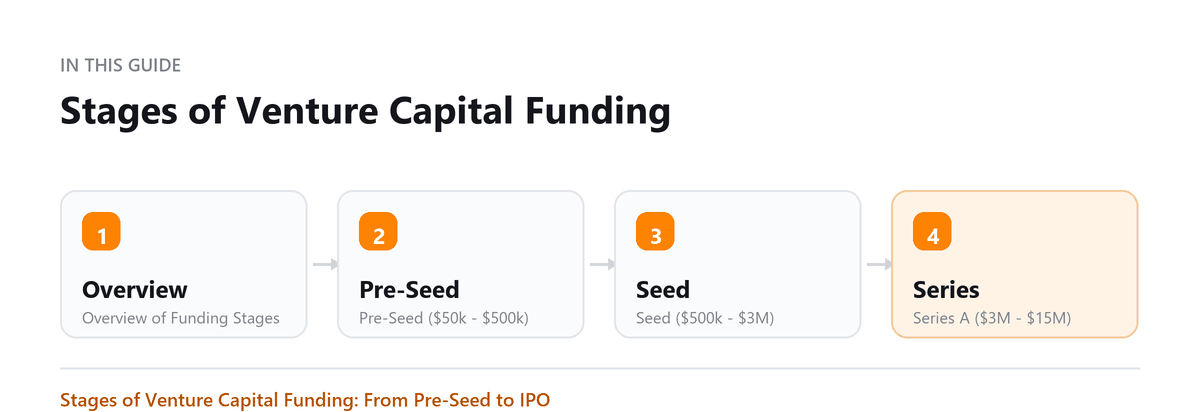
Overview of Funding Stages
| Stage | Typical Raise |
|---|---|
| Pre-Seed | $50k - $500k |
| Seed | $500k - $3M |
| Series A | $3M - $15M |
| Series B | $15M - $50M |
| Series C+ | $50M+ |
| Late Stage / Pre-IPO | $100M+ |
| IPO or M&A Exit | Varies |
Each stage is priced on evidence the previous one was supposed to produce. Raising before that evidence exists is what creates a flat or down round later, and that is considerably harder to recover from than waiting two quarters.
Abhinav Gupta, CPA, CA, MBA · LinkedInPre-Seed ($50k - $500k)
At pre-seed, the company is usually an idea, a prototype, or very early MVP. Revenue is zero or negligible.
- Investors: friends and family, angel investors, founder's personal savings, early-stage micro-VCs
- What they evaluate: founding team quality, size of problem, early product thinking
- Typical valuation: $1M - $5M pre-money (highly variable)
- Dilution: 10-20%
- Use of funds: build MVP, validate problem-solution fit
Seed ($500k - $3M)
Seed capital funds the journey from MVP to early product-market fit signal.
- Investors: angel syndicates, seed-stage VCs (Y Combinator, First Round, Precursor Ventures)
- What they evaluate: early customers or users, engagement data, team's ability to iterate
- Typical valuation: $5M - $15M pre-money
- Dilution: 15-25%
- Use of funds: hire initial team, refine product, acquire first 50-100 customers
Series A ($3M - $15M)
Series A is about proving the growth model, that you can acquire customers repeatably and economically.
- Investors: institutional VCs (Sequoia, a16z, Bessemer at this stage)
- What they evaluate: ARR ($1M-$3M is a common benchmark), growth rate (100%+ YoY), unit economics (LTV:CAC), product-market fit evidence
- Typical valuation: $15M - $60M pre-money
- Dilution: 15-25%
- Use of funds: build the sales team, double down on the growth channels that work
Series B ($15M - $50M)
Series B is for companies that have figured out growth and need capital to scale the machine.
- Investors: growth-stage VCs, crossover funds
- What they evaluate: proven go-to-market, strong NRR, clear path to market leadership in a defined category
- Typical valuation: $60M - $250M
- Dilution: 10-20%
- Use of funds: scale sales and marketing, expand geographies, invest in infrastructure
Series C and Beyond ($50M+)
Late-stage rounds are for category leaders pursuing international expansion, acquisitions, or preparing for exit.
- Investors: late-stage VCs, growth equity firms, hedge funds, sovereign wealth funds
- What they evaluate: market share, revenue scale ($30M+ ARR common), clear path to profitability or exit
- Typical valuation: $250M+
- Use of funds: M&A, international expansion, product diversification
Exit: IPO or M&A
| Exit Type | Characteristics |
|---|---|
| IPO (Initial Public Offering) | List shares on a public exchange. Requires $100M+ ARR for most SaaS IPOs. Ongoing public reporting obligations. |
| Strategic M&A | Sale to a larger company. Can happen at any stage if the acquirer sees strategic value. |
| Sponsor-to-Sponsor (PE Buyout) | Private equity buys the VC-backed company; common for profitable but pre-IPO SaaS businesses. |
| Direct Listing / SPAC | Alternative routes to public markets without traditional IPO underwriting. |
Typical Dilution Per Round
Founders who raise through to Series B typically own 20-40% at Series B, depending on how many rounds they raised, at what valuations, and whether they granted significant options.
Book a free consultation and we will get the numbers straight.
Frequently Asked Questions
Do all startups need to raise venture capital?
No. VC is the right fit for businesses targeting large markets with capital-intensive growth paths and an exit timeline of 7-10 years. Bootstrapped businesses that reach profitability can be equally valuable without dilution.
What is the difference between a seed round and a pre-seed round?
Pre-seed is the earliest capital, often before a product exists. Seed rounds are typically larger and come after a working MVP and some early validation. The boundary has blurred as seed rounds have grown in size.
What does a typical VC term sheet include?
Valuation (pre-money), investment amount, equity percentage, liquidation preference (1x non-participating is standard), anti-dilution (broad-based weighted average is standard), board composition, and pro-rata rights.
What do we need in order before approaching investors at any stage?
A clean cap table, a set of accounts somebody else can follow, and the corporate records that prove the company owns what it says it owns. Those three are checked at every stage and they are the ones most often found wanting: shares promised informally, accounts that disagree with the bank, intellectual property developed by a contractor with no assignment in place. Fixing any of them under offer pressure costs far more than fixing them early.
What actually changes between one stage and the next?
The question being asked. Early on it is whether the problem is real and whether you are the people to solve it, which is a judgement about you. Later it becomes whether the thing you built sells repeatably, which is a judgement about your numbers. Later still it is whether it scales profitably, which is a judgement about your unit economics. Each stage brings a harder standard of evidence rather than simply a larger cheque.

Written by
Abhinav Gupta, CPA, CA, MBA
Abhinav works with business owners across the US on industry-specific bookkeeping, from dental practices and restaurants to construction and e-commerce. He writes about what each trade's books actually need. Connect on LinkedIn
Free consultation
Want Books You Can Rely On?
Book a free consultation and we will get the numbers straight.