
A seller who does not charge sales tax on an exempt sale needs a valid certificate from the buyer, and the obligation sits with the seller rather than the buyer.
That is the part businesses underestimate. In a review the question is not whether the buyer was genuinely exempt, it is whether the seller held valid documentation at the time it decided not to charge.
This covers which certificates apply to which situations, how to complete and accept one, how to verify the buyer, how long to keep them, and what happens when a certificate turns out to be invalid.
Texas Sales Tax Basics
Texas imposes a 6.25% state sales and use tax. Local taxing jurisdictions (cities, counties, special districts) can add up to 2%, bringing the maximum combined rate to 8.25%. Most major Texas cities charge the full 8.25%.
| Component | Rate |
|---|---|
| State sales tax | 6.25% |
| Maximum local add-on | 2.00% |
| Maximum combined rate | 8.25% |
| Common major-city rate (Austin, Dallas, Houston, San Antonio) | 8.25% |
A certificate accepted in good faith protects the seller; one accepted without checking does not. Verify the buyer's permit before you accept it, keep the certificate on file, and remember that the obligation sits with whoever failed to collect.
Anu Gupta, CA, EA, B.Tech · LinkedInWho Qualifies for a Sales Tax Exemption?
- Businesses buying goods for resale (resale certificate)
- Farmers and ranchers buying qualifying agricultural items
- Manufacturers buying machinery used in production
- Qualifying nonprofit organizations
- Certain healthcare providers and patients
- Government entities
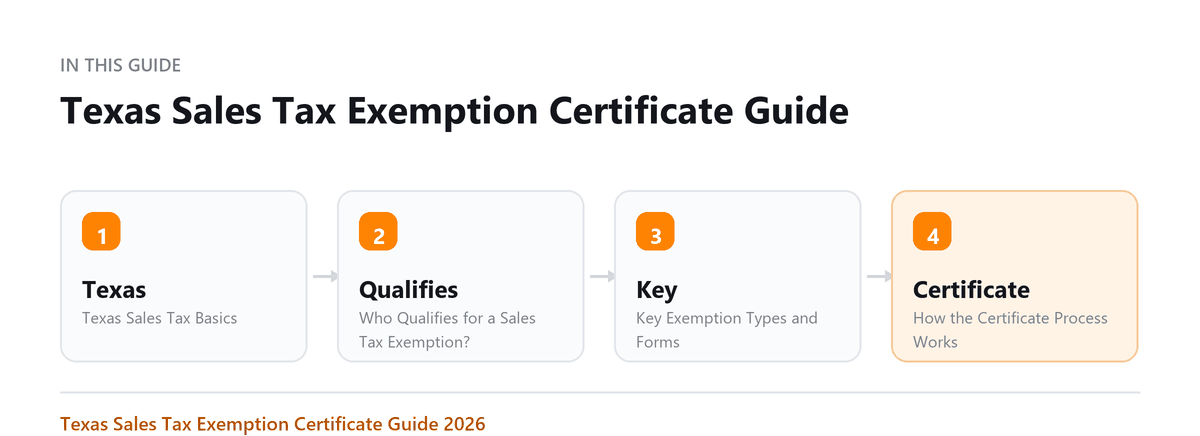
Key Exemption Types and Forms
1. Resale Certificate (Form 01-339)
If you buy goods to resell them, you do not pay sales tax at the time of purchase. You collect tax from your customer when you sell the item.
- Use Form 01-339: Texas Sales and Use Tax Resale Certificate
- Provide your Texas sales tax permit number
- Describe the items being purchased for resale
- The seller retains the certificate, do not send to the Comptroller
- A blanket certificate covers all future purchases from that vendor for the same type of goods
Pro Tip: Keep blanket resale certificates updated. If your business changes, issue a new certificate to your suppliers.
2. Agricultural Exemption
Farmers, ranchers, and timber producers can buy qualifying items tax-free. Registration with the Comptroller is required.
- Register online with the Texas Comptroller to receive an Agricultural/Timber Exemption Registration Number
- Present your registration number and Form 01-924 (Agriculture) or Form 01-925 (Timber) to the seller
- Qualifying items: seeds, fertilizer, farm equipment, livestock feed, irrigation equipment
- Non-qualifying: clothing, general vehicles, items used primarily for personal use
3. Manufacturing and Industrial Machinery
Machinery and equipment used directly in manufacturing, processing, fabricating, or repairing tangible personal property for sale are exempt.
- Equipment must be used more than 50% of the time in a qualifying manufacturing process
- Repair parts and replacement components also qualify
- Use the standard exemption certificate (Form 01-339) and check the appropriate exemption reason
- Pollution control equipment used in manufacturing may qualify separately
4. Nonprofit Organizations
Qualifying nonprofit organizations can purchase certain items tax-free and are exempt from collecting sales tax on qualifying sales.
- Must apply to the Comptroller using Form AP-204 (state tax exemption) or Form AP-205 (charitable organization)
- Not all nonprofits automatically qualify, federal 501(c)(3) status alone is not enough
- Exemption covers items used in the organization's exempt function
- Exempt sales: items sold at fundraisers limited to two per year
- Unrelated business sales are taxable
5. Healthcare Exemptions
- Prescription drugs and certain over-the-counter drugs are exempt
- Medical devices prescribed by a physician may be exempt
- Medicare/Medicaid-certified facilities have specific exemptions
- Consult the Comptroller's health care industry guide for specifics
How the Certificate Process Works
- Buyer determines they qualify for an exemption
- Buyer completes the appropriate exemption certificate with their name, address, exemption reason, and permit/registration number
- Buyer presents the certificate to the seller before the sale
- Seller reviews the certificate and retains it for at least 4 years
- Seller does not collect sales tax on the exempt transaction
- If the certificate later proves invalid, the seller may be liable for the uncollected tax, unless they accepted it in good faith
Seller Responsibilities and Liability
Sellers are not the tax police, but they bear risk if they accept invalid certificates:
- Accept certificates in good faith, if the certificate looks complete and credible, you are generally protected
- Verify the buyer's Texas sales tax permit via the Comptroller's online verification tool
- Retain all exemption certificates for at least 4 years
- Do not accept a certificate after the sale is complete
- If you have reason to suspect fraud, do not accept the certificate
Pro Tip: Use the Texas Comptroller's online Taxpayer Search to verify a buyer's sales tax permit number before accepting a resale certificate.
Annual Renewal
Exemption certificates for agriculture and timber registrations must be renewed every 4 years. Other exemption certificates (like resale) do not have a set expiration but should be updated if the buyer's information changes.
Book a free consultation and we will take the return off your desk.
Frequently Asked Questions
Does a Texas resale certificate expire?
No set expiration, but it should be updated if business details change.
Can an out-of-state business use a Texas resale certificate?
Out-of-state buyers may use their home-state resale certificate or a completed Form 01-339.
What if I misuse an exemption certificate?
Misuse is a criminal offense. Buyers who fraudulently use certificates are liable for the tax plus penalties.
Are services taxable in Texas?
Most services are not taxable. However, certain services (e.g., telecommunications, data processing, amusement) are taxable.
Where can I verify a Texas sales tax permit?
Texas Comptroller website: comptroller.texas.gov, Taxpayer Search.

Written by
Anu Gupta, CA, EA, B.Tech
Anu works with US businesses on tax and entity questions at Profitjets, from choosing a structure to the filings that follow it. She writes about the decisions owners make once and then live with for years. Connect on LinkedIn
Free consultation
Want the Filing Handled?
Book a free consultation and we will take the return off your desk.