
12 Questions to Ask Your Accountant When You Want to Grow Your Business
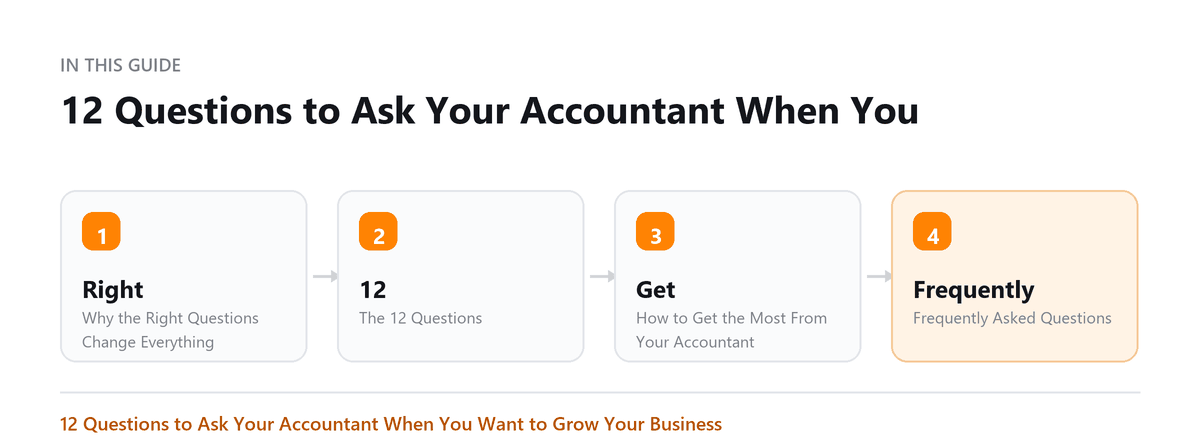
Why the Right Questions Change Everything, The 12 Questions, and How to Get the Most From Your Accountant
Most conversations with an accountant are about what already happened, which is a reasonable use of the relationship and not the most valuable one.
Growth changes the questions. What worked at the current size frequently breaks at twice it, and the person who sees your numbers every month is usually the first person able to say where.
This covers the questions worth asking when growth is the objective, what a good answer to each sounds like, and how to run the relationship so the answers keep coming.
Why the Right Questions Change Everything
Most business owners use their accountant primarily for tax prep and compliance. The smartest ones use their accountant as a growth advisor, but only if they ask the right questions. Here are 12 questions that unlock strategic value from your accounting relationship.
Ask what your accountant would change if the business doubled. The answer tells you whether they are thinking about where you are going or only recording where you have been, and that difference matters far more than their fee.
Abhinav Gupta, CPA, CA, MBA · LinkedInThe 12 Questions
Question 1: What entity type makes sense for me at my current stage?
Your entity choice (sole proprietor, LLC, S-corp, C-corp) has significant tax implications, and the optimal structure often changes as revenue grows. At $50k profit you may be fine as an LLC. At $150k profit, an S-corp election typically saves meaningful tax dollars.
What to listen for: a specific comparison of your after-tax take-home under different structures, not a generic answer about 'it depends.'
Question 2: What is my true profit margin by product or service line?
Many owners know their overall margin but not their per-product or per-service margin. Some offerings are highly profitable; others are subsidized by the rest. You cannot grow intelligently without knowing this.
What to listen for: your accountant should be able to run a revenue and direct cost analysis by offering, or tell you what data you need to capture to make this possible.
Question 3: Am I pricing correctly?
This is a strategic question your accountant can answer with data: what is your current gross margin, what is typical for your industry, and are you leaving money on the table? Many small businesses under-price because they under-estimate true costs.
What to listen for: a loaded cost analysis that includes not just direct costs but allocated overhead, plus a benchmark comparison if available.
Question 4: Where is my cash going?
Profit and cash are not the same thing. A profitable business can run out of cash if receivables lag, inventory builds up, or loan payments consume cash flow. Ask for a cash flow statement walkthrough, not just the income statement.
What to listen for: identification of your cash flow timing gaps, whether it's a payables/receivables mismatch, inventory build, or debt service.
Question 5: What is the optimal salary and distribution mix for me as an owner?
If you are an S-corp, your compensation mix between salary and distributions directly affects your payroll tax burden. Your accountant should review this annually, especially as revenue changes.
What to listen for: a specific dollar recommendation for your salary, not just 'reasonable compensation.' They should reference what a similarly skilled employee would be paid in your market.
Question 6: What can I do to minimize my tax bill this year?
Do not wait until tax prep time. Have this conversation mid-year (July-August) or even in Q1 when you can actually implement strategies. Year-end tax planning often finds only a fraction of the available opportunities.
- Retirement plan contributions (SEP-IRA, Solo 401k, defined benefit plan)
- Timing of income and expenses
- Equipment purchases and Section 179 elections
- Hiring family members for legitimate services
- Qualified Business Income (QBI) deduction optimization
Question 7: Am I ready to qualify for a business loan?
Growth often requires capital. Ask your accountant to look at your financials through a lender's eyes: debt service coverage ratio, personal credit, business credit profile, and what the bank will need to see. Do this before you need the money.
What to listen for: specific items to clean up or document, like separating personal and business expenses, getting two full years of filed business returns, or paying down existing debt.
Question 8: What does my business look like to a potential buyer?
Even if you do not plan to sell, understanding your business's value and what drives it makes you run the business better. Ask what EBITDA or seller's discretionary earnings are, what the current multiple for your industry is, and what would increase your value.
What to listen for: a valuation estimate using industry multiples, and two or three specific changes that would increase that number.
Question 9: What financial KPIs should I be tracking monthly?
If your accountant is only reviewing financials at year-end, you are operating blind. Ask for a monthly dashboard of the five to seven numbers that matter most for your specific business.
- Gross margin percentage
- Operating cash flow
- Revenue per employee or per service unit
- Accounts receivable days outstanding
- Customer acquisition cost and LTV (if applicable)
Question 10: Do I need to collect sales tax in new states as I expand?
Economic nexus rules mean that crossing a sales threshold in a state (often $100,000 in sales or 200 transactions) triggers a registration and collection obligation, even if you have no physical presence there. Growing businesses often cross these thresholds without realizing it.
What to listen for: a current nexus analysis by state based on where your customers are located. This should be updated annually.
Question 11: Should I bring any functions in-house vs. continuing to outsource?
At some growth stage, outsourced services become more expensive than hiring. Bookkeeping, marketing, customer service, and fulfillment all have crossover points. Ask your accountant to model the total cost of in-house vs. outsourced for any function you are spending significantly on.
Question 12: What do I need to know before hiring my first employee?
Employment changes your entire cost structure and compliance footprint. Before your first hire, understand: payroll taxes you will owe (FICA match, FUTA, SUTA), workers compensation requirements, benefits obligations, and how your deductible expenses change.
What to listen for: a specific cost-of-an-employee calculation, total employment cost including all taxes and benefits overhead, not just the salary offered.
How to Get the Most From Your Accountant
- Meet quarterly, not just at tax time, proactive advice requires ongoing dialogue
- Share your goals: if your accountant does not know you want to hit $2M revenue or sell in 5 years, they cannot advise toward that goal
- Bring your questions prepared, accountants bill by the hour; organized meetings are efficient meetings
- Ask for numbers: a good accountant quantifies advice, not just describes it
Book a free consultation and we will put senior eyes on your numbers.
Frequently Asked Questions
How often should I meet with my accountant if I want to grow?
At minimum quarterly. Growing businesses benefit from monthly check-ins, even a 30-minute financial review call. Annual-only relationships leave too many opportunities on the table.
What if my current accountant cannot answer these questions?
Some accountants specialize in compliance only and are not equipped for growth advisory. If your accountant consistently deflects strategic questions, consider interviewing additional firms. Many advisory-focused firms offer a free initial consultation.
Do I need a CPA specifically, or will a bookkeeper work?
A bookkeeper handles the recording of transactions. A CPA provides tax strategy, financial analysis, and advisory. For the questions in this guide, you need a CPA (or equivalent tax advisor). Your bookkeeper and CPA should work together, these are complementary roles.
When is the right time to ask these?
Before the decision, not after it, which sounds obvious and is the opposite of how most businesses use their accountant. A question asked while a decision is still open can change the outcome. The same question asked after a contract is signed, a person is hired or an entity is formed can only describe the consequences. Build one conversation into your year that happens when nothing is due, because that is the only one where planning is possible.
What if the answers we get are vague?
Ask for the reasoning rather than the conclusion. A good adviser can explain which facts drive the answer and what would change it, even when the answer itself is genuinely uncertain. Persistent vagueness usually means one of two things: the question is outside their experience, which is fine if they say so, or they have not looked at your business closely enough to answer it. Both are worth knowing, and neither improves by itself.

Written by
Abhinav Gupta, CPA, CA, MBA
Abhinav works with business owners across the US on industry-specific bookkeeping, from dental practices and restaurants to construction and e-commerce. He writes about what each trade's books actually need. Connect on LinkedIn
Free consultation
Want CFO-Level Clarity?
Book a free consultation and we will put senior eyes on your numbers.