
Driving for a platform makes you self-employed, whatever the app calls it, and that changes how income is reported and what is owed on it.
The largest deduction available is almost always the vehicle, and it is claimed on a record of the driving rather than on the fuel receipts. A year of mileage reconstructed afterwards is neither easy nor convincing.
This covers how drivers are classified, the forms the platform issues and what each one reports, how income and expenses are reported, the self-employment charge, and why quarterly payments matter for somebody with no withholding.
Are Uber Drivers Employees or Independent Contractors?
Uber classifies drivers as independent contractors, not employees. This means Uber does not withhold income taxes or pay the employer share of payroll taxes on your behalf. You are responsible for all of this, and for knowing the rules.
Platform drivers are running a business whether or not they think of it that way, and the mileage log is the single most valuable habit in it. Reconstructing a year of driving afterwards is neither easy nor convincing, and it is usually the largest deduction available.
Anu Gupta, CA, EA, B.Tech · LinkedInTax Forms You Will Receive from Uber
Form 1099-K
If you received $5,000 or more in gross payments through Uber in 2024 (or $600+ for 2025 forward under revised IRS rules), Uber will issue a 1099-K reporting your gross ride earnings.
- Reports gross receipts before Uber's service fees are deducted
- Do not confuse gross receipts with your net take-home pay
- Uber's fees are deductible as a business expense
Form 1099-NEC
If you earned $600 or more in non-ride income from Uber (referral bonuses, incentive payments, guaranteed earnings top-ups), Uber may issue a 1099-NEC.
- NEC stands for Non-Employee Compensation
- Reported on Schedule C along with your other Uber income
- Uber may combine all income on one form in some cases
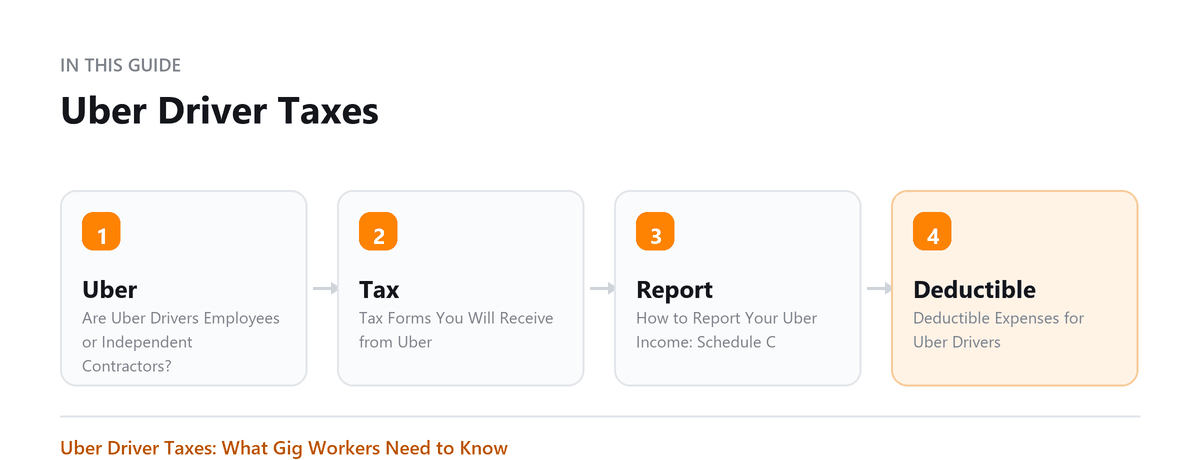
How to Report Your Uber Income: Schedule C
As a self-employed driver, you file Schedule C (Profit or Loss from Business) with your Form 1040. Here is how it works:
- Report gross income from all 1099s plus any cash tips not on the forms
- Deduct your business expenses (see below)
- The result is your net profit or loss
- Net profit flows to Schedule SE for self-employment tax and to Form 1040 for income tax
Deductible Expenses for Uber Drivers
Vehicle Expenses: Standard Mileage vs. Actual Cost
You have two options for deducting vehicle costs. Pick the one that gives you the larger deduction.
| Method | How It Works |
|---|---|
| Standard Mileage Rate | Deduct a set amount per mile driven for business. 2024 rate: 67 cents/mile. Simple; no tracking individual costs. |
| Actual Cost Method | Deduct actual expenses: gas, insurance, repairs, depreciation, prorated by business-use percentage. More paperwork but potentially larger deduction for newer/expensive vehicles. |
- Online miles (when the app is on and you are available): potentially deductible even without a passenger
- Offline miles (commuting from home to start driving): generally NOT deductible
- Miles between rides with the app on: deductible
- If using actual costs, depreciation (Section 179 or MACRS) can accelerate deductions for vehicle purchase
Pro Tip: Use a mileage tracking app like MileIQ, Stride, or Everlance. A mileage log is essential if the IRS asks for documentation.
Other Deductible Expenses
- Cell phone: deductible to the extent used for Uber business (e.g., 70% business use = 70% of phone bill)
- Uber service fees and commissions (subtract from gross 1099-K income)
- Car washes and detailing (business-related portion)
- Parking fees and tolls during rides
- Uber Pro membership fees if applicable
- Seat covers, phone mounts, and accessories purchased for the vehicle
- Health insurance premiums if self-employed and not eligible for employer coverage
Self-Employment Tax
Because Uber does not withhold taxes, you pay self-employment (SE) tax on your net profit. SE tax covers both the employee and employer share of Social Security and Medicare.
- SE tax rate: 15.3% on 92.35% of net SE income
- Above-the-line deduction: you can deduct half of your SE tax from gross income
- Example: $30,000 net Uber profit x 92.35% = $27,705 x 15.3% = $4,239 SE tax
- Deduct $2,120 (half of SE tax) above the line
Quarterly Estimated Taxes
With no employer withholding, you must pay estimated taxes quarterly if you expect to owe $1,000 or more for the year.
| Quarter | Payment Due Date |
|---|---|
| Q1 (Jan-Mar income) | April 15 |
| Q2 (Apr-May income) | June 15 |
| Q3 (Jun-Aug income) | September 15 |
| Q4 (Sep-Dec income) | January 15 of next year |
Pro Tip: A safe-harbor shortcut: pay 100% of last year's tax liability (or 110% if AGI was over $150k) in quarterly installments, and you will owe no underpayment penalty regardless of this year's actual tax.
Qualified Business Income (QBI) Deduction
As a self-employed Uber driver, you may qualify for the Section 199A QBI deduction, which allows you to deduct up to 20% of your qualified business income.
- Reduces taxable income (not SE tax)
- Subject to income thresholds and limitations
- Claim on Form 8995 (simple version) or Form 8995-A
- Confirm eligibility based on your total taxable income for the year
Book a free consultation and we will take the return off your desk.
Frequently Asked Questions
Do I pay taxes on my full 1099-K amount?
No. The 1099-K shows gross receipts. Deduct your business expenses to arrive at taxable net profit.
What if I did not receive a 1099 but still earned income?
You must still report all income, even without a 1099.
Can I deduct vehicle insurance?
Yes, proportionally under the actual-cost method. Under standard mileage, insurance is built into the rate.
Should I form an LLC?
An LLC does not change your federal tax treatment as a sole proprietor. An S-corp election could reduce SE tax at higher income levels.
When should I switch to the S-corp structure?
Generally worthwhile when net SE income exceeds $40,000-$60,000/year. Consult a CPA.

Written by
Anu Gupta, CA, EA, B.Tech
Anu works with US businesses on tax and entity questions at Profitjets, from choosing a structure to the filings that follow it. She writes about the decisions owners make once and then live with for years. Connect on LinkedIn
Free consultation
Want the Filing Handled?
Book a free consultation and we will take the return off your desk.