
What Is a Tax Write-Off? How Business and Personal Deductions Work
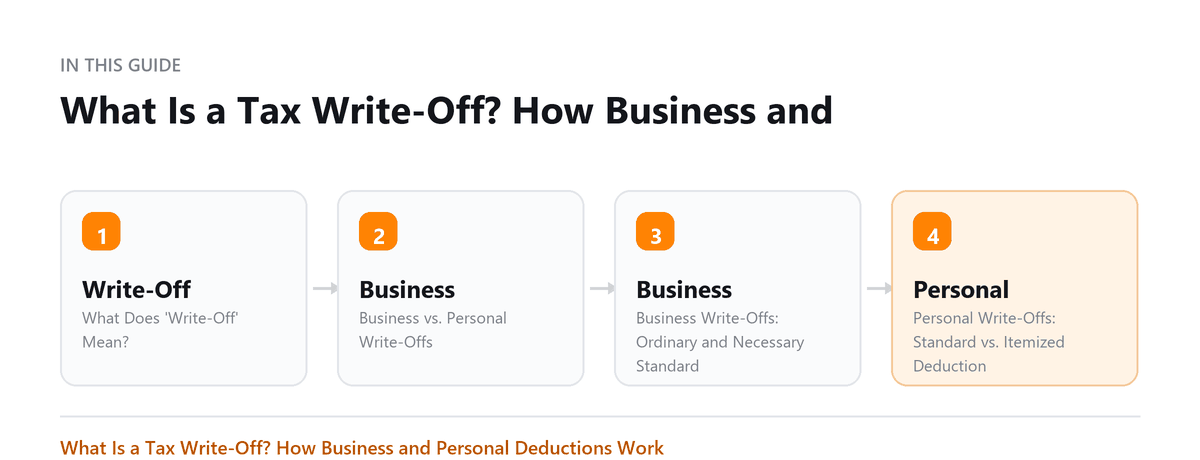
What Does 'Write-Off' Mean, Business vs. Personal Write-Offs, and Business Write-Offs: Ordinary and Necessary Standard

Write-off is used loosely to mean almost anything that reduces tax, and the mechanisms behind it behave nothing alike.
Something deducted before your income figure is calculated is worth more than the same amount deducted after it. Something capitalised is not a write-off this year at all. The word hides those differences rather than explaining them.
This covers what the term actually means, how business and personal deductions differ, the standard every business deduction has to meet, where a deduction sits in the calculation, and when a cost has to be spread over years instead.
What Does 'Write-Off' Mean?
A tax write-off is a deduction that reduces your taxable income. It does not eliminate a dollar of tax for every dollar of expense, it reduces the income on which tax is calculated. The actual tax saved equals the expense amount multiplied by your marginal tax rate.
| Scenario | Amount |
|---|---|
| Business expense deducted | $1,000 |
| Your marginal tax bracket | 22% |
| Actual tax saved | $220 |
| Out-of-pocket cost after tax savings | $780 |
Pro Tip: A write-off is not a dollar-for-dollar tax reduction. Spending $1,000 to save $220 in taxes is only a good deal if you genuinely need the expense.
The word covers several different mechanisms that behave nothing alike. Something deducted before your income figure is calculated is worth more than the same amount deducted after it, and something capitalised is not a write-off this year at all. The label hides more than it explains.
Anu Gupta, CA, EA, B.Tech · LinkedInBusiness vs. Personal Write-Offs
| Type | How It Works |
|---|---|
| Business write-offs (Schedule C) | Deduct ordinary and necessary business expenses from gross business income |
| Personal itemized deductions (Schedule A) | Deduct certain personal expenses instead of the standard deduction |
| Above-the-line personal deductions | Deduct from gross income without itemizing (e.g., student loan interest, IRA contributions) |
Business Write-Offs: Ordinary and Necessary Standard
The IRS allows deduction of business expenses that are (1) ordinary, common and accepted in your type of business, and (2) necessary, appropriate and helpful for your business. Both conditions must be met.
- Rent for business premises
- Employee wages and salaries
- Cost of goods sold (inventory)
- Professional services (accounting, legal)
- Marketing and advertising
- Business travel and meals (50% for meals)
- Equipment and software
- Insurance (business policies)
- Business-use vehicle expenses
- Home office (if exclusively and regularly used for business)
Personal Write-Offs: Standard vs. Itemized Deduction
For personal deductions, you choose between the standard deduction and itemizing. Take whichever is higher.
| Filing Status | 2024 Standard Deduction |
|---|---|
| Single | $14,600 |
| Married Filing Jointly | $29,200 |
| Head of Household | $21,900 |
Itemized deductions include:
- SALT (state and local taxes): capped at $10,000 through 2025
- Mortgage interest (up to $750,000 of qualifying debt)
- Charitable contributions (up to 60% of AGI in cash)
- Casualty and theft losses (federally declared disaster areas only)
- Medical expenses exceeding 7.5% of AGI
Above-the-Line vs. Below-the-Line Deductions
The 'line' refers to Adjusted Gross Income (AGI). Above-the-line deductions reduce AGI itself; below-the-line deductions reduce taxable income after AGI.
| Type | Examples |
|---|---|
| Above-the-line (adjustments to income) | IRA contributions, student loan interest, SE tax deduction, alimony (pre-2019 agreements), SE health insurance |
| Below-the-line (itemized or standard) | SALT, mortgage interest, charitable contributions |
Pro Tip: Above-the-line deductions are more valuable because they reduce AGI, which in turn reduces the threshold for many other deductions and credits that phase out as income rises.
Capital Expenditures vs. Current Expenses
Not all business expenses are immediately deductible. The IRS distinguishes between:
| Type | Tax Treatment |
|---|---|
| Current expense: ordinary operating cost (rent, supplies, wages) | Fully deductible in the year paid |
| Capital expenditure: purchase of a long-lived asset (equipment, vehicle, building) | Depreciated over the asset's useful life (spread over multiple years) |
| Section 179 election | Immediately deduct up to $1,160,000 of qualifying equipment in the year of purchase |
| Bonus depreciation | Additional first-year deduction for qualifying property (100% in earlier years; phasing down) |
Depreciation as a Multi-Year Write-Off
When you capitalize an asset, you recover its cost over its useful life through annual depreciation deductions. The IRS assigns 'MACRS' recovery periods:
- 5-year property: computers, vehicles, certain equipment
- 7-year property: most business furniture and fixtures
- 15-year property: land improvements
- 27.5-year property: residential rental real estate
- 39-year property: commercial real estate
Common Write-Off Mistakes to Avoid
- Deducting personal expenses as business expenses (audit risk)
- Not keeping receipts and documentation
- Deducting 100% of mixed-use expenses (car, home, phone) instead of the business-use portion
- Expensing capital assets that should be depreciated
- Claiming hobby losses, the IRS disallows losses from activities not conducted with a profit motive
Book a free consultation and we will take the return off your desk.
Frequently Asked Questions
Is a write-off the same as a tax credit?
No. A deduction reduces taxable income. A credit reduces tax dollar-for-dollar. Credits are more valuable.
Can I write off a vacation if I do some business?
Only the allocable business portion. Travel to a business destination may be fully deductible; personal days are not.
Can I write off home office expenses as an employee?
No. The home office deduction was eliminated for W-2 employees under TCJA (2018-2025). Only self-employed individuals can claim it.
What records do I need for write-offs?
Receipts, bank statements, invoices, mileage logs, and documentation showing the business purpose.
How long should I keep tax records?
Generally 3-7 years. 7 years if you claimed a bad debt deduction; indefinitely for fraudulent or non-filed returns.

Written by
Anu Gupta, CA, EA, B.Tech
Anu works with US businesses on tax and entity questions at Profitjets, from choosing a structure to the filings that follow it. She writes about the decisions owners make once and then live with for years. Connect on LinkedIn
Free consultation
Want the Filing Handled?
Book a free consultation and we will take the return off your desk.