
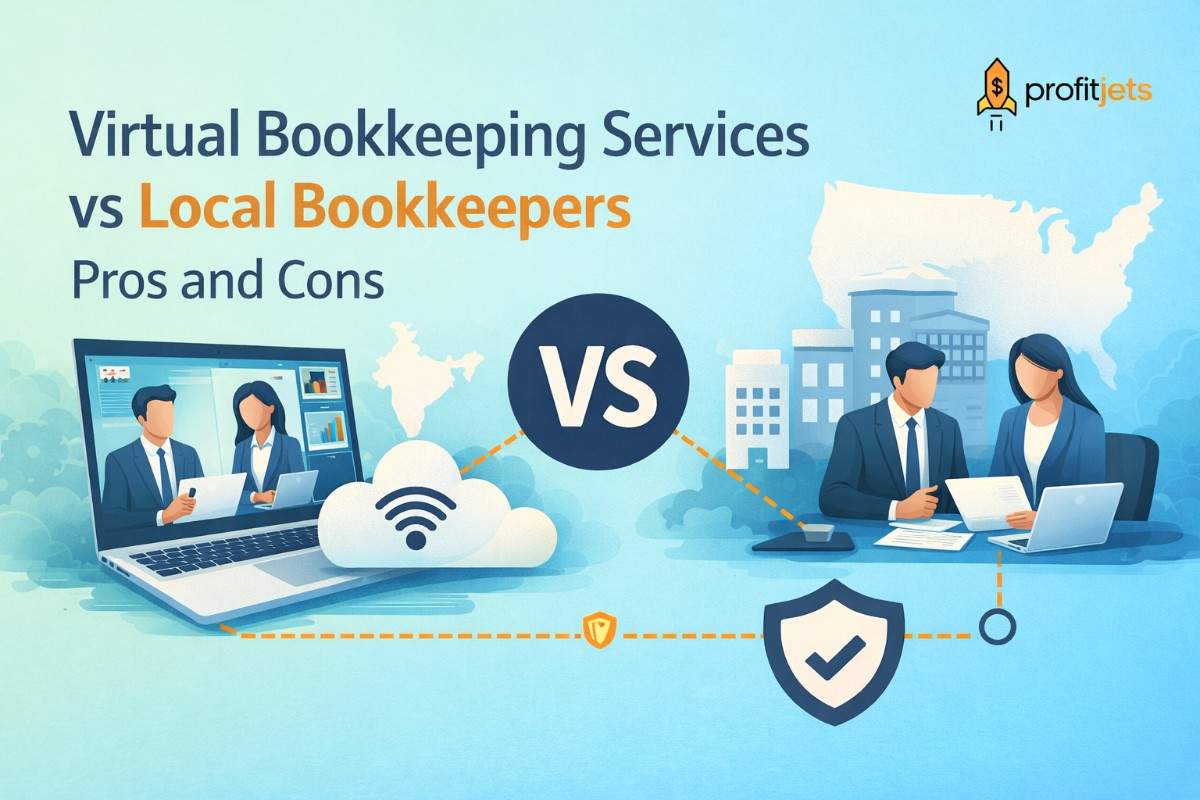
Early-stage startup founders and financial leaders face a critical decision when managing their finances: should you rely on virtual bookkeeping services for QuickBooks or hire a local in-person bookkeeper? Bookkeeping is the backbone of startup finance, ensuring accurate records for compliance and decision-making. With the rise of cloud-based accounting tools like QuickBooks Online, outsourced bookkeeping (virtual bookkeeping) has become a popular alternative to traditional local bookkeeping. In this article, we’ll explore what each option entails, clearly outline the pros and cons of virtual QuickBooks bookkeeping versus local in-person bookkeeping, and help you determine which fits your business needs. We’ll also highlight how providers like Profitjets can support your financial growth.
What Are Virtual Bookkeeping Services for QuickBooks?
Virtual bookkeeping services involve a remote bookkeeper or team managing your books via cloud software (commonly QuickBooks Online). In this model, your bookkeeper doesn’t work on-site; instead, they access your financial data securely over the internet and perform all tasks remotely. QuickBooks bookkeeping services delivered virtually leverage real-time, cloud-based accounting – both you and the bookkeeper log into the same system from anywhere. They handle daily transactions, account reconciliations, financial reports, payroll, and more, just like an on-site bookkeeper would, except communication and document exchange happen digitally (e.g., via email, secure portals, or video calls).
How Virtual Bookkeeping Works?
Your remote finance team connects to your QuickBooks or other accounting software with proper credentials. They record and categorize transactions, reconcile accounts, and generate reports on a regular schedule (often monthly). Questions or reviews are handled through Zoom meetings, chat, or phone as needed. For example, a SaaS startup might give a virtual bookkeeper access to QuickBooks Online; the bookkeeper updates the ledgers and shares monthly profit-and-loss statements without ever setting foot in the office[1]. This approach offers flexibility, as you gain access to professionals who can manage your books from anywhere in the world.
What Is a Local In-Person Bookkeeper?
A local in-person bookkeeper is a professional in your vicinity who handles your bookkeeping on-site or through in-person interactions. This could be an independent bookkeeper who visits your office periodically, a local bookkeeping firm, or even a part-time employee. They may collect physical receipts and invoices, meet with you face-to-face to review financials, and have first-hand familiarity with your paper records and local financial institutions. Many local bookkeepers use accounting software as well, but they might work with desktop versions (e.g., QuickBooks Desktop) or have you send files, rather than collaborating in real-time via the cloud.
How Local Bookkeeping Works?
With a local bookkeeper, you might schedule weekly or monthly on-site visits. They can physically organize paperwork, discuss issues in person, and provide printed reports or in-person presentations of your financial statements. For example, a small retail business might have a local bookkeeper come in every Friday to process invoices, reconcile the cash register, and manage payroll on a local computer. Proximity allows for hands-on support – if there’s an audit or urgent need, a local bookkeeper can be there to help prepare documents and guide you through it.
Local bookkeepers often bring knowledge of local tax rules and state or regional compliance (sales tax, city business regulations, etc.), which can be a big plus for businesses operating in one area. However, their services and style can vary widely – some now offer hybrid or remote services too, but the defining factor is that they are available for in-person interaction when needed.
Pros and Cons of Virtual Bookkeeping Services (QuickBooks Online)
Virtual QuickBooks bookkeeping offers a modern, tech-driven solution. Let’s break down its advantages and disadvantages:
Pros of Virtual QuickBooks Bookkeeping
Cost-Effective and Scalable:
- Virtual bookkeeping services typically charge lower fees than on-site bookkeepers because they have less overhead. You’re not paying for office space or a full-time salary with benefits. Businesses can save a significant amount – for example, outsourcing bookkeeping for around $2,500/month could save about $19,000 annually compared to a full-time in-house bookkeeper. Some sources estimate that outsourcing can cut costs by up to 70% versus hiring in-house. Additionally, you can scale services up or down as your startup grows without the hassle of recruiting or layoffs.
Access to Specialized Expertise:
- When you go virtual, you are not limited to local talent. You can tap into a nationwide (or global) pool of experts with experience in your industry[9]. For instance, if you run a SaaS company, you can find virtual bookkeepers who understand subscription revenue, MRR/ARR, and SaaS metrics deeply. Providers like Profitjets even offer specialists for bookkeeping for SaaS companies, knowing the intricacies of revenue recognition and subscription billing that local generalists might not. This outsourced bookkeeping model means you get a qualified pro who fits your niche, which can be crucial for complex sectors.
Real-Time Collaboration & Cloud-Based Convenience:
- Virtual bookkeepers work with cloud-based accounting tools (e.g., QuickBooks Online, Xero). This means your financial data is updated in real time and accessible to you 24/7 from anywhere. You can pull up cash flow statements or balance sheets on demand. The transparency and real-time access improve oversight and may reduce fraud or errors. With cloud platforms, both you and your bookkeeper see the latest data, and discrepancies can be spotted quickly. In contrast, a traditional approach that relies on exchanging files or paperwork could delay insight. For a busy founder, knowing your books are being updated live is a huge relief.
Flexible Schedules and Faster Responses:
- Remote finance teams often offer flexible engagement. Need extra attention during the year-end or a funding round? A virtual service can allocate more resources. During slower periods, you might scale back. You generally pay only for what you need. Communication can also be very swift – many virtual bookkeepers utilize email, Slack, or project management tools to answer questions quickly. Without needing to book an in-person meeting, you might resolve minor queries in minutes. (However, see the note on time zones in the cons below.)
Focus on Core Business:
- By outsourcing bookkeeping, startup founders and CFOs free up valuable time. Instead of pouring hours into QuickBooks entries or fixing reconciliation issues, you can focus on strategy, product development, and growth. As QuickBooks’ own guide notes, handing off routine bookkeeping to a trained professional lets you spend less time in spreadsheets and more time running your business[14]. This is a strategic advantage for small teams where every team member wears multiple hats.

Cons of Virtual QuickBooks Bookkeeping
No In-Person Presence or Personal Touch:
- The flipside of remote work is the lack of physical interaction. Some business owners value being able to sit across the table from their bookkeeper to build trust. Virtual services, by definition, don’t provide on-site visits. This can make relationships feel less personal, especially if you prefer face-to-face communication. There’s no dropping by their office for a quick chat; everything is via phone or screen. While many virtual bookkeepers strive to offer personalized service (including video calls), it’s not the same as an in-person rapport.
Requires Tech Savviness and Reliable Internet:
- Virtual bookkeeping relies on digital tools. Both you and your bookkeeper need to be comfortable with cloud software, online banking, scanning or emailing documents, etc. If you or your team aren’t tech-savvy, the digital process might pose a learning curve. Moreover, a stable internet connection is critical – if your internet is down, or if the cloud software has an outage, work may be disrupted. In essence, virtual bookkeeping introduces a dependence on technology that some traditional business owners may find intimidating.
Time Zone and Communication Challenges:
- If your virtual bookkeeping service is in a different city or country, you might face time zone differences. This can delay communications – for example, your question at 4 PM might not get answered until the next business day if your bookkeeper is already offline for the night[18]. Additionally, communicating primarily through email or messaging can sometimes lead to misunderstandings if not managed well. To mitigate this, it’s important to set clear communication norms (scheduled check-ins, response times) with a remote bookkeeper.
Trust and Data Security Concerns:
- Handing over financial data to a third party requires a high level of trust. When you work virtually, you must ensure the provider has strong security protocols in place. Reputable virtual bookkeeping firms use encrypted cloud systems and multi-factor authentication to protect your data. Still, some businesses feel less secure when their books are not handled in-house or by someone they know locally. It’s crucial to vet the provider’s data protection practices. (For instance, Profitjets emphasizes compliance with ISO 27001 standards and uses tools like Citrix ShareFile and LastPass for security.) If you choose a virtual service, be sure to clarify how your sensitive information will be stored and safeguarded.
Less Familiarity with Local Nuances:
- A remote bookkeeper might not immediately know your city or state-specific regulations, or the informal nuances of your business environment. Unlike a local bookkeeper who might know that “County X has a quirk in its property tax filings” or has connections with local CPAs, a virtual bookkeeper deals with many regions and relies on you to inform them of strictly local obligations. Many virtual firms do train their staff in multi-state compliance and standard regulations, so this is a minor issue for most typical businesses. But if your startup operates in a highly localized context or a niche market with unusual rules, you’ll need to ensure your virtual bookkeeper is brought up to speed. With good communication and documentation from your side, an experienced virtual bookkeeper can handle compliance just fine, but the onboarding may require more effort than with someone local who “just knows” the local environment.
Pros and Cons of Local In-Person Bookkeepers
Traditional local bookkeepers remain a valuable option for many businesses. Let’s examine their advantages and drawbacks in comparison to virtual services:
Pros of Local Bookkeeping
Face-to-Face Relationship and Trust:
- Many people feel more comfortable discussing finances in person. With a local bookkeeper, you can have face-to-face meetings to ask questions or explain nuances of your business. This personal interaction can build trust and rapport. Sitting down across the table can be reassuring, especially during stressful times like audits or year-end reviews. For business owners who prefer handshake relationships, a local bookkeeper provides that human touch that virtual arrangements sometimes lack.
On-Site Support and Hands-On Assistance:
- If your financial records include a lot of paper receipts or invoices, or if you simply like having someone present, a local bookkeeper can physically come to your office. They can help organize your files, witness your signature on documents, or even represent you during on-site audits. During a tax audit or a quick document review, having a professional right there by your side can be invaluable. In contrast, with a virtual service, you’d be faxing or scanning documents back and forth during an audit, which some may find cumbersome.
Local Expertise (Tax and Regulations):
- A local bookkeeper is likely well-versed in your specific state or regional tax laws and compliance requirements. They understand the deadlines for local filings, state sales tax peculiarities, or city business license renewals. For businesses that operate mainly in one locale, this knowledge can help avoid compliance slip-ups. Additionally, if your industry has local regulatory nuances (for example, a local retail tax or specific reporting to a state agency), a nearby professional might already be familiar with it. Essentially, they bring neighborhood knowledge that a national remote service might not have readily.
Possibly Broader Role in Office:
In some cases, a local bookkeeper (especially if an employee) might handle other office duties when present, like administrative tasks or ad-hoc financial consulting on the fly. Being on-site, they might notice issues or opportunities simply by being around and observing the business day-to-day. This isn’t guaranteed with every bookkeeper, but some startups leverage a part-time in-person bookkeeper as a quasi office manager who wears multiple hats.
Cons of Local Bookkeeping
Higher Costs
- Hiring locally can be more expensive. Local bookkeepers often have to cover their travel time or maintain an office, and those costs are built into their fees. If they’re a full-time or part-time employee, you have salary, benefits, and taxes to consider. Even independent local contractors tend to charge more per hour than remote services, due to local cost-of-living or simply less competition. A brick-and-mortar operation has overhead costs (rent, utilities, commute) that virtual services don’t have. For a budget-conscious startup, these higher fees might be hard to justify, especially when equally competent virtual options exist at a fraction of the price.
Limited Talent Pool
- When you restrict your search to a “bookkeeper near me,” you might not find the ideal expertise for your business. Your choice is limited to professionals in your geographic area. If you live outside a major city or in a region with few finance professionals, you could struggle to find a bookkeeper who has experience with your industry or scale. For example, a cutting-edge SaaS startup in a small town might not find any local bookkeepers familiar with SaaS metrics or venture funding nuances. In contrast, going virtual means you can find a specialist anywhere in the country. Thus, local hiring sometimes means settling for available skills rather than getting exactly what you need.
Less Flexibility and Rigid Scheduling
- Local bookkeepers typically operate within set business hours and may juggle multiple clients or responsibilities. You might have to book appointments days or weeks in advance for an on-site meeting. If you have urgent questions after hours or need sudden help on a weekend, a local bookkeeper might not be available. Their capacity is also limited – one person can only handle so much workload. If your company rapidly grows, your local bookkeeper might struggle to keep up, whereas a virtual service could assign additional staff easily. In short, the scalability and on-demand support are usually less with a local independent bookkeeper compared to an outsourced team.
Potentially Outdated Processes
- Not all local bookkeepers are behind the times, but some traditional bookkeepers might lean on older methods (like Excel spreadsheets or desktop software without cloud sharing). If a local bookkeeper isn’t adept with modern cloud tools, you could miss out on real-time visibility. For instance, you might only get reports once a month in a binder, whereas a cloud-based approach could let you see weekly updates. Many local professionals do adopt QuickBooks Online and similar platforms now, but if you encounter one who doesn’t, it could be a drawback in terms of convenience and efficiency.
Geographic Constraints
- If your business expands or if you move, a local bookkeeper’s service may no longer be practical. Say your startup opened a second office in another state – your hometown bookkeeper might not be able to assist with the new location’s needs or travel there. Virtual services, on the other hand, follow you wherever you go. Additionally, if your operations cross state lines or country borders, a local bookkeeper might not have experience in multi-jurisdiction accounting, while virtual firms often cater to multi-state or international businesses.
Ready to Simplify Your Finances with Virtual Bookkeeping Services?
Stop stressing over messy books and missed deadlines. With Profitjets’ virtual bookkeeping services, you get accurate financial records, real-time insights, and expert support, without the cost of an in-house team.
Get started today and take control of your business finances with confidence.
Virtual vs. Local Bookkeeping
| Feature | Virtual Bookkeeping Services for QuickBooks | Local In-Person Bookkeepers |
| Cost | Generally lower cost with flexible pricing and low overhead | Often, higher fees are due to office and travel overhead |
| Access to Experts | Global talent pool with easy access to industry specialists | Limited to professionals available in the local area |
| Interaction | Remote communication via email, phone, and video calls | Face-to-face meetings and in-person discussions |
| Flexibility & Scale | Highly scalable and easy to adjust as the business grows | Less scalable due to fixed schedules and limited capacity |
| Technology | Cloud-based QuickBooks with real-time data access | May rely on desktop software or paper-based processes |
| Compliance Focus | Strong multi-state and global compliance knowledge | Deep understanding of local and regional regulations |
| Availability | Accessible from anywhere with flexible time coverage | Restricted to local business hours |
As the table shows, virtual bookkeeping services for QuickBooks shine in cost and flexibility, whereas local bookkeepers excel in personal touch and local know-how. The importance of each factor depends on your business priorities.

Additional Considerations and Myths
When weighing virtual versus local bookkeeping, consider a few final points and common misconceptions:
Data Security
Some worry that virtual bookkeeping isn’t secure. In reality, professional virtual bookkeepers use bank-level encryption and security protocols to protect data. Always verify a provider’s security measures, but don’t assume in-house or local is automatically safer – even local bookkeepers often use cloud systems today. With proper safeguards (NDAs, encrypted file sharing, two-factor authentication), your financial data can be as secure with a virtual team as with a person in your office.
Building Relationships Remotely
It’s a myth that you can’t build a strong working relationship with a remote bookkeeper. Many virtual services assign dedicated bookkeepers who schedule regular video calls, providing a personal touch despite the distance. Over time, they’ll learn your business just as a local bookkeeper would. It’s certainly possible to have an excellent rapport and trust with a virtual bookkeeper – it just requires good communication practices (just like any professional relationship).
One is Always Better – Not Necessarily: There’s no one-size-fits-all answer. Some assume online = modern and therefore always better, or conversely that local = better service. In fact, many local bookkeepers have moved to a virtual or hybrid model for efficiency. And many virtual firms have top-notch professionals, including CPAs, who are just as qualified as anyone local. It really comes down to what your business needs and your comfort level.
Startup Perspective
If you’re a startup founder or a SaaS company, you might lean towards virtual bookkeeping for its cost savings and scalability. Fast-growing tech companies often prefer a remote finance team that can grow with them and is familiar with cloud tools and SaaS metrics. As Profitjets pointed out in a 2022 briefing, new businesses should weigh that while on-site bookkeeping has its advantages, it can come with significant drawbacks for startups, whereas virtual services open the door to hundreds of accountants without the limitations of location. That broad access and efficiency can be a game-changer when you’re trying to move fast and keep overhead low.
On the other hand, if your operations are very local (e.g., a local services business) or if you highly value face-to-face trust, a local bookkeeper might be the better cultural fit. Some founders sleep better knowing they can occasionally meet the person handling their books in person. It’s about finding the right balance for your peace of mind and business complexity.
Choosing the Right Path for Your Business
Deciding between virtual bookkeeping and a local bookkeeper comes down to your priorities: cost, convenience, personal touch, and specific business needs. Many modern startups and SMEs find that virtual bookkeeping services for QuickBooks strike the right balance of affordability, expertise, and efficiency – especially with the robust capabilities of QuickBooks Online and similar cloud-based accounting platforms. By contrast, a local in-person bookkeeper might be invaluable if you need that on-site presence and local insight.
If you’re looking to save costs, access top talent, and leverage real-time financial data, going virtual is a compelling choice. If you can’t imagine not having someone visit your office or you have complex local tax issues, a local bookkeeper could be worth the extra expense.
Ready to explore the benefits of virtual bookkeeping for your business? Consider reaching out to a trusted provider like Profitjets. Profitjets is a global bookkeeping and accounting partner that can seamlessly manage your QuickBooks bookkeeping and act as an extension of your team. With Profitjets’ virtual bookkeeping expertise, you get accurate books, financial clarity, and strategic support without geographical limits.
Need Expert Help? Let’s Talk
Have questions or want a customized bookkeeping solution for your business? Our experts are here to help.
Looking for reliable virtual bookkeeping services
Connect with Profitjets and get expert support today.
FAQs
What are virtual bookkeeping services for QuickBooks?
Virtual bookkeeping services for QuickBooks involve managing your financial records remotely using cloud-based QuickBooks software. Instead of an on-site bookkeeper, a dedicated remote team handles transactions, reconciliations, reporting, and compliance while giving you real-time access to your books from anywhere.
Is virtual bookkeeping better than hiring a local bookkeeper?
Virtual bookkeeping is often better for startups and growing businesses that value flexibility, lower costs, and access to specialized expertise. Local bookkeepers can be helpful for businesses that need frequent in-person support, but virtual bookkeeping usually offers better scalability and faster access to insights.
Are virtual QuickBooks bookkeepers secure?
Yes, reputable virtual bookkeeping providers use secure cloud systems, encrypted access, role-based permissions, and strict internal controls. When set up correctly, virtual bookkeeping with QuickBooks is just as secure as working with a local in-person bookkeeper.
Can virtual bookkeepers handle complex businesses like SaaS or e-commerce?
Absolutely. In fact, virtual bookkeeping is often a better fit for SaaS, e-commerce, and tech-enabled businesses. Remote teams typically specialize in areas like subscription revenue, marketplace payouts, inventory accounting, and multi-currency reporting, which many local bookkeepers may not handle regularly.
Do I still need an accountant if I use virtual bookkeeping?
Yes. Bookkeeping and accounting serve different purposes. A virtual bookkeeper manages your day-to-day financial records, while an accountant or CPA focuses on tax filings, audits, and strategic planning. Many businesses use virtual bookkeeping services alongside their accountant for better accuracy and efficiency.
Is virtual bookkeeping suitable for early-stage startups?
Virtual bookkeeping is especially well-suited for early-stage startups. It provides professional financial structure without the cost of hiring a full-time in-house bookkeeper, helping founders stay investor-ready from day one.
Can virtual bookkeepers work across different countries or time zones?
Yes. One of the biggest advantages of virtual bookkeeping is global support. Many providers operate across time zones, allowing work to continue even outside your local business hours, which improves turnaround time and consistency.
How do I know if my business is ready to switch to virtual bookkeeping?
If you already use QuickBooks Online, share documents digitally, and want clearer financial visibility without increasing overhead, your business is ready for virtual bookkeeping. Most transitions can be completed smoothly with minimal disruption.
How does Profitjets support businesses with virtual bookkeeping?
Profitjets provides virtual bookkeeping services for QuickBooks designed specifically for startups and growing companies. The focus is on clean books, accurate reporting, and financial clarity so founders can make better decisions and stay prepared for investors.