
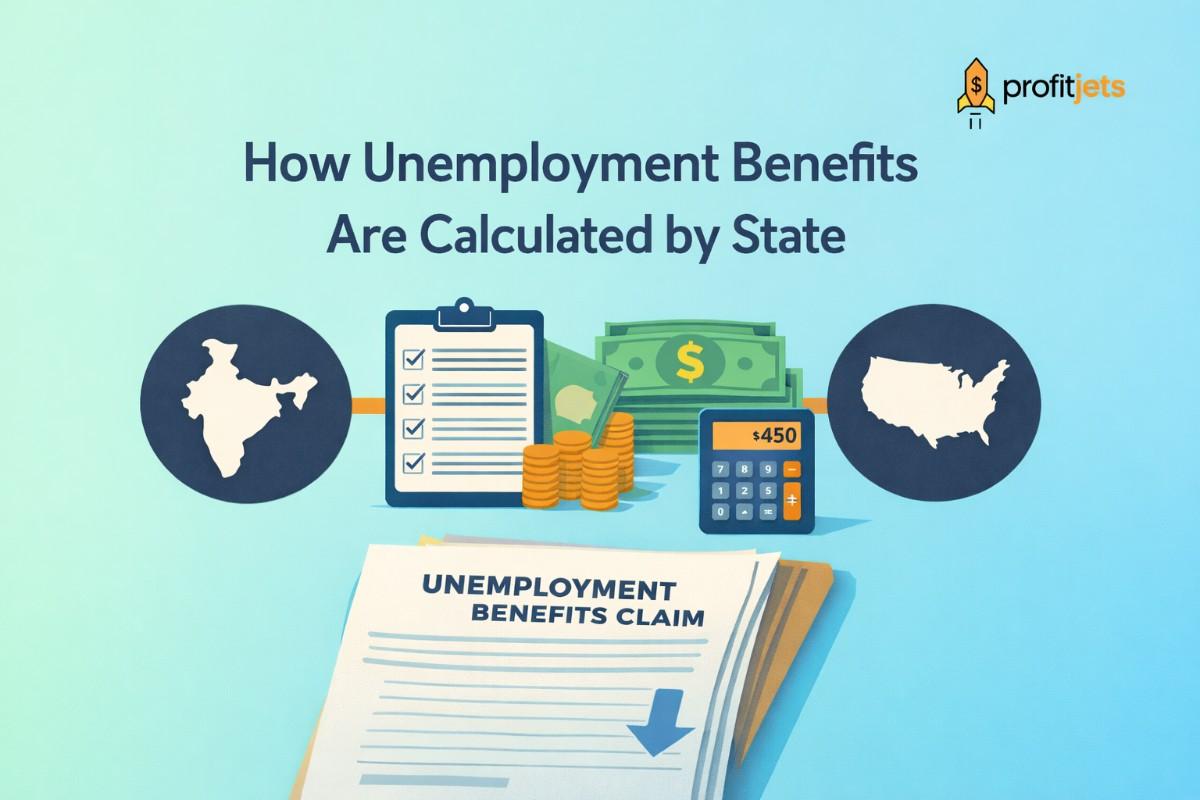
Unemployment insurance (UI) provides temporary wage replacement to eligible workers who lose their jobs through no fault of their own. In the U.S., each state administers its own UI program, with varying rules on benefit amounts and durations. For business owners, it’s crucial to understand how these benefits are calculated, because employers fund them via payroll taxes. How “unemployment benefits are calculated by state” directly affects your SUTA tax burden. This guide explains the base-period and wage history rules states use to compute benefits, highlights key state-by-state differences (e.g., highest/lowest weekly benefit caps), outlines employer obligations (SUTA/FUTA taxes and reporting), and shares actionable tips for small businesses to reduce unemployment tax costs.
Overview: How Unemployment Benefits Are Calculated
Every state sets a formula for computing a claimant’s weekly benefit amount (WBA), typically based on the worker’s earnings during a base period. Generally, the base period is the first four of the last five completed calendar quarters before the claim. (If a worker’s wages don’t qualify under that period, many states use an alternative base period of the most recent four quarters.) The state then applies a replacement rate or formula to those base-period wages to arrive at the weekly benefit. Common calculation methods include:
High-quarter method
Most states use the quarter with the highest earnings as the basis. They compute the average weekly wage in that quarter (usually by dividing by 13 weeks) and multiply by a replacement rate (often ~50%). For example, if your highest quarter earnings were $2,600, your average weekly wage is $200. At a 50% replacement rate, the benefit would be $100/week. Many states simplify this by using a single fraction (e.g., 1/26) of high-quarter wages.
Multi-quarter or annual method
Some states average wages over multiple quarters or even annually. For instance, Colorado pays the higher of (a) 60% of your average weekly wage over the two highest quarters, or (b) 50% of your average weekly wage over the last 12 months. Other states pay a flat percentage of annual base-period wages.
Minimum/maximum caps
States impose statutory minimum and maximum WBAs. For 2025, the highest cap is $823 (Massachusetts) and the lowest is $235 (Mississippi). No matter how the formula computes out, your benefit won’t exceed the state’s maximum. (Minimum benefits can be as low as $40-$100 in some states.)
Benefit duration
Most states pay up to 26 weeks of regular unemployment. Exceptions: North Carolina and Florida limit it to 12 weeks, while Montana allows up to 28 weeks. After that period, extended benefits or other programs may kick in during high-unemployment periods, but the standard is roughly half a year.
In summary, your employees’ highest base-period earnings and the state’s replacement formula determine the weekly benefit. The state then multiplies that by up to the benefit duration cap. For example: Alabama computes WBA as one-26th of the average of your two highest-earning base quarters (min $45, max $275). Massachusetts pays 50% of your average weekly wage (max $823) – the nation’s highest benefit. Mississippi uses 1/26 of your highest quarter (max $235) – the lowest in the U.S. These calculations and caps vary by state, so it’s key to know your state’s method when budgeting unemployment costs.
Understand your unemployment tax impact, get expert help from Profitjets today.
Unemployment Benefits by State: Key Differences
While the general concepts above apply nationwide, each state’s exact formula can differ greatly. Here are some notable examples and groupings:
Highest vs. lowest benefits
As of 2025, Massachusetts offers the highest maximum weekly benefit at $823 (50% of average weekly earnings). Mississippi has the lowest cap at $235 (1/26 of the highest quarter earnings). States like New Jersey and Michigan are also high (max near $800), whereas many Southern and small states pay under $400 weekly.
Different formulas
Some states use unique formulas. For example, California uses a benefit schedule (chart) based on your highest quarter. Iowa uses 1/23 of the highest-quarter earnings (increasing for dependents). Hawaii and North Dakota have unusual formulas (Hawaii: 1/21 of the highest quarter; ND: a weighted sum of the top 2½ quarters). Many states simply use 1/25th or 1/26th of high-quarter wages.
Benefit duration
Most states cap benefits at 26 weeks. North Carolina and Florida are notable exceptions, allowing only 12 weeks. Montana permits up to 28 weeks. This means employers in NC/FL face quicker turnarounds on UI costs, while Montana’s fund is liable longer per claim.
Miscellaneous factors
Some states offer partial benefits for part-time earnings (an “earnings disregard” for partial unemployment). Others allow dependents’ allowances or different rates for seasonal workers. The specific rules (such as exempting some part-time pay) vary.
In summary, “unemployment benefits by state” can range widely. To illustrate, here are a few quick examples:
- Alabama: WBA = 1/26 of the average of your two highest base quarters (min $45, max $275).
- Colorado: WBA = the greater of (60% of avg. weekly wage over the top two quarters) or (50% of avg. weekly wage over the last 12 months) (max $781).
- Florida: WBA = 1/26 of the highest quarter (min $32, max $275); only 12 weeks paid.
- Georgia: WBA = 1/42 of earnings in the two highest quarters (or 1/21 of the highest quarter), (min $55, max $365).
- New York: WBA = 1/25 to 1/26 of the highest quarter (min $104, max $504).
- North Carolina: WBA = total earnings in last two quarters ÷ 52 (min $15, max $350; only 12 weeks).
- Washington (DC): WBA = 1/26 of the highest quarter (min $50, max $444). – …and so on.
Understanding your state’s benefit schedule is crucial. When employees collect unemployment, the weekly payment comes straight out of that state’s UI fund, which is funded by employers’ SUTA taxes. So high benefits or long durations can increase total taxes paid by employers.
Employer Responsibilities: Funding and Reporting
Employers are responsible for funding unemployment insurance through payroll taxes, and they must comply with reporting requirements. Key points:
State vs. Federal taxes
Employers pay both state UI taxes (commonly called SUTA – State Unemployment Tax Act) and federal UI tax (FUTA). FUTA is a flat 6.0% on the first $7,000 of each employee’s annual wages (max $420 per employee). Employers normally receive a credit (up to 5.4%) for timely SUTA payments, reducing the net FUTA rate to 0.6%. SUTA rates and wage bases vary by state.
State SUTA rules
Every state has a different annual SUI tax rate, a different tax rate range, and a different wage base. The wage base is the limit on wages per employee subject to SUTA (e.g. $7,000, $12,000, $40,000 depending on state). Once an employee’s wages exceed that base in a year, the employer pays no more SUTA on that worker. Each state also has minimum and maximum tax rates. Importantly, new businesses usually start at a standard “new employer” rate until they build an experience rating.
Experience rating
SUTA is experience-rated, meaning your tax rate is partly determined by your history of claims. States assign each employer an experience rating: employers with few or no claims get low rates, while firms with many former employees drawing benefits pay higher rates. In other words, each approved unemployment claim makes your SUTA rate rise. The U.S. Chamber notes: “The number of… former employees that have claimed unemployment benefits… affects the SUTA rate.” Keeping layoffs and claims down therefore helps lower your UI tax cost.
Reporting and compliance
Employers generally must file quarterly wage and tax reports to the state UI agency and remit SUTA taxes according to state schedules. If an employee files a claim, the employer will receive a notice from the state unemployment commission, including details (wages, employment dates, separation reason). As an employer, you must verify these details. If any information is incorrect (e.g., wrong wage or termination reason), you should immediately notify the agency. If a claim is questionable, you have the right to contest it within the state’s timeframe. Contesting wrongful claims (for example, a quit instead of a layoff) can prevent unwarranted benefits and protect your SUTA rate.
Additional obligations
Most employers must also handle unemployment compensation paperwork when hiring (some states require notifying new hires, etc.), and maintain records of employees and wages. In Alaska, New Jersey, and Pennsylvania, employees even contribute to a small share of UI taxes. Nonprofits or religious organizations may be exempt from SUTA.
In sum, employer responsibility for UI means: (a) paying federal and state UI taxes, (b) reporting wages and state UI contributions, and (c) managing unemployment claims and records. These duties are part of payroll management. Many businesses find value in outsourcing this compliance to professional [Payroll Services] or [HR & Compliance] consultants. For example, ProfitJets’ [Payroll Services] can ensure SUTA is calculated correctly in each state, and our [HR & Compliance] experts can help document terminations and contest claims as needed.

Tips for Reducing Unemployment Tax Liability
While UI taxes are mandatory, employers can take steps to minimize their unemployment insurance costs and avoid unnecessary tax hikes:
Reduce employee turnover
High turnover means more employees hitting the taxable wage base and more potential claims. As one guide notes, “employee turnover can be a significant factor in driving higher SUTA costs.” By retaining workers (e.g., through cross-training or alternative assignments instead of layoffs), you limit the wages subject to SUTA and reduce new claims. A StaffMarket example shows that eliminating turnover cuts a sample company’s SUTA tax bill nearly in half.
Avoid layoffs when possible
If you must cut staff, look for alternatives (reducing hours, temporary furloughs, transfers). Every layoff that leads to a claim can raise your experience rate. “Avoid terminations and layoffs if possible,” StaffMarket advises, noting that doing so helps keep SUTA costs in line.
Document performance and terminations
Practice sound HR procedures. Conduct regular performance reviews and keep written records of any disciplinary actions. If you terminate an employee for cause, having documented warnings or performance issues will help you successfully contest the claim. Without documentation, “most state workforce boards will approve” claims even for cause terminations. In other words, thorough records can keep a wrongful claim from becoming your expense.
Contest improper claims promptly
Always respond to every UI notice. If you believe a claim is invalid (e.g., the employee quit voluntarily), file an appeal with the state unemployment office within the deadline. Contest questionable claims vigorously; it’s often the only way to prevent an unjust benefit and a resulting rise in your tax rate. Many states allow you to present evidence (resignation letters, misconduct documentation) at a hearing.
Correct classification
Ensure workers are properly classified as W-2 employees or contractors. Misclassification of an employee as an independent contractor may save SUTA in the short term, but can trigger large back-taxes and penalties if discovered.
Consider a PEO or outsourcing
Some small businesses join a Professional Employer Organization (PEO), which pools wages and experience ratings. Depending on the arrangement, you may benefit from the PEO’s larger pool (often at a lower rate) and expert handling of UI claims. ProfitJets does not operate as a PEO, but outsourcing payroll and HR (e.g., using our Payroll and [Tax Filing Services]) can similarly offload compliance and reduce errors that lead to higher UI costs.
Taking these steps, particularly reducing turnover and maintaining solid HR practices, can significantly lower your unemployment tax burden over time. For example, StaffMarket notes that “reducing your company’s turnover… will have the long-term benefit of lowering your experience rating”, yielding both short- and long-term savings.

Conclusion: Compliance and Payroll Management
In conclusion, understanding how unemployment is calculated in each state is essential for U.S. employers. The base-period wage rules and state formulas determine benefit amounts, and these directly influence the State Unemployment Tax (SUTA) your business pays. By staying informed and proactive – maintaining accurate payroll records, filing UI taxes on time, and contesting invalid claims, you can control unemployment insurance costs. Compliance is not optional: states expect timely reporting of wages and prompt response to claims. Failing to do so can result in higher taxes, penalties, or audits.
For busy business owners, partnering with a reliable accounting and payroll provider can simplify compliance. ProfitJets offers integrated solutions – from new company [Business Registration] to ongoing [Payroll Services], [HR & Compliance], and [Tax Filing Services] to help ensure your unemployment insurance obligations are handled correctly. Proper payroll management and adherence to state UI laws will keep your business in good standing and protect your bottom line. By staying informed and utilizing expert help when needed, you can minimize your unemployment tax liability while focusing on growing your business.
Understand your unemployment tax impact, get expert help from Profitjets today.
FAQs
How are unemployment benefits calculated in the U.S.?
Unemployment benefits are calculated at the state level. Each state uses a formula based on the worker’s prior earnings during a “base period,” applies a replacement percentage, and then caps the weekly benefit at a statutory maximum. The exact calculation method varies by state.
What is a “base period” for unemployment benefits?
The base period is generally the first four of the last five completed calendar quarters before a claim is filed. If a worker doesn’t qualify under this standard base period, many states use an “alternative base period” (the most recent four quarters).
How long can someone receive unemployment benefits?
Most states pay benefits for up to 26 weeks, though some allow fewer (e.g., 12 weeks) and some slightly more. Duration varies by state.
How do unemployment claims affect my business taxes?
Approved unemployment claims increase your experience rating, which can raise your State Unemployment Tax (SUTA) rate and overall payroll tax costs.
What can employers do to reduce unemployment tax liability?
Limit layoffs and turnover, document performance issues, contest improper claims promptly, classify workers correctly, and maintain strong HR policies to avoid unnecessary claims.