
When the economy turns, not all types of spending stop at the same time. The vacation is canceled, the new car is postponed, fewer people go to dinner. The pipe, on the other hand, is repaired, the doctor is visited, the groceries bought, the taxes declared. The businesses that cater to them tend to experience a dip as well as a decline, but not an implosion.
It is in this context that the concept of recession-proof businesses becomes interesting. The truth is never completely recession proof, revenue growth can slow, customers can look for cheaper alternatives and reduce their spend, or clients can reduce their overall spend.
The reason why recession-resistant businesses are so attractive is that demand never disappears. The need is still there, allowing the business to have something to offer and to fight discretionary areas such as luxury retail, travel, and fine dining for clients' business.
If you are thinking of starting a business in 2026, or diversifying your current business activities with other lines of work that can provide stability during a recession, the categories below have been recession-proof in the past, and the following text discusses why as well as the limitations of each.
Expert Perspective
The single biggest factor in recession resilience is whether the customer needs you or just wants you. Needs get cut last. Recurring revenue helps too, because a client who's already on a monthly plan rarely goes through the hassle of switching in a downturn. It's why discount retailers grew through 2008 and 2009 while department stores struggled. They were selling essentials to people who suddenly cared a lot more about price.
Ankit Sagatani, MBA, B.Com · LinkedInThis guide explains what makes a business recession-resistant and walks through 10 business ideas that have historically held up when the economy slows.
Why Choose a Recession-Proof Business?
A recession-proof (or recession-resistant) business serves needs that persist regardless of economic conditions: healthcare, food, utilities, basic home maintenance, financial services. These businesses are not immune to recessions: revenue growth may slow, and consumers may trade down to lower-price options within the category. But they do not face the existential demand collapse that discretionary-spend businesses face, luxury retail, entertainment, travel, and high-end restaurants.
- Essential demand: customers need the service regardless of economic conditions, there is no alternative to not getting it
- Sticky relationships: recurring service businesses (accounting, healthcare, property management) retain customers through downturns because switching costs are high and timing is poor
- Counter-cyclical opportunities: some businesses actually grow in recessions, debt collection, pawn shops, discount retail, and financial restructuring services see increased demand exactly when the economy contracts
1. Accounting and Bookkeeping Services
Businesses need accurate financials in good times and bad and they need them more urgently in a recession when cash flow is tight, lenders are scrutinising books, and tax planning becomes more valuable. Accounting and bookkeeping services are among the most recession-resistant service businesses: clients may reduce hours but rarely eliminate the function entirely.
If your balance sheet doesn't give you a clear picture of your owner's equity, retained earnings, and financial position, Profitjets can help. Our bookkeeping services keep your accounts accurate and reconciled, while our CFO services turn those numbers into useful insight for cash flow, planning, and business decisions. Schedule a consultation to review where your financial reporting stands and what needs to improve.
2. Healthcare and Medical Services
Healthcare demand is largely non-discretionary people do not postpone treating a health problem because the economy is weak. While some elective procedures see volume decline in recessions, primary care, mental health services, and urgent care tend to be stable or growing. Healthcare businesses with recurring patient relationships (general practice, therapy, dentistry) are particularly resilient.
3. Food and Grocery
People need to eat. During recessions, consumers shift spending from restaurants to grocery stores, which means grocery, food production, and food service businesses (particularly those focused on value) tend to be stable. The shift benefits discount grocers, meal-kit services, and bulk food retailers. Note: full-service restaurant dining is NOT recession-proof; fast casual and QSR are more resilient.
4. Home Repair and Maintenance
When consumers cannot afford to move to a new home, they fix the one they have. Essential home repairs: plumbing, HVAC, electrical, roofing see sustained demand regardless of economic conditions because they address physical necessity, not lifestyle. Discretionary home improvement (renovations, upgrades) is more cyclical, but core maintenance is recession-resistant.
5. Cleaning and Janitorial Services
Commercial and residential cleaning is an essential service with high customer retention and recurring revenue. Commercial clients (offices, healthcare facilities, retail) maintain cleaning contracts even in downturns because building hygiene standards are often contractual or regulatory requirements.
Residential cleaning, while more discretionary, tends to be retained by households as a time-saving necessity rather than a luxury.
6. Freelancing and Consulting
During recessions, companies cut full-time staff but maintain demand for specialised skills and often use freelancers and consultants to fill the gap at lower cost than permanent hires. This creates increased demand for specialised freelancers in IT, marketing, accounting, HR, and legal. The business model is flexible, low-overhead, and scalable.
7. Digital Marketing Services
As traditional advertising budgets are cut during recessions, businesses shift spend to measurable, lower-cost digital channels: SEO, paid search, email, and social. This actually increases demand for digital marketing specialists who can deliver ROI-measurable results. Businesses that reduce marketing spending in a recession typically see accelerated market share erosion with the opportunity for those who continue.
8. E-Commerce
Online retail has grown through every recession since 2008. Consumers seeking value shift from brick-and-mortar to online where price comparison is easier and deals are more accessible. E-commerce businesses in essential categories (household goods, basic apparel, supplements) are particularly resilient. Note: not all e-commerce is recession-proof luxury and high-end e-commerce faces the same demand pressure as physical luxury retail.
9. Technology Support Services
As businesses rely more heavily on technology and operate with leaner IT teams during downturns, outsourced tech support, managed services, and cybersecurity services see stable or growing demand. Technology infrastructure, cloud services, security, communications is now a business necessity, not a discretionary investment.
10. Financial Advisory Services
Recessions create demand for financial restructuring, debt management, bankruptcy consulting, and personal financial planning. Businesses and individuals facing financial stress seek professional guidance on managing debt, reducing costs, and protecting assets. Financial advisory services have a counter-cyclical demand element while the economy contracts, the need for guidance expands.
Book a free consultation and we will stress test your numbers.
Frequently Asked Questions
What makes a business truly recession-proof?
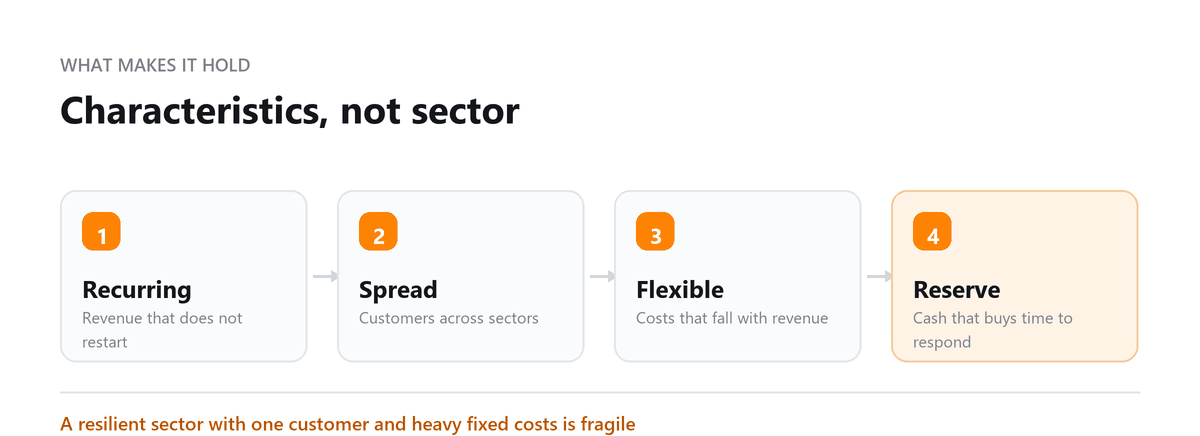
No business is completely immune. The most recession-resistant businesses meet essential needs rather than optional wants, earn recurring revenue from loyal customers, offer value that becomes more appealing when people are cutting costs, and keep fixed costs low enough to adjust if revenue falls.
Is franchising a recession-proof business model?
Franchises in resilient categories, such as quick-service food, home services, and healthcare support, often perform relatively well thanks to brand recognition, proven systems, and franchisor support. The trade-off is cost. Upfront franchise fees and ongoing royalties can strain cash flow in a downturn, so review the specific franchise's financial requirements and sector carefully.
Which recession-resistant businesses cost the least to start?
Service businesses usually have the lowest startup costs. Bookkeeping, freelancing and consulting, cleaning, and digital marketing can often be started with modest equipment, software, and marketing budgets. Businesses that need inventory, vehicles, or specialized licenses, such as healthcare or trades, generally require more capital upfront.
Can an existing business become more recession-resistant?
Yes. Adding recurring revenue through service plans or retainers, reducing reliance on a few large customers, keeping fixed costs flexible, and building a cash reserve all make a business more resilient. Offering a lower-priced option alongside your core service can also help keep customers who start trading down.
Should I start a business during a recession?
It can be a good time, depending on the business. Costs for space, equipment, and even talent can be lower, and there may be less competition for customers. The key is choosing a model with steady demand, keeping startup costs lean, and having enough cash to get through a slower-than-expected first year.

Written by
Ankit Sagatani, MBA, B.Com
Ankit works with business owners across the US on industry-specific bookkeeping, from real estate to construction and retail. He writes about what each trade's books actually need. Connect on LinkedIn Connect on LinkedIn
Free consultation
Worried About a Downturn?
Book a free consultation and we will stress test your numbers.