
Founders make this choice early, usually on the first year's tax outcome, and then live with it through hiring, fundraising and sometimes a sale.
The two structures diverge most at the points that matter later: who can own them, how investors expect to invest, how equity is granted to staff, and what happens on exit.
This covers how each is taxed, what investors expect, how equity works under each, the cost and administration of both, and when the original choice is worth revisiting.
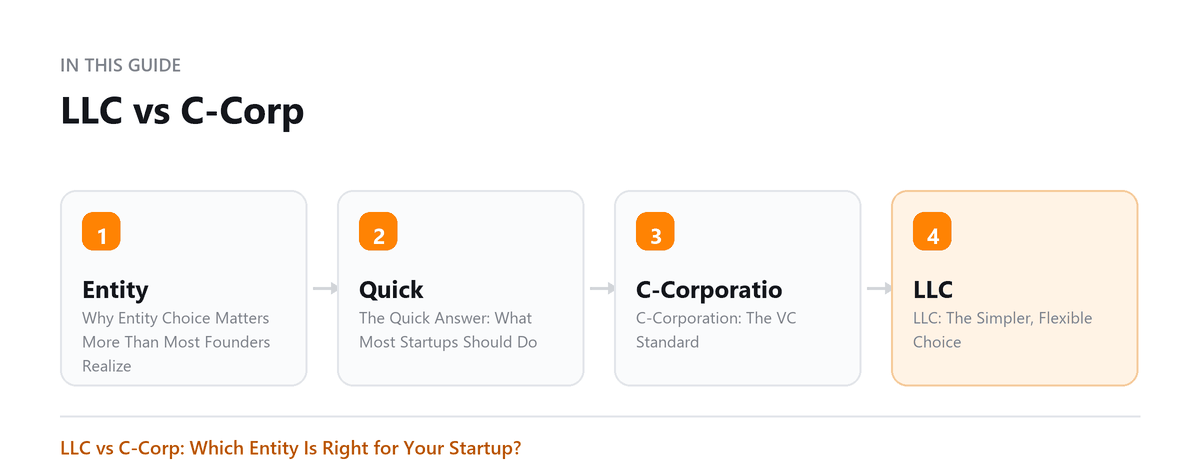
Why Entity Choice Matters More Than Most Founders Realize
The LLC vs C-Corp decision affects your ability to raise venture capital, how you pay taxes, how you issue equity to employees, and what happens when you eventually sell. Getting it wrong early is expensive to fix. Getting it right takes about 30 minutes of clear thinking.
Founders choose on the first year's tax outcome and live with it through a funding round and sometimes a sale. Model several years, including what happens when you raise, bring in an owner who is not eligible, or exit. The exit is where the wrong structure costs most.
Abhinav Gupta, CPA, CA, MBA · LinkedInThe Quick Answer: What Most Startups Should Do
| Your Situation | Recommended Entity |
|---|---|
| Seeking VC funding | Delaware C-Corp |
| Bootstrapped, US-based service business | LLC (your home state or Delaware) |
| Solo founder, no employees | Single-member LLC |
| Indian founder targeting US VCs | Delaware C-Corp |
| Professional services (law, medicine) | Professional LLC or PLLC |
C-Corporation: The VC Standard
A C-corporation is a separate legal entity that pays its own taxes (currently 21% federal corporate rate). Shareholders pay tax again when they receive dividends. This double-taxation sounds bad, but for startups it rarely matters because profits are reinvested rather than distributed.
Why VCs Cannot Invest in LLCs
Most venture funds are structured as LPs or LLCs themselves. Their limited partners include tax-exempt institutions (pension funds, university endowments) that cannot receive pass-through income from an operating company because it creates Unrelated Business Taxable Income (UBTI). A C-corp blocks that problem completely.
QSBS: The Tax Benefit Worth Up to $10 Million
Section 1202 of the Internal Revenue Code lets qualifying founders and investors exclude up to $10 million in capital gains (or 10x their investment, whichever is greater) when they sell C-corp stock held for more than five years. Key requirements:
- Must be a domestic C-corp (not S-corp, not LLC)
- Stock must be acquired at original issuance (not secondary market)
- Active business in a qualifying trade (excludes professional services, finance, hospitality)
- Aggregate gross assets under $50 million at the time of issuance
- Stock must be held for more than 5 years
Pro Tip: 83(b) elections + QSBS together can shelter tens of millions in gains. File the 83(b) within 30 days of your restricted stock grant to start the QSBS clock.
Delaware: Why Almost Every VC-Backed Startup Incorporates There
Delaware is not just a preference, it is a contractual expectation from most institutional investors. Reasons:
- Court of Chancery: Specialized business court with no juries and predictable case law going back centuries
- Investor-friendly case law: Protective provisions, drag-along rights, and liquidation preferences are well-tested
- Series seed/A term sheets assume Delaware C-corp structure
- Registered agent ecosystem is mature and inexpensive
- No state income tax on income from intangible property (royalties, etc.) for non-Delaware operations
LLC: The Simpler, Flexible Choice
An LLC combines the liability protection of a corporation with the tax simplicity of a partnership. Income flows directly to members and is reported on their personal returns.
When LLC Makes Sense
- You plan to stay bootstrapped and do not need institutional capital
- Your business generates profits you want to distribute to owners currently
- You are a solo founder or small group without complex equity arrangements
- You operate a real estate, consulting, or professional services business
- You want operational flexibility without a formal board structure
LLC Tax Treatment Options
| Classification | Tax Treatment |
|---|---|
| Single-member LLC (default) | Disregarded entity, Schedule C on personal return |
| Multi-member LLC (default) | Partnership, Form 1065, K-1s to members |
| LLC elected as S-corp | Pass-through with payroll tax savings (salary + distribution split) |
| LLC elected as C-corp | Rare, if you need C-corp treatment, just form a C-corp |
Why Not S-Corp?
S-corps have severe restrictions that make them incompatible with venture funding:
- Maximum 100 shareholders
- Only US citizens and permanent residents can be shareholders (no foreign investors, no VC funds structured as partnerships)
- Only one class of stock (no preferred shares, VCs require preferred equity)
- No corporate shareholders (VC funds are corporations or partnerships)
S-corps work for profitable small businesses that want pass-through taxation with payroll tax optimization. They are not a startup funding vehicle.
Converting LLC to C-Corp Later: Is It Easy?
Conversion is possible but has costs:
- Tax event: converting LLC to C-corp is generally a taxable event if the LLC has appreciated assets
- Legal costs: $2,000-$8,000 in attorney fees depending on complexity
- QSBS clock restarts from conversion date
- Investors will see the conversion history during diligence
If there is any realistic chance you will raise VC, start as a Delaware C-corp.
Decision Framework: 5 Questions to Ask
- Do you plan to raise venture capital in the next 3 years? If yes, Delaware C-corp.
- Do you need to issue equity options to employees? C-corp (ISO stock options only available in corps).
- Do you want profits to pass through to you currently? LLC or S-corp.
- Are you an Indian founder targeting US investors? Delaware C-corp.
- Are you a solo service provider with no growth capital plans? Single-member LLC.
Book a free consultation and we will get the numbers straight.
Frequently Asked Questions
Can I change from LLC to C-corp later?
Yes, but it triggers a taxable event and restarts the QSBS holding period. If you anticipate VC funding, start as a C-corp.
Can an LLC issue stock options to employees?
LLCs issue profits interests, not stock options. Incentive Stock Options (ISOs), the most tax-advantaged employee equity, are only available in corporations. If employee equity is a priority, use a C-corp.
Does an LLC protect personal assets like a corporation?
Yes, both LLCs and corporations provide limited liability protection. The distinction is in taxation and capital structure, not liability protection.
What state should I incorporate in?
Delaware for VC-backed startups. Your home state for local service businesses that will not raise institutional capital. Wyoming is popular for privacy-focused or asset-protection-focused businesses.
How much does it cost to form a Delaware C-corp?
State filing fee: $89-$109. Registered agent: $50-$300/year. Attorney fees (optional): $1,500-$5,000 for full formation package. Platforms like Stripe Atlas, Clerky, or Firstbase offer $500-$2,000 all-in packages.

Written by
Abhinav Gupta, CPA, CA, MBA
Abhinav works with business owners across the US on industry-specific bookkeeping, from dental practices and restaurants to construction and e-commerce. He writes about what each trade's books actually need. Connect on LinkedIn
Free consultation
Want Books You Can Rely On?
Book a free consultation and we will get the numbers straight.