
What is Virtual Bookkeeping? Benefits of Virtual Bookkeeping
What virtual bookkeeping actually is, how the monthly cycle runs, and why it has become the default for small businesses
Virtual bookkeeping is virtually structuring, recording and reviewing business transactions. Virtual bookkeeper handles your financial activity including expense records, reconciliations, transactions and maintains financial health of your business. Cloud based accounting software helps information sharing in a secured, real time portal forecasting transparency.
Without needing to stay proximal to clients, virtual bookkeeper helps provide flexible and affordable solutions to enterprises. In house bookkeeping often ends up expensive for small and growing businesses so outsourcing their bookkeeping services online enables a clean financial picture in comparison to the cost involved. Compared to conventional bookkeeping practices, geographical proximity is never a limitation for virtual bookkeeping services. More than enabling convenience, virtual bookkeeping streamlines your financial operations.
Virtual bookkeeping is not a compromise on quality, it is an upgrade in infrastructure. When a business moves from a local part-time bookkeeper to a virtual service built on cloud software, they typically get more accurate records, faster reporting, and better data security.
Ankit Sarawagi, CPA, CA, MBA · LinkedInVirtual Bookkeeping: An Overview
Virtual bookkeeping operates entirely online. Skilled professionals manage your finances remotely using cloud-based platforms and automation, eliminating traditional paper-based processes and the need for physical presence. Transactions flow in automatically through bank feeds, are categorised and reconciled using a combination of AI-powered automation and human expertise, and are compiled into financial reports that are available to you in real time.
How Does Virtual Bookkeeping Work?
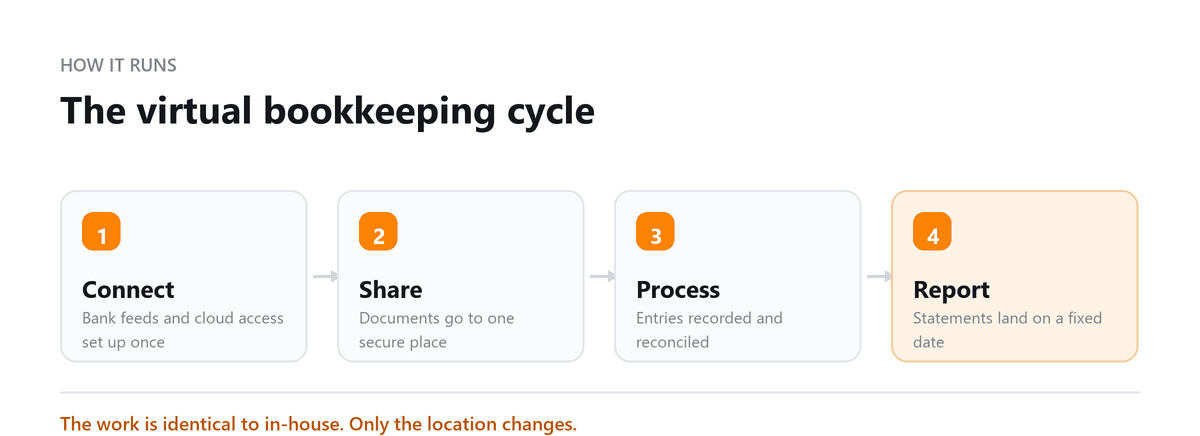
The process is straightforward once set up. Your cloud accounting software (QuickBooks Online, Xero, FreshBooks, or similar) connects to your bank accounts and payment platforms via secure bank feeds. Transactions are imported automatically and your virtual bookkeeper categorises, reconciles, and reviews them on the agreed schedule. Financial reports are generated and shared with you on a regular basis, typically monthly, with ongoing access to your dashboard whenever you need it.
Virtual Bookkeeping vs. Traditional Bookkeeping
| Feature | Traditional Bookkeeping | Virtual Bookkeeping |
|---|---|---|
| Location | On-site | Fully remote |
| Technology | Limited software use | Cloud-based, AI-assisted |
| Automation | Minimal | Extensive, bank feeds, auto-categorisation |
| Data Access | Periodic printed or emailed reports | Real-time dashboards, 24/7 access |
| Scalability | Limited, requires hiring | Highly scalable, adjusts to business needs |
| Cost | Higher overhead (office, equipment) | Cost-effective, pay for service only |
| Expertise | Variable, depends on individual hire | Certified specialists available |
Key Benefits of Virtual Bookkeeping
- Accuracy and Efficiency: AI automation reduces manual errors and speeds up categorisation
- Real-time financial data: Dashboard access means you always know where your numbers stand
- Cost-effectiveness: No employment overhead, you pay for the service, not the seat
- Scalability: Services adjust as your business grows without new hires
- Access to certified professionals: Specialist expertise without the cost of a specialist salary
Why Virtual Bookkeeping Works for Small Businesses
Small businesses are the primary beneficiaries of virtual bookkeeping. The economics make sense at every stage: at launch, you get professional financial management without the budget for a full-time hire; as you grow, services scale with you; and throughout, you get access to software and expertise that would otherwise require significant investment. Business owners can concentrate on operations while financial management is handled by qualified professionals.
The Future of Virtual Bookkeeping
AI-Assisted Automation
Machine learning is already handling routine categorisation and anomaly detection in most major bookkeeping platforms. The trajectory is toward more automation of repetitive tasks, with human bookkeepers focusing on review, advisory, and exception handling.
Hyper-Specialisation
Virtual bookkeeping providers are increasingly specialising by industry, e-commerce, SaaS, real estate, healthcare bringing sector-specific expertise that a generalist bookkeeper typically cannot match.
Blockchain and Data Integrity
Emerging applications of blockchain technology promise to make financial records more tamper-proof and auditable, further strengthening the accuracy and trustworthiness of virtual bookkeeping outputs.
Data-Driven Financial Decisions
As reporting tools become more sophisticated, virtual bookkeeping is evolving from a record-keeping service into a real-time financial intelligence function, giving business owners the data they need to make faster, better decisions.
We have extensively provided virtual bookkeeping services for 350+ small businesses at Profitjets and we have seen the flexibility it offers. Most of them we came across were startled seeing the benefits it offers and ended up setting it as default. As the service provided clear financial visibility they could analyze the issue before us briefing it. So it helped reduce our time consumption enabling the reliable approach in bookkeeping services.
Book a free consultation and we will show you exactly how the handover works.
Frequently Asked Questions
What is virtual bookkeeping?
Virtual bookkeeping is the delivery of professional bookkeeping services entirely online, using cloud-based accounting software. A virtual bookkeeper manages your financial records, reconciles accounts, and delivers reports remotely, with no in-person presence required.
Is virtual bookkeeping as accurate as in-person bookkeeping?
Yes, in most cases more so. Cloud accounting platforms with automated bank feeds, built-in reconciliation checks, and AI-assisted categorisation reduce the manual errors that are common in traditional, spreadsheet-based approaches.
What software is used for virtual bookkeeping?
The most widely used platforms are QuickBooks Online, Xero, and FreshBooks. Most professional virtual bookkeepers are certified on at least one major platform and will recommend the best fit for your business size and industry.
How much does virtual bookkeeping cost?
Costs typically range from $150 to $1,500 per month depending on transaction volume and service scope. This is almost always less expensive than a part-time in-house hire once employment costs are factored in.
How do I get started with virtual bookkeeping?
The typical onboarding process involves an initial consultation to understand your business, setting up or migrating to cloud accounting software, connecting bank feeds, and establishing the reporting schedule. Most professional services can have you set up and running within one to two weeks.
Conclusion
Virtual bookkeeping is not a trend, it is the standard model for modern financial record-keeping. Cloud technology, automated bank feeds, and qualified remote professionals have made it more reliable, more accessible, and more cost-effective than the traditional alternative. Whether you are starting fresh or transitioning from an in-house setup, virtual bookkeeping gives small businesses access to the financial infrastructure they need to grow with confidence.

Written by
Ankit Sarawagi, CPA, CA, MBA
Ankit leads the finance team at Profitjets, where he has worked with 500+ businesses across the US on bookkeeping, tax and CFO-level strategy. He writes about the habits that keep small business books accurate all year. Connect on LinkedIn
Free consultation
Thinking About Going Virtual?
Book a free consultation and we will show you exactly how the handover works.