
Every founder starts out life as what? You set the direction, pitch the investors, sign the cheques, and build the forecast late at night in a spreadsheet. At some point that stops working and you raise your first serious fundraise or have your first board meeting and the question becomes what it is you're relinquishing when you bring on a CFO.
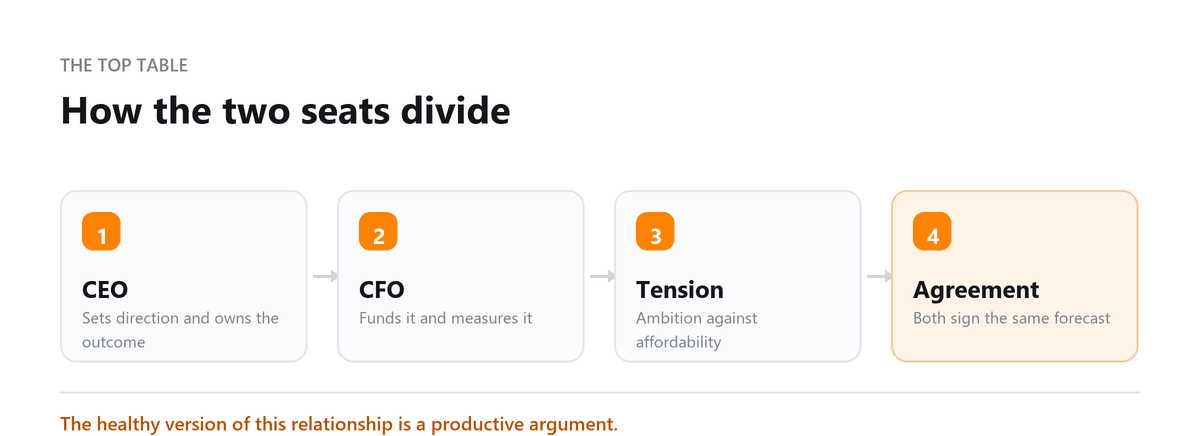
In short the CEO determines the direction and the CFO ensures it can be afforded. Both occupy the C-suite, both report (in differing ways) to the board and both influence the decisions that drive the business, but with varying degrees of accountability and a different angle of approach.
When the relationship is healthy the board hears one story about strategy and finance, but with unhealthy dynamics, the guidance becomes inconsistent, the targets slippery, and at least one of the two likely to end up packing up and leaving the building.
Expert Perspective
The most underrated part of a CFO's job is the part CEOs rarely talk about in public: being the person who says no when the numbers don't back what the CEO wants to do. That only works if there's trust and credibility between them. A CFO who can't push back constructively isn't doing the whole job.
Anu Gupta, CA, EA, B.Tech · LinkedInThis guide covers what each role does, where they overlap and differ, how the two work together, and what a strong CEO-CFO partnership looks like in practice.
CEO vs CFO: Definition
What is a CEO?
A Chief Executive Officer (CEO) is the highest-ranking executive in a company. The CEO sets the company's vision, strategy, and culture, the direction the organization is heading and the values that guide how it gets there. The CEO makes the final call on all major decisions: significant investments, key executive hires, strategic partnerships, and M&A. The CEO is accountable to the board of directors, which can hire and fire the CEO based on company performance.
What is a CFO?
A Chief Financial Officer (CFO) is the senior executive responsible for the company's financial health. The CFO manages financial planning and analysis, investor relations, capital structure, treasury, risk management, and financial reporting. The CFO translates the CEO's strategic vision into financial plans and is responsible for ensuring the company has the capital, and the financial discipline, to execute that vision. The CFO reports to the CEO but also has a direct governance relationship with the board through the audit and finance committees.
CEO vs CFO: Similarities
Both the CEO and CFO are C-suite executives who interact directly with the board of directors. Both carry company-wide influence, their decisions affect every department and every employee. Both are accountable for overall business performance and both require strategic thinking at the highest level. Both are public faces of the company in specific external contexts: the CEO to customers, media, and the broader business ecosystem; the CFO to investors, lenders, and rating agencies.
CEO vs CFO: Differences
| Dimension | CEO | CFO |
|---|---|---|
| Primary accountability | Company performance and vision | Financial performance and integrity |
| Decision authority | Final authority on all major decisions | Financial veto and counsel on all major decisions |
| Reports to | Board of Directors | CEO (and board audit/finance committee) |
| External focus | Customers, media, regulatory, ecosystem | Investors, lenders, auditors, rating agencies |
| Background | Varied (product, sales, operations, finance) | Finance, accounting, investment banking |
| Succession | Sets the vision (board selects successor) | Often a candidate for CEO succession |
CEO vs CFO: Responsibilities
The CEO is responsible for strategic direction, setting where the company is going, communicating that direction clearly to employees, investors, and the market, and building the organizational culture that attracts and retains the talent needed to get there. The CEO owns the company's major external relationships: key customers, regulatory bodies, strategic partners, and the board. They make the hiring decisions for their direct reports and set the tone for how the executive team functions.
The CFO is responsible for translating that direction into financial reality. They build the financial models that stress-test the CEO's ambitions against available capital and market realities. They manage the investor relations function, quarterly earnings calls, investor day presentations, and one-on-one meetings with analysts and institutional investors. They oversee treasury and capital allocation, ensuring cash is deployed where it generates the best returns. They manage audit and compliance obligations that carry personal liability implications.
How CEO and CFO Work Together
The CEO-CFO relationship is arguably the most important executive pairing in any company. It functions best as a complementary partnership: the CEO provides the strategic ambition and organizational energy; the CFO provides the financial discipline and analytical rigor that ensures those ambitions are grounded in reality. When this partnership works well, the board receives coherent, unified financial and strategic messaging. When it breaks down, the results are visible in inconsistent guidance, missed financial targets, and executive turnover.
The CFO's role in challenging the CEO is one of the most underappreciated aspects of the job. A strong CFO does not simply execute the CEO's financial requests, they pressure-test strategic assumptions, flag when projected returns do not justify the capital requirement, and sometimes say no to initiatives that the CEO is enthusiastic about. This requires a trust relationship between the two executives that takes time to build and must be maintained through transparent, direct communication.
Board dynamics add an important dimension to the CEO-CFO relationship. The CFO's independent relationship with the audit committee, reporting directly to the committee on financial controls, audit findings, and any concerns about financial reporting integrity, is a governance safeguard designed to ensure the board receives accurate financial information even if the CEO might prefer a different narrative. This independence is a feature, not a tension point, though it requires both executives to understand and respect their respective governance obligations.
Accounting Software: Empowering CFOs
Modern cloud financial systems, NetSuite, Sage Intacct, Oracle Fusion, give CFOs real-time business performance visibility that they can share with the CEO in dashboard form. Revenue by product and geography, cash position and runway, customer metrics, and operating expense tracking are all available on demand rather than through a monthly close cycle. This real-time visibility enables faster CEO decision-making because the financial picture is always current, not a snapshot from three weeks ago.
Conclusion
The CEO and CFO are the two most critical executive relationships in any company. The CEO leads the vision; the CFO anchors it in financial reality. The most successful companies have a CEO-CFO partnership characterized by mutual trust, honest communication, and clear role boundaries, where the CEO's strategic ambitions are regularly tested against the CFO's financial analysis, and the resulting plans reflect both ambition and discipline.
I’ve worked with businesses where the CEO and finance team were looking at the same numbers but using them to answer very different questions. In one engagement, the CEO needed clarity on whether the business could afford its planned expansion, while the finance team was focused mainly on historical reporting. We brought the two perspectives together through a forward-looking cash-flow forecast and financial model, giving the CEO a clearer financial basis for the decision.
Book a free consultation and we will take the finance seat off you.
Frequently Asked Questions
Can one person be both CEO and CFO?
In very early startups, founders often cover both roles for a while. Once a company has investors or lenders, though, combining them becomes a problem, because it removes the internal check between strategic ambition and financial discipline. Most boards and investors expect the two roles to be separated as the business grows.
What happens when the CEO and CFO disagree?
Some disagreement is healthy, since part of the CFO's job is testing the CEO's plans against the numbers. When a disagreement is significant, it usually goes to the board through the audit or finance committee. If the two can't resolve fundamental differences over time, one of them typically leaves.
Does a CFO have veto power over the CEO?
Not formally in most companies. A CFO can still carry real weight, though, by refusing to sign off on projections they consider misleading, raising concerns with the audit committee, or disagreeing openly in board discussions. In regulated industries, the CFO also has legal responsibilities that create accountability independent of the CEO.
Can a CFO become a CEO?
Yes, and at well-run companies it's a common path, especially in financial services, private equity-backed businesses, and companies where financial performance drives most of the value. CFOs who make the move usually need to build skills outside finance, such as product instincts, sales leadership, and managing external relationships.
How do the CEO's and CFO's relationships with the board differ?
The CEO reports directly to the board and is its main point of accountability. The CFO also has a direct relationship with the board, mainly through the audit and finance committees, and that relationship is independent of the CEO. It gives the board a way to hear financial concerns that might not come through the CEO.

Written by
Anu Gupta, CA, EA, B.Tech
Anu works with US businesses on tax and entity questions at Profitjets, from choosing a structure to the filings that follow it. She writes about the decisions owners make once and then live with for years. Connect on LinkedIn
Free consultation
Founder Doing Both Jobs?
Book a free consultation and we will take the finance seat off you.