
What it costs to win a customer is one of the few numbers that decides whether a growth plan works, and it is calculated inconsistently almost everywhere.
The disagreements are about what belongs in it and over what period. Spend and signings rarely land in the same month, which means a single month's figure measures the calendar as much as the business.
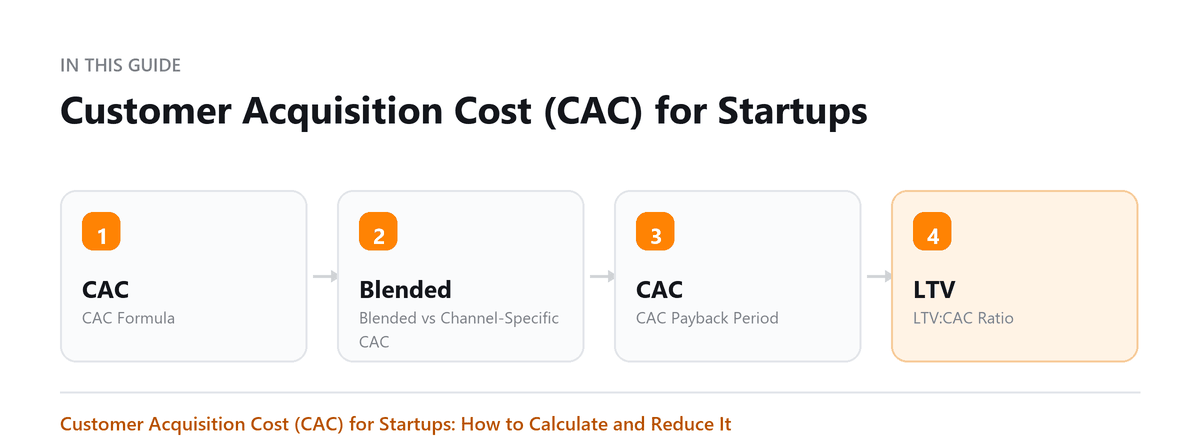
This covers what belongs in the calculation, the difference between the blended figure and the one for a single channel, how long it takes to earn back, how it relates to what a customer is worth, and how to reduce it.
Customer acquisition cost (CAC) is the total spend required to win one new customer. It is the most important unit-economics metric for early-stage startups because it determines whether your growth is sustainable or destroys value.
CAC Formula
CAC = Total Sales and Marketing Spend / Number of New Customers Acquired
Include in sales and marketing spend: salaries (sales reps, marketing team), ad spend, agency fees, software tools (CRM, marketing automation), events, and outbound SDR costs. Be consistent about the time period, monthly or quarterly.
Spend and signings rarely land in the same month, so dividing one by the other inside a single month measures the calendar more than the business. Read it as a rolling figure over a quarter, or by the cohort the spend actually produced.
Abhinav Gupta, CPA, CA, MBA · LinkedInBlended vs Channel-Specific CAC
| CAC Type | What It Shows |
|---|---|
| Blended CAC | Total S&M spend / total new customers, your overall average |
| Paid CAC | Paid channel spend / customers from paid channels, true cost of paid acquisition |
| Organic CAC | Content/SEO investment / customers from organic, often near zero short term but costly to build |
| Channel-Specific CAC | Google Ads CAC vs LinkedIn Ads CAC vs Outbound SDR CAC |
Investors want to see blended and paid CAC. Channel-specific CAC helps you find where to allocate more or less spend.
CAC Payback Period
CAC Payback Period = CAC / (ARPU x Gross Margin %). This is the number of months to recover what you spent to acquire a customer. SaaS benchmark: under 12 months for efficient businesses, under 18 months is acceptable for venture-backed growth.
LTV:CAC Ratio
LTV:CAC = Customer Lifetime Value / CAC. The venture benchmark for SaaS is 3:1 or better. Below 1:1 means you lose money on every customer. Between 1:1 and 3:1 is a warning zone.
| LTV:CAC Ratio | Interpretation |
|---|---|
| Below 1:1 | Destroying value with each customer won, unsustainable |
| 1:1 to 3:1 | Marginal, reduce CAC or improve LTV before scaling |
| 3:1 | Venture benchmark, healthy enough to scale |
| Above 5:1 | May be under-investing in growth, could acquire more aggressively |
How to Reduce CAC
Improve Conversion Rates
- A/B test landing pages: a 1% improvement in conversion halves CAC if traffic stays flat
- Simplify the sign-up or sales flow: every extra step loses prospects
- Invest in sales enablement: better demos, case studies, and ROI calculators shorten sales cycles
Invest in Content Marketing (Lower CPL)
- SEO-driven content compounds over time: cost per lead from organic drops as domain authority grows
- Content educates buyers before the sales conversation, shortening the cycle
Increase Referral and Word-of-Mouth
- A referral customer typically has 30-50% lower CAC than paid
- Build a formal referral programme with incentives once you have 100+ customers
Improve Onboarding to Reduce Churn
- Higher churn forces higher growth, you need to replace leaving customers
- Fixing the first 30-day experience is often the highest-ROI CAC reduction move
Cohort Analysis
Group customers by acquisition month and track their revenue over time. Cohort analysis reveals whether CAC is improving, whether LTV is holding, and which channels produce the best long-term customers, not just the cheapest first-year customers.
Book a free consultation and we will get the numbers straight.
Frequently Asked Questions
Should I include founder time in CAC?
Yes, if founders are spending significant time on sales, that time has an opportunity cost. Especially relevant for Series A due diligence where investors want to see unit economics that hold when you hire a sales team.
What is a good CAC for a SaaS startup?
It depends entirely on ARPU and gross margin. A $50/month product with a $600 CAC and a 24-month payback is fine. The ratio matters more than the absolute number.
How often should I recalculate CAC?
Monthly for channel-specific CAC (to catch inefficient spend fast). Quarterly for blended CAC trends. CAC tends to rise as you exhaust the easiest-to-reach customers.
What belongs in the cost, and what does not?
Everything spent to win a customer who was not already coming: advertising, the sales and marketing team's cost, the tools they use, agency fees, and the discounts or credits given to close. What does not belong is the cost of serving the customer once they have signed, or anything that would have been spent whether or not you acquired anyone. The test is whether stopping the spend would stop the customers arriving.
Why does the number look so different from month to month?
Because spend and signings rarely land in the same month, and a small denominator swings wildly. A campaign paid for in one month produces customers over the next two, so dividing one by the other inside a single month measures the calendar more than the business. Reading it as a rolling figure over a quarter, or by the cohort the spend actually produced, removes most of the noise.

Written by
Abhinav Gupta, CPA, CA, MBA
Abhinav works with business owners across the US on industry-specific bookkeeping, from dental practices and restaurants to construction and e-commerce. He writes about what each trade's books actually need. Connect on LinkedIn
Free consultation
Want Books You Can Rely On?
Book a free consultation and we will get the numbers straight.