
Most people meet this form expecting to owe something and are surprised to find that filing and paying are largely separate questions here.
The return records what has been given and what allowance has been used against a lifetime amount. In many cases nothing is payable at the time, and the filing exists so that the position can be reconstructed later, often by an executor who was not party to any of it.
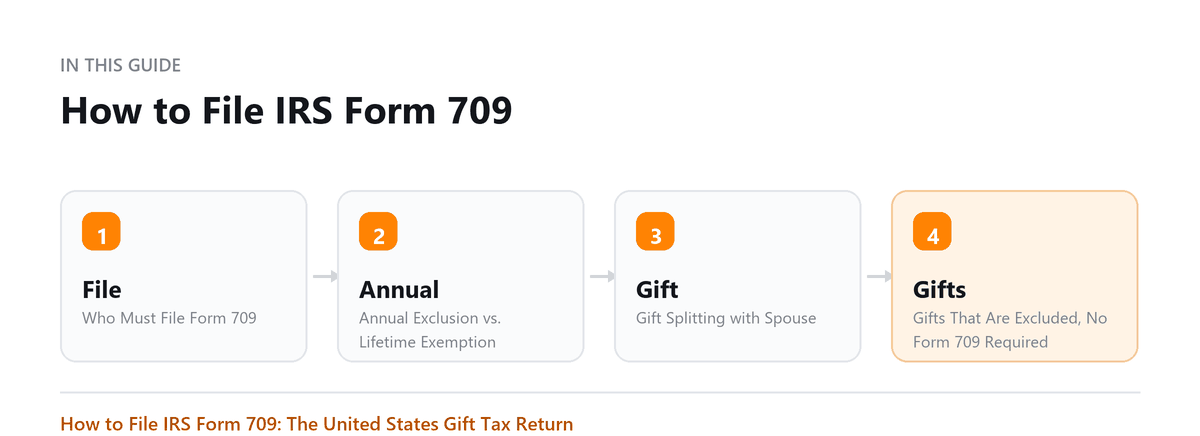
This covers who has to file, how the annual and lifetime allowances interact, how splitting between spouses works, what is excluded entirely, and how gifts of property rather than cash are valued.
Form 709 is the US Gift Tax Return. If you gave gifts in excess of the annual exclusion during the year, you must file Form 709, even if no gift tax is actually due. Understanding the annual exclusion, the lifetime exemption, and how they interact is essential for anyone engaged in estate planning.
Who Must File Form 709
You must file Form 709 if you are a US citizen or resident and during the calendar year you:
- Gave gifts to any single recipient that exceeded the annual exclusion amount ($18,000 per recipient in 2024, $19,000 in 2025)
- Gave a gift of a future interest (any gift other than a direct, present-interest gift, regardless of amount)
- Made a gift splitting election with your spouse (even if your individual gifts were under the exclusion)
- Made direct payments to a foreign individual's tuition or medical expenses (these are generally excluded but must be properly structured)
People skip this when nothing is payable, which is exactly when filing matters most. The filing is the record of what has been used, and that history has to be reconciled years later by somebody who was not in the room. A gift made and never reported leaves nothing behind for them to work from.
Ankit Sarawagi, CPA, CA, MBA · LinkedInAnnual Exclusion vs. Lifetime Exemption
Annual Exclusion
Each person can give up to $18,000 (2024) to as many different recipients as they want without any gift tax consequences and without filing Form 709. The exclusion is per recipient, per year.
- Example: You can give $18,000 each to your three children, two grandchildren, and a friend, that is $108,000 total with zero gift tax and no Form 709 required
- The exclusion resets each January 1
- There is no cap on the total number of recipients
Lifetime Exemption (Unified Credit)
Gifts above the annual exclusion reduce your lifetime exemption. For 2024, the lifetime exemption is $13,610,000 per person ($27,220,000 for married couples using gift splitting).
The same exemption applies to the estate tax. Every dollar of lifetime exemption used for gifts reduces the exemption available at death.
Gift Splitting with Spouse
Married couples can elect to treat a gift from one spouse as made half by each spouse. This doubles the effective annual exclusion to $36,000 per recipient (2024) and doubles the lifetime exemption available.
- Both spouses must be US citizens or residents at the time of the gift
- Both spouses must consent, by signing Form 709
- Both spouses must file Form 709 to make the gift-splitting election, even if only one spouse made gifts
- The consent covers all gifts made during that calendar year (you cannot split some gifts and not others)
Gifts That Are Excluded, No Form 709 Required
- Annual exclusion gifts ($18,000 per recipient, 2024), as long as they are present-interest gifts
- Tuition paid directly to an educational institution on behalf of anyone (no dollar limit)
- Medical expenses paid directly to a medical provider on behalf of anyone (no dollar limit)
- Gifts to a US citizen spouse (unlimited marital deduction)
- Gifts to qualifying political organizations
- Gifts to qualifying charities (claimed as a charitable deduction)
Pro Tip: Tuition and medical payments must be made directly to the institution or provider, payments to the student/patient do not qualify for the exclusion.
Filing Deadline
| Event | Deadline |
|---|---|
| Form 709 due date | April 15 (same as Form 1040) |
| Automatic extension | October 15, file Form 4868 (same as income tax extension) or Form 8892 |
| Filing after death of donor | Estate tax return due date if donor died during the year |
An extension to file is not an extension to pay gift tax. If any gift tax is owed, pay it by April 15.
How Form 709 Is Structured
| Part | Content |
|---|---|
| Part 1, General Information | Donor information, consent to gift splitting, prior gift history |
| Part 2, Tax Computation | Taxable gifts, reduction for annual exclusions, cumulative taxable gifts, unified credit computation |
| Schedule A, Gifts | List each gift with: donee name, description, date, value, annual exclusion claimed |
| Schedule B, Prior Taxable Gifts | Cumulative gifts from prior years (used to compute the correct tax rate, gift tax is progressive) |
| Schedule C, Deceased Spouse Unused Exemption | If claiming portability (DSUE) from a deceased spouse |
| Schedule D, Computation of Generation-Skipping Tax | For gifts to grandchildren or more remote descendants |
Valuation of Gifts
Gifts must be valued at fair market value on the date of the gift. Common valuation issues:
- Publicly traded stock: average of high and low price on the date of gift
- Real estate: requires a qualified appraisal
- Interests in closely held businesses: complex valuation; discounts for lack of marketability and minority interest are common
- Art and collectibles: qualified appraisal required
Pro Tip: A qualified appraisal attached to Form 709 starts the statute of limitations on valuation challenges, without it, the IRS can challenge the value indefinitely.
Gift Tax Rates
Gift tax rates are the same as estate tax rates, from 18% to 40% on taxable gifts above the lifetime exemption. In practice, most taxpayers never pay gift tax because their total lifetime gifts remain under the lifetime exemption.
Book a free consultation and we will take the return off your desk.
Frequently Asked Questions
If no gift tax is owed, do I still need to file Form 709?
Yes, if any of the filing triggers apply (gifts over the annual exclusion, future-interest gifts, or gift-splitting election). Filing Form 709 even when no tax is owed is important because it starts the statute of limitations for IRS challenges to gift values.
Can married couples give $36,000 per recipient without filing Form 709?
Only if you make the gift-splitting election, which itself requires filing Form 709. Without the election, each spouse's annual exclusion is independent, one spouse giving $36,000 to a single recipient must file Form 709 even if the couple intended it as a joint gift.
What happens if I die after using some of my lifetime exemption?
The amount of lifetime exemption used for gifts is subtracted from your estate tax exemption at death. Your estate will have a smaller exemption available.
Is there a state gift tax?
Most states do not have a gift tax. Connecticut is a notable exception. Check your state's rules.
Why file when nothing is payable?
Because the filing records what was used, and that record is what matters later. Amounts applied against a lifetime allowance need to be tracked across many years and eventually reconciled by an executor, and the filings are how that history exists. Filing also starts the clock on how long the position can be examined. A gift made and never reported leaves no record, and the person who has to reconstruct it is rarely the person who made it.

Written by
Ankit Sarawagi, CPA, CA, MBA
Ankit leads the finance team at Profitjets, where he has worked with 500+ businesses across the US on bookkeeping, tax and CFO-level strategy. He writes about the habits that keep small business books accurate all year. Connect on LinkedIn
Free consultation
Want the Filing Handled?
Book a free consultation and we will take the return off your desk.