
IRS Schedule E (Form 1040): Supplemental Income and Loss, Complete Guide
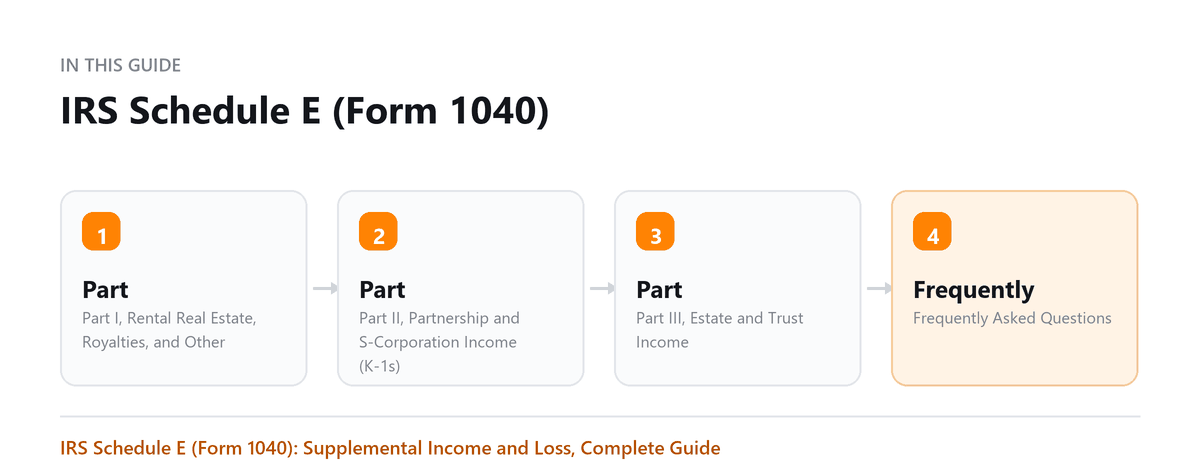
Part I, Rental Real Estate, Royalties, and Other and Part II, Partnership and S-Corporation Income (K-1s)
This is where income that arrives without you working for it gets reported: rent from property, and your share of results from partnerships, S-corporations, estates and trusts.
What makes it demanding is not the arithmetic but the record keeping behind it. Property positions depend on figures established at purchase and added to over years, and allocations from other entities arrive on statements you did not prepare and cannot easily check.
This covers what belongs in each part, how rental income and expenses are reported, how allocations from other entities flow through, and the records that have to survive for as long as you hold the asset.
Schedule E is attached to Form 1040 to report supplemental income and losses from sources other than active business operations. The three main categories are: (1) rental real estate, royalties, and similar activities; (2) partnership, S-corporation, estate, and trust income from Schedule K-1s; and (3) real estate mortgage investment conduit (REMIC) income. Schedule E income is often passive, which has important tax implications.
Part I, Rental Real Estate, Royalties, and Other
Gross Rental Income
Report all rent received during the year, including advance rent, lease cancellation payments, and security deposits applied to rent. Do not reduce by expenses at this stage.
Deductible Rental Expenses
| Expense Category | Notes |
|---|---|
| Advertising | Cost of listing on Zillow, Realtor.com, local ads |
| Auto and travel | Mileage at IRS rate for property management trips; keep a log |
| Cleaning and maintenance | Routine cleaning, lawn care, pest control |
| Commissions | Property manager commissions (typically 8-12% of rent) |
| Insurance | Landlord/rental property insurance premiums |
| Legal and professional fees | Attorney, CPA fees related to the rental property |
| Management fees | Property management company fees |
| Mortgage interest | Report on Schedule E, not Schedule A |
| Other interest | Loans taken to pay for rental property expenses |
| Repairs | Like-for-like fixes (NOT improvements, which are capitalized) |
| Supplies | Cleaning supplies, maintenance supplies |
| Taxes | Property taxes; note that landlords are NOT subject to SALT cap on rental property |
| Utilities | Water, electricity, gas if paid by landlord |
| Depreciation | 27.5-year straight-line for residential; attach Form 4562 |
Depreciation
Residential rental property is depreciated over 27.5 years using the straight-line method. The depreciable basis is the cost of the building (not land) plus capitalized improvements. Calculate on Form 4562 and carry the result to Schedule E.
Pro Tip: A cost segregation study can reclassify portions of a building to 5, 7, or 15-year property, dramatically accelerating depreciation deductions in the early years of ownership.
Passive Activity Loss (PAL) Rules
Rental activities are generally passive. Passive losses can only offset passive income. Exceptions:
- $25,000 special allowance: Active participation landlords with AGI below $100,000 may deduct up to $25,000 of rental losses against non-passive income. The allowance phases out between $100,000 and $150,000 AGI.
- Real estate professional: If more than 50% of personal services are in real property trades or businesses AND more than 750 hours are spent in real property, rental activities are non-passive.
- Short-term rentals: If average rental period is 7 days or fewer, the activity may not be a rental for passive activity purposes.
Property owners underestimate how long these records have to survive. What you paid, what you spent improving it, and how that was split between repairs and improvements all decide the position when you eventually sell, which may be decades away. Treat the purchase and improvement file as a permanent record, not a yearly one.
Ankit Sarawagi, CPA, CA, MBA · LinkedInPart II, Partnership and S-Corporation Income (K-1s)
If you are a partner in a partnership or shareholder in an S-corporation, you receive a Schedule K-1 each year. Enter the amounts from the K-1 on Part II of Schedule E. Each entity has its own row.
| K-1 Box (Partnership) | Where It Goes on Schedule E |
|---|---|
| Box 1, Ordinary business income (loss) | Column (f) or (g), passive or non-passive |
| Box 2, Net rental real estate income (loss) | Separate row; passive unless real estate professional |
| Box 5, Interest income | Schedule B also |
| Box 6a, Ordinary dividends | Schedule B also |
| Box 9a, Net long-term capital gain | Schedule D also |
| Box 14, Self-employment earnings | Schedule SE |
Part III, Estate and Trust Income
If you are a beneficiary of an estate or trust, you receive a Schedule K-1 (Form 1041) reporting your share of income. Enter these amounts in Part III of Schedule E.
Book a free consultation and we will scope it with you.
Frequently Asked Questions
Is Airbnb income reported on Schedule E?
Typically yes, if average rental is more than 7 days and you do not provide substantial services (like a hotel). If you provide substantial services (meals, daily cleaning), report on Schedule C.
Can I deduct a home office on Schedule E?
Only if you use a separate, dedicated space exclusively for managing your rental properties. Rules are strict.
What if I have multiple rental properties?
Each property gets its own set of lines in Part I of Schedule E. If you have more than three properties, attach additional pages.
Are K-1 losses from an S-corp always passive?
No. Losses are passive only if you do not materially participate in the business. Material participation is tested against seven IRS tests.
How do suspended passive losses work?
Passive losses that exceed passive income in the current year are suspended and carried forward. They are released when the property is sold or the activity is fully disposed of.

Written by
Ankit Sarawagi, CPA, CA, MBA
Ankit leads the finance team at Profitjets, where he has worked with 500+ businesses across the US on bookkeeping, tax and CFO-level strategy. He writes about the habits that keep small business books accurate all year. Connect on LinkedIn
Free consultation
Want This Handled Properly?
Book a free consultation and we will scope it with you.