
Buying senior finance capability by the day rather than employing it has become ordinary, and the arrangements that work are the ones scoped properly at the start.
An engagement expressed only as days per month fills with whatever is urgent, which is rarely what the business engaged them for. Naming the outputs is what keeps it pointed at the work that justified the cost.
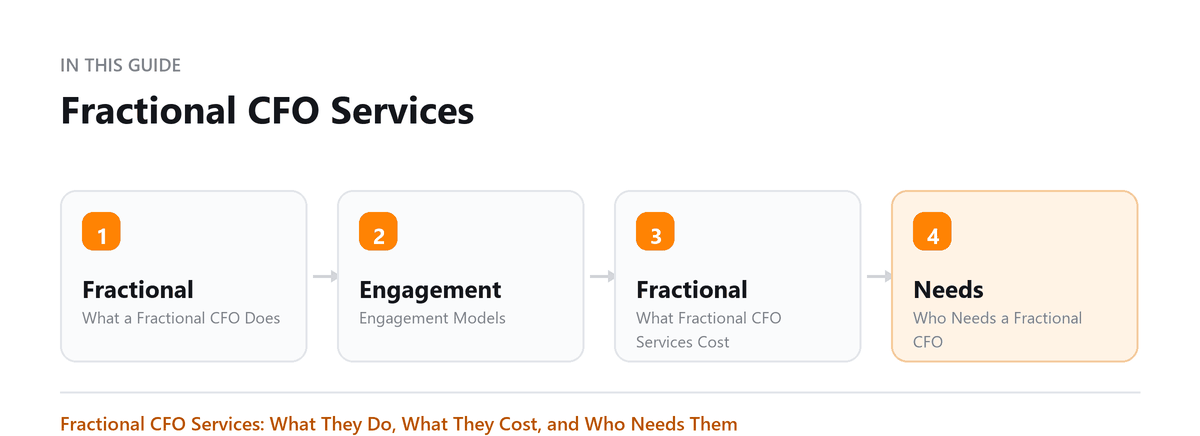
This covers what the role actually delivers, the engagement models available, what it costs relative to employing, which businesses benefit most, and how to judge whether it is paying for itself.
A fractional CFO is a senior finance executive who works for your company on a part-time or project basis. You get CFO-level thinking without CFO-level salary. This model has grown dramatically as companies recognize that $20M businesses cannot afford a $250,000 full-time CFO but cannot afford to go without strategic financial leadership either.
What a Fractional CFO Does
Financial Strategy
The fractional CFO translates your business goals into financial terms: what does the next 12-24 months look like financially, what does it cost to execute the plan, and what assumptions are most at risk? They build and maintain the financial model that drives your decisions.
Fundraising Advisory
If you are raising equity or debt, the fractional CFO prepares the financial model, structures the narrative, and helps you navigate term sheet economics (dilution, liquidation preferences, down-round protection). They have seen dozens of raise processes and know what investors will ask before they ask it.
Model Building and Scenario Analysis
Three-scenario models (base, upside, downside), sensitivity tables, driver-based planning, and what-if analysis for major decisions (hiring a new sales team, entering a new market, acquiring a competitor).
Lender and Investor Prep
Bank credit applications, SBA loan packages, covenant compliance models, investor data rooms, and audit preparation. The fractional CFO makes sure your financials are banker-ready before you walk in the door.
Board and Management Reporting
Monthly board packages with financial performance, KPI dashboard, variance analysis, and forward guidance. Investors and board members evaluate management based partly on the quality of reporting they receive. A well-constructed board package builds confidence.
Scope it by deliverables and not only by days. An arrangement expressed purely as time fills with whatever is urgent, which is rarely what you engaged them for. Name the outputs, say when each is due, and review it quarterly.
Abhinav Gupta, CPA, CA, MBA · LinkedInEngagement Models
| Model | Description |
|---|---|
| Part-time retainer | 5-20 hours/week on a monthly retainer; ongoing relationship |
| Project-based | Defined deliverable: model build, fundraising prep, audit support; fixed fee |
| Interim CFO | Full-time engagement to cover a vacancy or bridge to permanent hire |
| Advisory | Monthly advisory call + ad-hoc availability; lower commitment |
What Fractional CFO Services Cost
| Engagement Type | Typical Cost |
|---|---|
| 5-10 hrs/week retainer | $3,000 - $6,000/month |
| 10-20 hrs/week retainer | $6,000 - $12,000/month |
| Full-service CFO package (CFO + controller + bookkeeping) | $8,000 - $15,000/month |
| Project-based (financial model) | $5,000 - $15,000 per project |
| Project-based (fundraising support) | $10,000 - $30,000 for a raise |
| Interim full-time CFO | $15,000 - $30,000/month |
Compare to a full-time CFO at $150,000-$300,000 per year in base salary plus benefits, equity, and recruiting costs. The fractional model delivers 60-80% of the output at 20-30% of the cost for most companies under $50M in revenue.
Who Needs a Fractional CFO
| Company Stage | Why Fractional CFO |
|---|---|
| $3M-$20M revenue | Too large to manage without financial strategy; too small to afford full-time CFO |
| Raising Series A or B | Investors will ask CFO-level questions; you need CFO-level answers |
| Preparing for acquisition | Buyer due diligence requires CFO-prepared financial data room |
| First institutional bank line | Banks require CFO-quality financials and projections |
| CFO departed suddenly | Interim fractional CFO covers the gap without a rushed full-time hire |
| Private equity-backed portco | PE firms expect board-level financial reporting from day one |
The ROI of a Fractional CFO
The question is not whether you can afford a fractional CFO. The question is what it costs not to have one.
- Average owner time spent on ad-hoc financial analysis: 10-15 hours/month
- Tax errors from lack of proactive planning: average IRS underpayment penalty + 0.5% per month interest
- Valuation difference between investor-ready and non-investor-ready financials: 0.5-2x EBITDA multiple
- Cost of a bank line declined because financials were not presentable: 15-20% factoring rate as alternative
Book a free consultation and we will put senior eyes on your numbers.
Frequently Asked Questions
How do I find a good fractional CFO?
Referrals from your attorney, banker, or board members are the most reliable source. Ask for references and have a conversation about what they have specifically done, not just their background. A fractional CFO who has led three successful fundraises is more valuable for your raise than one who advised on financial reporting.
How long does a fractional CFO engagement typically last?
Most ongoing retainer relationships run 12-36 months. Project-based engagements are 1-6 months. Many companies use a fractional CFO until they can afford and justify a full-time hire.
Can a fractional CFO sign my bank loan documents or tax returns?
Signing authority depends on your corporate structure and the specific document. A fractional CFO can be designated as an authorized officer for bank purposes. Tax returns must be signed by your CPA (PTIN holder). Equity financing documents are signed by authorized executives and counsel.
What should we have ready before the first session?
The last two years of accounts, the current management figures however rough, the bank balances and any facilities, the cap table, and a list of the decisions you are facing in the next six months. The last item is the one that makes the difference: it turns an orientation exercise into work. A first session spent on what you already know is a session you paid for and did not need.
How do we scope the engagement so it does not drift?
By defining the deliverables and the time, not just the time. An arrangement expressed only as days per month tends to fill with whatever is urgent, which is rarely what you engaged them for. Name the outputs, say when each is due, and agree what comes out of scope if something new goes in. Review it quarterly, because the right scope in month one is usually the wrong one by month nine.

Written by
Abhinav Gupta, CPA, CA, MBA
Abhinav works with business owners across the US on industry-specific bookkeeping, from dental practices and restaurants to construction and e-commerce. He writes about what each trade's books actually need. Connect on LinkedIn
Free consultation
Want CFO-Level Clarity?
Book a free consultation and we will put senior eyes on your numbers.