
Handing the accounting to somebody outside the business is a common step and the transition is where it usually goes wrong.
The decision itself is straightforward. Running two systems in parallel for a quarter, with nobody clearly responsible for the close, is what turns a sensible move into a difficult year.
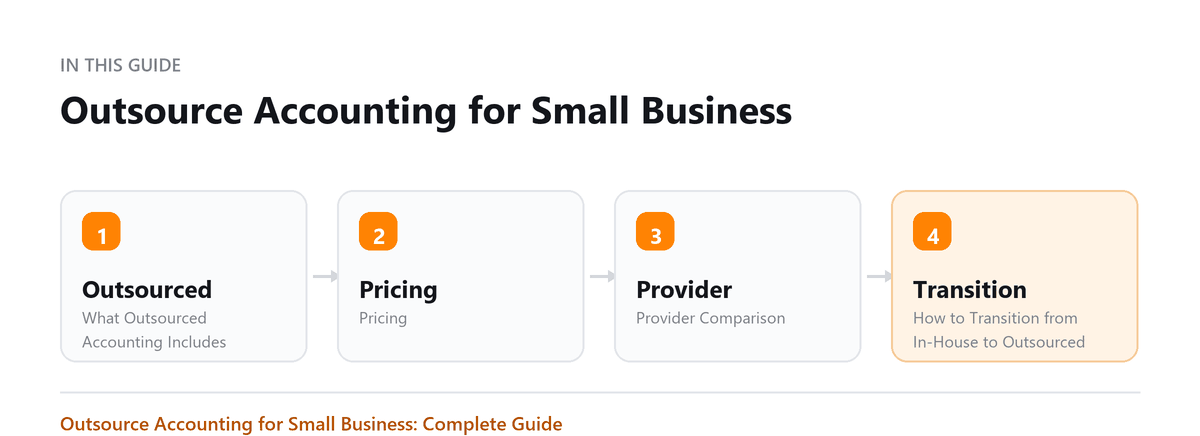
This covers what is normally included, how it is priced, how the different kinds of provider compare, how to run the transition, and what to look for before signing.
Outsourcing accounting is one of the highest-ROI decisions a small business owner can make. You stop spending 10-20 hours per month on books you are not trained for, you get accurate financials to make decisions with, and you eliminate the compliance risk of DIY tax prep. This guide covers everything you need to know.
What Outsourced Accounting Includes
| Service | What It Covers |
|---|---|
| Bookkeeping | Daily/weekly transaction recording, bank feed review, categorization |
| Bank reconciliation | Monthly reconciliation of all accounts to bank statements |
| Accounts payable | Invoice processing, payment scheduling, vendor management |
| Accounts receivable | Invoice generation, payment tracking, collections follow-up |
| Month-end close | Accruals, prepayments, depreciation, and trial balance review |
| Financial statements | Monthly P&L, balance sheet, and cash flow statement |
| Payroll | Payroll processing, payroll tax deposits, W-2/1099 prep |
| Sales tax | Return preparation and filing across applicable states |
| Tax preparation | Federal and state business income tax returns |
| CFO advisory | Budgeting, forecasting, and strategic financial guidance |
Move in one direction and finish. The expensive version of this is a half-transition where some work sits inside, some outside and nobody is clearly responsible for the close. Agree who owns each task in writing before the first month runs.
Abhinav Gupta, CPA, CA, MBA · LinkedInPricing
| Service Level | Monthly Cost |
|---|---|
| Bookkeeping only (< 50 transactions/month) | $300 - $600 |
| Bookkeeping only (50-200 transactions/month) | $600 - $1,200 |
| Bookkeeping + month-end close + financials | $800 - $2,000 |
| Full accounting (close + payroll + sales tax) | $1,500 - $4,000 |
| Full accounting + fractional CFO | $4,000 - $10,000 |
Pro Tip: Most small businesses with under $3M in revenue need the mid-tier package: bookkeeping, month-end close, financial statements, and tax prep. Budget $1,000-$2,500/month and expect a 5-10x return in owner time freed and tax accuracy.
Provider Comparison
| Provider | Best For |
|---|---|
| Profitjets | Growth-stage businesses and CPAs needing outsourced accounting with CFO capability |
| Bench | Sole proprietors and small businesses wanting simple monthly reports |
| Bookkeeper360 | QuickBooks-centric small businesses needing full-service accounting |
| Pilot | Venture-backed startups needing investor-ready GAAP financials |
| Paro | Businesses needing fractional CFO or controller talent on demand |
How to Transition from In-House to Outsourced
- Document your current process: what gets done, by whom, in what software
- Inventory access credentials: bank feeds, payroll, accounts payable systems
- Select your outsourced provider and sign an MSA
- Run a parallel period: both teams close the same month independently
- Compare results and resolve discrepancies
- Hand off fully at the start of the next month
- Decommission internal processes (or re-assign internal staff)
Most transitions take 30-60 days. Larger or more complex operations may take 90 days. Do not rush the parallel period; it catches setup errors before they affect live reporting.
What to Look for in a Provider
- Experience in your industry (restaurant, SaaS, e-commerce, real estate, all require different expertise)
- Software compatibility: they should work in your existing systems, not force migration
- Response time SLA: what is their turnaround on questions and tasks?
- Team structure: do you have a dedicated contact or a shared queue?
- Security: SOC 2 certification, encryption, and NDA coverage for your data
- References: ask for clients in your industry and revenue range
Book a free consultation and we will put senior eyes on your numbers.
Frequently Asked Questions
Do I lose control when I outsource accounting?
You gain control. Outsourced accounting gives you accurate financial statements, which is the foundation of control. Without accurate books, you are making decisions blind. Payment authorization, budget approval, and strategic decisions remain with you.
What happens if my outsourced provider makes a mistake?
Ask about their professional liability (E&O) insurance before signing. Reputable providers carry coverage that compensates you for errors caused by their negligence. Also confirm how they handle amendments if a prior period error is discovered.
Can I outsource just part of my accounting?
Yes. Many businesses outsource bookkeeping only and keep tax prep with their CPA. Others outsource everything including CFO advisory. You can start with one function and expand as your confidence in the provider grows.
How long does moving the work actually take?
Plan for a full reporting cycle before anything feels normal, and two before it is. The first month is spent gathering access, agreeing the chart of accounts and finding out what the previous arrangement left unfinished. The second is the first real close. Businesses that expect it to be seamless from week one tend to judge the provider on the handover rather than on the service.
What do we need to hand over, and what should we keep copies of?
Hand over access to the accounting system, the bank feeds in read-only form, the payroll records, and the last closed set of accounts with its supporting schedules. Keep your own copy of all of it, in a location you control. The test of a good handover is whether you could reverse it: if the answer depends on the provider's goodwill, something important is sitting in their systems rather than yours.

Written by
Abhinav Gupta, CPA, CA, MBA
Abhinav works with business owners across the US on industry-specific bookkeeping, from dental practices and restaurants to construction and e-commerce. He writes about what each trade's books actually need. Connect on LinkedIn
Free consultation
Want CFO-Level Clarity?
Book a free consultation and we will put senior eyes on your numbers.