
A homeowners association has a choice about how it files, and the choice is made afresh every year rather than settled once.
It turns on how the association's income splits between amounts collected from members for the association's own purposes and everything else. That split moves year to year with interest, rentals, fees and one-off receipts.
This covers the tests the election depends on, what counts on each side of the split, how the election is made, how the tax is computed, and the limitation on losses that makes a bad year harder to absorb.
Homeowners associations (HOAs) face a choice each year: file Form 1120 (the standard corporate return) or elect to file the simplified Form 1120-H under Section 528. The 1120-H election protects exempt function income (membership dues, assessments, fees) from taxation entirely, taxing only non-exempt income at a flat rate. This guide explains the tests, the election process, and the tax implications.
Why File Form 1120-H?
Under the standard Form 1120, an HOA's full taxable income is subject to regular corporate tax rates. Under Form 1120-H, exempt function income is completely excluded from taxation. Only non-exempt function income (investment income, rental income from non-members) is taxed, at a flat rate of 30% for condominiums and residential associations, or 32% for timeshare associations.
The choice is made afresh every year because the facts that drive it change every year. Associations get into trouble by deciding once and repeating the decision, without anybody re-examining how the income actually split. Classify each source annually, and minute the purpose of any special assessment when the board approves it.
Ankit Sarawagi, CPA, CA, MBA · LinkedInTwo Qualification Tests
The 60% Income Test
At least 60% of the association's gross income for the year must be exempt function income. Exempt function income includes dues, assessments, fees, and charges imposed on members to finance the organization's activities.
The 90% Expenditure Test
At least 90% of the association's expenditures must be for the acquisition, construction, management, maintenance, and care of association property. Property used for residential purposes qualifies; commercial property does not.
| Test | Threshold |
|---|---|
| 60% Gross Income Test | At least 60% of gross income from exempt function sources |
| 90% Expenditure Test | At least 90% of expenditures for residential association property |
Pro Tip: If the HOA fails either test for the year, it cannot elect Form 1120-H and must file Form 1120 instead, which could expose all income, including dues and assessments, to tax.
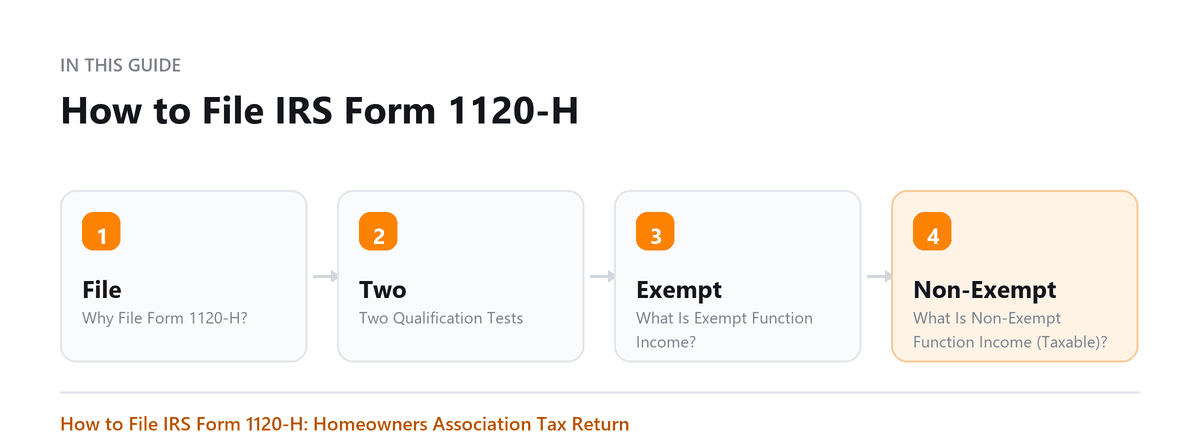
What Is Exempt Function Income?
- Membership dues, assessments, and fees from owners
- Special assessments collected for capital improvements
- Fines and penalties imposed on members
- Move-in/move-out fees charged to owners
What Is Non-Exempt Function Income (Taxable)?
- Interest income on the operating or reserve fund
- Rental income from renting common area facilities to non-members or third parties
- Advertising income (from HOA newsletter, etc.)
- Guest fees if charged to non-members
How to Make the Election
The election is made by simply filing Form 1120-H for the tax year. There is no separate election form. The election is made annually, the association can choose to file Form 1120-H in some years and Form 1120 in others, whichever produces a lower tax liability.
Computing Tax on Form 1120-H
- Enter total gross income on Line 1.
- Subtract exempt function income to get non-exempt function gross income.
- Subtract allowable deductions directly connected to non-exempt income.
- The resulting taxable income is taxed at 30% (or 32% for timeshares).
- Subtract any tax credits (limited, most credits do not apply).
- Net tax is the balance due.
Cannot Carry Losses
A significant limitation of Form 1120-H: the association cannot carry net operating losses (NOLs) to other years. If the non-exempt function activities produce a loss, it simply disappears. This is why some associations prefer Form 1120 in loss years.
Filing Deadline
Form 1120-H is due the 15th day of the 4th month after the tax year ends, April 15 for calendar-year HOAs. A 6-month extension is available via Form 7004, extending the deadline to October 15.
Book a free consultation and we will take the return off your desk.
Frequently Asked Questions
Does every HOA have to file a tax return?
Generally yes. Even if the HOA has minimal non-exempt income, filing is required if the entity is incorporated as a corporation (which most HOAs are). Some small associations organized as non-profit organizations under state law may have different requirements.
Is an HOA's reserve fund interest taxable?
Yes, interest earned on the reserve fund is non-exempt function income and is taxable on Form 1120-H at the applicable flat rate.
Can an HOA that fails the 60%/90% tests fix the issue?
If the HOA fails either test mid-year, it should review whether any reclassification of income or expenses is appropriate. However, retroactive manipulation to meet the tests is not permitted. If the tests are failed, file Form 1120 for that year.
What should an association do before deciding how to file?
Work out how its income actually splits for the year, because the choice depends on facts that change annually. That means classifying each source, not assuming last year's split still holds, and identifying anything unusual such as a one-off receipt or income from non-members. The decision is made for each year rather than once, so the analysis has to be done each year too.
What records support the classification of income?
The governing documents, the budget and the resolutions behind any special assessment, plus the underlying receipts. The question is what each amount was collected for and from whom, and that is established by the association's own paperwork rather than by how it was described in the accounts. Boards that minute the purpose of an assessment when they approve it make this straightforward.

Written by
Ankit Sarawagi, CPA, CA, MBA
Ankit leads the finance team at Profitjets, where he has worked with 500+ businesses across the US on bookkeeping, tax and CFO-level strategy. He writes about the habits that keep small business books accurate all year. Connect on LinkedIn
Free consultation
Want the Filing Handled?
Book a free consultation and we will take the return off your desk.