
Employees who buy shares through a qualifying purchase plan receive this statement, and most of them file it away without reading it.
It matters years later. The figures on it decide how the eventual sale is treated, and brokers routinely report a cost that does not reflect the amount already taxed as pay, which leads employees to count the same amount twice.
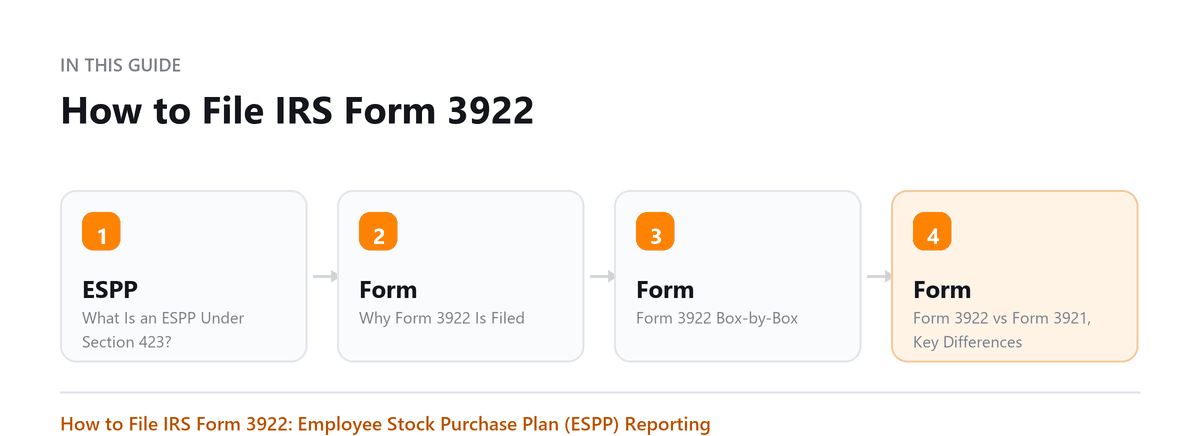
This covers what the plan is, why the statement is issued, what each box reports, how it differs from its companion form, and how the holding period changes the treatment on sale.
Corporations that offer Employee Stock Purchase Plans (ESPPs) under Section 423 must file Form 3922 whenever an employee acquires stock under the plan. Form 3922 is an information return, similar to Form 3921 for ISOs, that gives both the IRS and the employee the data needed to calculate tax on the eventual sale. Here is what every employer needs to know.
What Is an ESPP Under Section 423?
A Section 423 ESPP allows employees to purchase company stock at a discount (up to 15%) using after-tax payroll deductions. The plan offers favorable tax treatment: no income tax at purchase time (unlike non-qualifying ESPPs), with special rules on the eventual sale. The plan must meet specific requirements: all full-time employees must be eligible, and no employee can hold more than 5% of company stock.
Tell employees to keep this. The figures on it decide their position when they eventually sell, which may be years later, and brokers frequently report a cost that does not reflect the amount already treated as pay. Without this statement they will overpay and not know it.
Ankit Sarawagi, CPA, CA, MBA · LinkedInWhy Form 3922 Is Filed
Form 3922 captures the key pricing data the IRS needs to verify that employees correctly report their ESPP income. Without the form, the IRS cannot verify the discount amount or distinguish qualifying from disqualifying dispositions.
Form 3922 Box-by-Box
| Box | Information |
|---|---|
| Box 1, Date option granted | The first day of the offering period |
| Box 2, Date option exercised (share purchase date) | The last day of the offering/purchase period |
| Box 3, FMV per share on grant date | Market price (or lower of grant/purchase date FMV if plan uses lookback) |
| Box 4, FMV per share on exercise date | Market price on the purchase date |
| Box 5, Exercise price paid per share | Actual purchase price (with the discount) |
| Box 6, Number of shares transferred | Total shares purchased |
| Box 7, Date legal title transferred | Date the employee received the shares |
Form 3922 vs Form 3921, Key Differences
| Feature | Form 3921 (ISO) vs Form 3922 (ESPP) |
|---|---|
| Plan type | ISO, Incentive Stock Option | ESPP, Section 423 purchase plan |
| Tax event at exercise/purchase | AMT preference (ISO) | None for qualifying ESPP |
| Discount mechanism | Strike price set at grant | Discount up to 15% from FMV |
| Employee contribution | No (option grants are free) | Yes (after-tax payroll deductions) |
Tax Treatment: Qualifying vs Disqualifying Dispositions
Qualifying Disposition
The employee holds the shares for MORE than 2 years from the grant date AND more than 1 year from the purchase date. In a qualifying disposition:
- The lesser of (a) the actual gain on sale, or (b) the discount at the grant date is ordinary income
- Any remaining gain is long-term capital gain
- No income reported at the time of purchase
Disqualifying Disposition
If the employee sells before satisfying the holding period, the entire discount (FMV at purchase minus purchase price) is ordinary income in the year of sale. The employer may need to include this on the employee's W-2.
Filing Deadlines
| Deadline | Action |
|---|---|
| January 31 | Provide Copy B to the employee |
| February 28 (paper) | File Copy A with the IRS |
| March 31 (e-file) | File Copy A with the IRS electronically |
Common Mistakes
- Confusing the offering period start (grant date) with the purchase date, both dates and FMVs are required
- Not filing a separate 3922 for each purchase period (e.g., two purchase dates per year means two forms per employee)
- Missing the January 31 employee copy deadline
- Failing to track the lookback provision, if the plan offers the lower of grant date or purchase date FMV, you need both prices
Book a free consultation and we will take the return off your desk.
Frequently Asked Questions
Does a private company need to file Form 3922?
Yes, if it offers a qualifying Section 423 ESPP. Private company FMV must be determined by a reasonable method (e.g., 409A valuation).
Do employees owe tax when they purchase shares under an ESPP?
Not for a qualifying Section 423 ESPP at the time of purchase. Tax is recognized only when the shares are sold. The tax treatment depends on the holding period at that point.
What if an employee participates in multiple offering periods in the same year?
A separate Form 3922 is required for each offering period purchase. If an employee participates in two purchase periods in a year, two Form 3922s must be filed for that employee.
Why does this matter years after the shares were bought?
Because it records the figures needed to work out the position when the shares are sold, which may be much later. The treatment on sale depends on how long the shares were held relative to the relevant dates, and those dates are on this statement. An employee who kept it has the answer; one who did not is asking a former employer for records from several years ago.
What do employees most often get wrong on their own returns?
The cost used when they sell. Brokerage statements frequently report a figure that does not reflect the amount already treated as compensation, and using it without adjustment results in the same amount being counted twice. Checking the sale against this statement, rather than accepting the broker's figure, is the single most valuable thing an employee can do with it.

Written by
Ankit Sarawagi, CPA, CA, MBA
Ankit leads the finance team at Profitjets, where he has worked with 500+ businesses across the US on bookkeeping, tax and CFO-level strategy. He writes about the habits that keep small business books accurate all year. Connect on LinkedIn
Free consultation
Want the Filing Handled?
Book a free consultation and we will take the return off your desk.