
Retirement plans carry rules about who may deal with the plan and how it must be funded, and this is the return that reports a breach of them.
Most of the situations behind it were not deliberate. A loan, a property transaction or a payment involving somebody connected to the employer can be a prohibited transaction without anybody intending harm, and the liability can be personal.
This covers who files, the categories the form deals with, how the charge escalates where a breach is not corrected, how the return is completed, and why this does not replace the separate labour department filings.
Most employers who sponsor retirement plans never need to file Form 5330. But when a plan engages in a prohibited transaction, accumulates excess contributions, or fails certain funding requirements, the IRS imposes excise taxes, and Form 5330 is how those taxes are reported and paid. This guide explains when Form 5330 is required, the key excise taxes, and the correction strategies that can reduce or eliminate the liability.
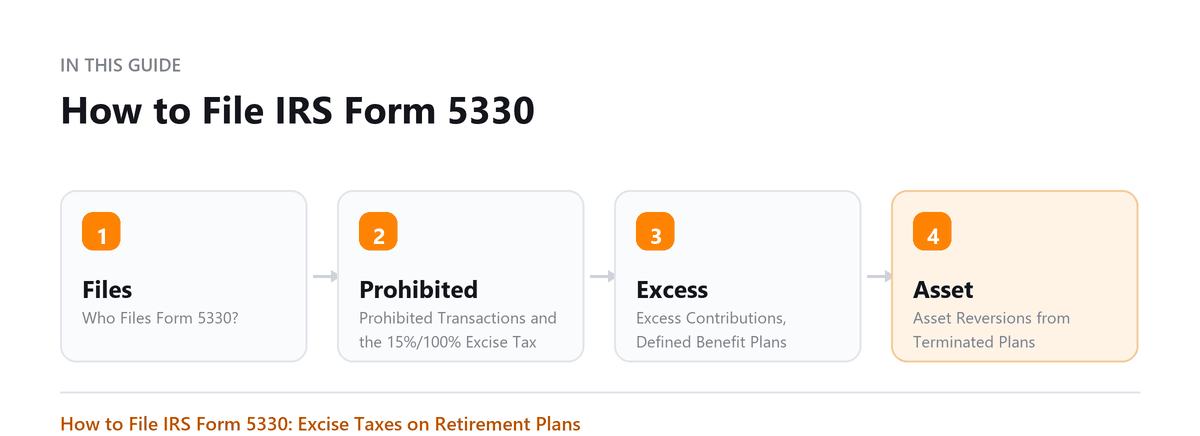
Who Files Form 5330?
Form 5330 is filed by the party responsible for the excise tax, which varies by the tax:
| Excise Tax | Who Files |
|---|---|
| Prohibited transactions (Section 4975) | Disqualified person who engaged in the transaction |
| Excess contributions to defined benefit plans (Section 4972) | Employer |
| Excess annual additions to defined contribution plans (Section 4973) | Employer |
| Reversion of qualified plan assets (Section 4980) | Employer |
| Failure to meet minimum funding standards (Section 4971) | Employer |
Stop before acting. There are correction programmes for most categories of plan failure, and using the right one generally produces a materially better outcome than a well-meant self-correction. Some routes also close once steps have been taken, so take advice first.
Ankit Sarawagi, CPA, CA, MBA · LinkedInProhibited Transactions and the 15%/100% Excise Tax
A prohibited transaction occurs when a plan engages in certain transactions with a disqualified person (employer, fiduciary, plan officer, 50%+ owner, etc.). Prohibited transactions include:
- Sale, exchange, or lease of property between the plan and a disqualified person
- Lending of money to a disqualified person
- Furnishing of goods, services, or facilities between the plan and a disqualified person
- Transfer of plan assets to a disqualified person
- Self-dealing by a fiduciary
The initial excise tax is 15% of the 'amount involved' per year the prohibited transaction remains uncorrected. If the transaction is not corrected within the taxable period, a second-tier tax of 100% of the amount involved applies.
Pro Tip: Correct prohibited transactions promptly under the IRS Voluntary Correction Program (VCP) or the DOL Voluntary Fiduciary Correction Program (VFCP) to avoid the 100% second-tier tax.
Excess Contributions, Defined Benefit Plans
If an employer contributes more to a defined benefit plan than the deductible limit in a year, the excess is subject to a 10% excise tax. The excess contribution is the amount not deductible under Section 404.
Asset Reversions from Terminated Plans
When a qualified plan terminates and excess assets revert to the employer, a 20% excise tax applies to the reversion amount. The tax increases to 50% if the employer does not establish a qualified replacement plan or increase participant benefits within certain parameters.
Minimum Funding Failures
Defined benefit plans and money purchase pension plans must meet minimum funding requirements. If contributions fall short of the required minimum, the shortfall is subject to a 10% excise tax. Waivers are available in cases of temporary substantial business hardship.
How to Complete Form 5330
- Identify which excise tax(es) apply (Form 5330 covers multiple excise taxes on separate schedules).
- For each applicable tax, complete the relevant section and compute the tax.
- Total the excise taxes on the summary section.
- Apply any allowable credits or reductions.
- Sign and date the return.
Filing Deadline
Form 5330 is generally due by the last day of the 7th month following the end of the plan year for which the tax applies. A 6-month extension is available (Form 5558 for extension of time).
Form 5330 Is Not a Substitute for DOL Filings
Many prohibited transactions and plan failures also have reporting requirements with the Department of Labor (DOL). The Form 5500 series and any corrective filings under VFCP are separate from the Form 5330. Both filing tracks must be addressed.
Book a free consultation and we will take the return off your desk.
Frequently Asked Questions
Can we avoid the 100% tax if we correct the prohibited transaction after the initial tax is assessed?
Yes. If the prohibited transaction is corrected before the second-tier tax is assessed (generally, before a notice of deficiency is issued), the IRS can abate the second-tier tax. Correction must be made by reversing the transaction and restoring the plan to the position it would have been in had the prohibited transaction not occurred.
Who is a disqualified person?
Disqualified persons include: the employer and any related organization, plan trustees and administrators, officers and directors who have 10%+ authority, 50%+ shareholders/partners, employees earning more than $150,000 (certain plans), family members of the above, and entities owned by the above.
What if we discover the prohibited transaction years later?
The 15% excise tax applies for each year the prohibited transaction continues uncorrected. A late discovery could result in substantial accumulated taxes. Working with a plan attorney to determine the correction date and tax exposure is critical.
What should be done first on discovering a problem with a plan?
Stop, document the facts, and take advice before acting, because the correction route affects the outcome and some routes close once steps are taken. Correction programmes exist for several categories of plan failure, and using the right one generally produces a materially better result than self-correcting in an ad hoc way. Both the tax authority and the labour department may have an interest, and they are separate processes.
Who is actually liable here?
The person or entity that engaged in the transaction, which is often an individual rather than the plan or the employer. That personal exposure is the part most often misunderstood by trustees and owners who assumed the obligation sat with the plan. It is also why arrangements involving the plan and anyone connected with the employer deserve a check before they happen rather than afterwards.

Written by
Ankit Sarawagi, CPA, CA, MBA
Ankit leads the finance team at Profitjets, where he has worked with 500+ businesses across the US on bookkeeping, tax and CFO-level strategy. He writes about the habits that keep small business books accurate all year. Connect on LinkedIn
Free consultation
Want the Filing Handled?
Book a free consultation and we will take the return off your desk.