
This is the form for losses from casualty and theft, and the rules around it changed materially for personal losses, which is why guidance written some years ago can be confidently out of date.
Claims here are examined closely. What decides them is usually the evidence of value before and after, of what the property cost, and of what was recovered from insurance or anywhere else.
This covers what qualifies, how personal and business losses are treated differently, how the loss is calculated, how theft losses work, and where the result goes on the return.
What Is Form 4684?
IRS Form 4684, Casualties and Thefts, is used to report and calculate losses from sudden, unexpected, or unusual events such as fires, floods, earthquakes, storms, accidents, and thefts. The form determines how much of your loss, if any, is deductible on your tax return.
Claims of this kind are examined closely, and they are won or lost on evidence gathered while the facts were fresh: photographs, estimates, the incident report and the insurer's correspondence. Collect it in the weeks after, not in the months before filing.
Ankit Sarawagi, CPA, CA, MBA · LinkedInMajor Change After TCJA 2017: Federal Disaster Requirement
Before the Tax Cuts and Jobs Act of 2017, individuals could deduct personal casualty and theft losses from any event. Under TCJA, for tax years 2018 through 2025:
- Personal casualty and theft losses are only deductible if they occur in a federally declared disaster area.
- Business property and income-producing property losses (Section B) are NOT subject to this restriction, they remain deductible regardless of federal disaster declaration.
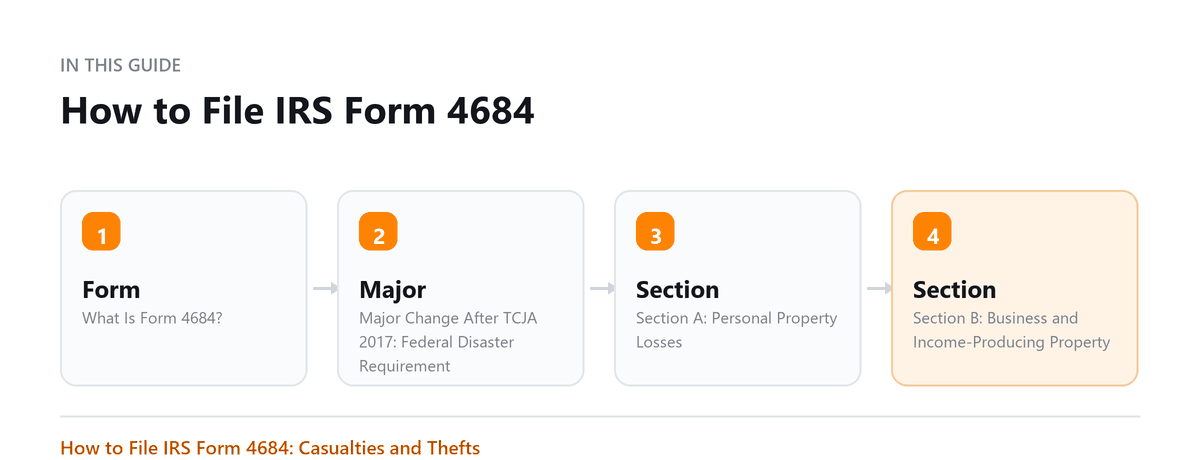
Section A: Personal Property Losses
Section A of Form 4684 covers losses to personal property (your home, car, personal belongings). Steps:
- Enter the FMV of the property immediately BEFORE the casualty/theft.
- Enter the FMV of the property immediately AFTER the casualty/theft.
- Calculate the decrease in FMV (before minus after).
- Take the LOWER of: decrease in FMV or adjusted basis of the property.
- Subtract insurance reimbursements and other compensation received or expected.
- Subtract the $100 floor per casualty event.
- Total all Section A losses, then subtract 10% of your AGI.
- The remainder (if positive) is your deductible personal casualty loss.
Section B: Business and Income-Producing Property
Section B covers property used in a trade or business or held for income production (rental property, investment property). Key differences:
- No $100 floor per event.
- No 10% AGI limitation.
- Losses may be fully deductible as business losses.
- Business casualty losses from Section B flow to Form 4797 (if depreciable property).
- Not subject to the federally declared disaster requirement.
Calculating the Loss Amount
The formula for the loss amount (before the $100 floor and AGI limitation):
Loss = Lesser of (FMV Before - FMV After) or Adjusted Basis - Insurance Proceeds - Other Reimbursements
FMV Determination
Fair market value must be established. The IRS accepts:
- Appraisals by qualified appraisers.
- Cost of repairs as evidence of decline in FMV (if repairs restore the property to pre-casualty condition and do not increase value).
- Insurance company assessments.
- Comparable sales in the area for real property.
Theft Losses
Theft losses follow the same calculation but with important timing rules:
- The theft must actually be a crime under the law of the state where it occurred.
- Theft losses are deducted in the year the theft is DISCOVERED, not the year of the crime.
- If there is a reasonable expectation of reimbursement (insurance claim pending), deduct only in the year when recovery becomes certain that reimbursement is not coming.
Where the Loss Goes
| Type of Loss | Where It Flows |
|---|---|
| Personal casualty loss (Section A) | Schedule A, itemized deductions (after $100 floor and 10% AGI limit) |
| Business property loss (Section B) | Form 4797 (if depreciable) or Schedule C/E as appropriate |
| Income-producing property (Section B) | Schedule A as a miscellaneous deduction (without 2% AGI floor) or Form 4797 |
Federally Declared Disasters: Special Rules
- If your loss occurs in a federally declared disaster area, you can elect to deduct the loss in the PRIOR year (by amending that return), which may accelerate your refund.
- Look up the FEMA disaster declaration number, you may need to enter it on Form 4684.
- Some disasters have special IRS relief provisions (extended deadlines, enhanced deductions).
Book a free consultation and we will take the return off your desk.
Frequently Asked Questions
My car was totaled in an accident. Can I deduct the loss?
If the accident occurred in a federally declared disaster area, yes (for personal-use vehicles). Otherwise, post-TCJA, personal vehicle losses are not deductible unless in a declared disaster. If the vehicle was used for business, Section B rules apply.
A tree fell on my home during a hurricane. The insurance paid most of it. What can I deduct?
If the hurricane was a federally declared disaster, you can deduct the uninsured portion, subject to the $100 floor and 10% AGI limitation. Subtract everything insurance paid or will pay.
Someone stole equipment from my business. Is that deductible?
Yes. Business theft losses are deductible in Section B without the federal disaster requirement. You deduct the theft in the year discovered.
What is a Ponzi scheme loss under Form 4684?
The IRS provides a safe harbor for victims of Ponzi schemes to claim theft losses (Revenue Procedure 2009-20). There are specific calculations and elections. A tax professional should assist with this.
What evidence supports a claim of this kind?
Proof of what the property was worth before, what it was worth afterwards, what it originally cost, and what was recovered from insurance or anyone else. Photographs, appraisals, repair estimates, police or incident reports and the insurer's correspondence all contribute. Because claims of this type are examined closely, contemporaneous evidence assembled while the facts are fresh is considerably stronger than a reconstruction.

Written by
Ankit Sarawagi, CPA, CA, MBA
Ankit leads the finance team at Profitjets, where he has worked with 500+ businesses across the US on bookkeeping, tax and CFO-level strategy. He writes about the habits that keep small business books accurate all year. Connect on LinkedIn
Free consultation
Want the Filing Handled?
Book a free consultation and we will take the return off your desk.