
Years go unfiled for ordinary reasons: a difficult period, a business that collapsed, records that were never kept. The gap then becomes its own obstacle, because starting feels impossible.
Filing late is almost always better than not filing, including where the money is not there to pay. The consequences of failing to file and of failing to pay are separate, and the first is generally harsher.
This covers why to file anyway, how to recover documents for years you no longer have records for, which year to start with, why the right year's forms matter, and what to do about the balance owed.
Why You Should File Late Returns Even If You Cannot Pay
Many people avoid filing because they know they owe money and cannot pay. This is the wrong strategy. The failure-to-file penalty (5% per month, max 25%) is 10 times larger than the failure-to-pay penalty (0.5% per month). Filing without paying stops the larger penalty.
Start from the earliest year and work forwards, and start from the transcripts rather than concluding the records are gone. They show what third parties reported about you, which gives you a skeleton to build on, and banks will usually supply statements you can no longer download.
Ankit Sarawagi, CPA, CA, MBA · LinkedInIf You Are Owed a Refund: File Quickly
If the IRS owes you money, there is a 3-year rule on refunds. If you do not file within 3 years of the original due date, you forfeit the refund permanently. The money goes to the US Treasury.
Example: For tax year 2021 (due April 18, 2022), you had until April 18, 2025 to claim a refund. After that date, any refund owed for 2021 is gone.
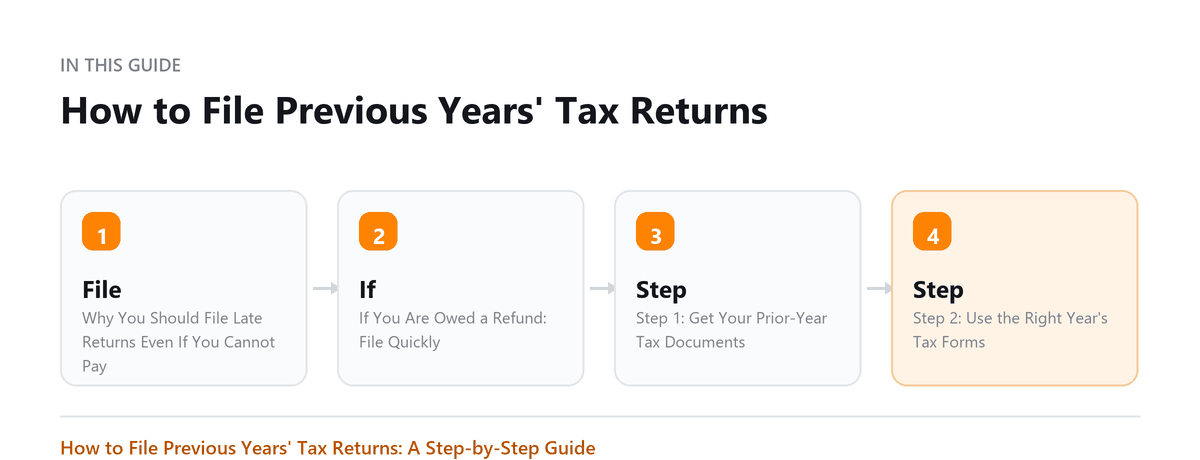
Step 1: Get Your Prior-Year Tax Documents
IRS Transcript
Order a Wage and Income transcript for free from IRS.gov. This shows all income reported to the IRS (W-2s, 1099s, etc.) for prior years. Available online through IRS.gov/individuals or by calling 800-908-9946.
Form 4506-T
To request a copy of a previously filed return, use Form 4506-T. The IRS can provide transcripts for returns filed in the last 3 years.
W-2 from Social Security Administration
For older years, the SSA can provide earnings records. Submit Form SSA-7050-F4 (Request for Social Security Earnings Information). A fee applies.
Contact Former Employers
Employers are required to keep payroll records for several years. Contact HR or payroll departments directly for copies of W-2s.
Step 2: Use the Right Year's Tax Forms
You must use the tax forms for the year you are filing, not the current year's forms. Tax law changes year to year.
- Download prior-year forms from IRS.gov/forms-pubs
- Most tax software (TurboTax, TaxAct, H&R Block) supports filing 2-3 prior years
- For older years, you may need a professional or paper forms
Step 3: Complete and Mail the Return
Prior-year returns generally cannot be e-filed after 2-3 years. You must print, sign, and mail the return to the appropriate IRS address (listed in the instructions for that year's Form 1040).
Step 4: File State Returns Too
If your state has an income tax, you likely have a prior-year state filing obligation as well. File state returns separately using the prior-year state forms.
Free Filing Resources
VITA (Volunteer Income Tax Assistance)
VITA offers free tax preparation for people who generally make $67,000 or less, persons with disabilities, and limited English-speaking taxpayers. VITA sites can often help with prior-year returns.
IRS Free File Fillable Forms
Available for current-year returns only. For prior years, you must use paid software or a professional.
If You Owe Tax: Payment Options
- Pay in full: stops all future interest and penalties
- Installment Agreement: monthly payment plan (apply online at IRS.gov or file Form 9465)
- Offer in Compromise: settle for less than owed (strict eligibility requirements)
- Currently Not Collectible status: temporary relief if you cannot pay anything
Pro Tip: File all unfiled returns before applying for an installment agreement. The IRS generally will not accept a payment plan until all required returns are filed.
Book a free consultation and we will take the return off your desk.
Frequently Asked Questions
Can I e-file prior-year returns?
For recent years (typically current year minus 2), most software supports e-filing. Older years require paper filing.
What happens if I just ignore years I have not filed?
The IRS can file a Substitute for Return (SFR) on your behalf using the income information it has. SFRs do not include deductions, so the tax assessment will almost certainly be higher than if you filed yourself. The IRS can then begin collection actions including levies and liens.
How many years back can the IRS go to collect?
The IRS has 10 years from the date of assessment to collect a tax debt. If a return was never filed, the 10-year clock never starts.
Where do we start if we do not have the records for those years?
With the transcripts the tax authority can provide, which typically show what third parties reported about you: wages, other income and certain payments. That gives a skeleton to build on. Bank statements for the period fill in much of the rest, and banks can usually supply older statements even if you cannot download them. Start there rather than concluding that the years cannot be filed.
Which year should be filed first?
The earliest, and then forward in order. Figures carry between years, so preparing them out of sequence produces returns that contradict each other and have to be amended. Filing forwards also means each year's carried amounts are settled before the next one relies on them, which is the difference between one exercise and several.

Written by
Ankit Sarawagi, CPA, CA, MBA
Ankit leads the finance team at Profitjets, where he has worked with 500+ businesses across the US on bookkeeping, tax and CFO-level strategy. He writes about the habits that keep small business books accurate all year. Connect on LinkedIn
Free consultation
Want the Filing Handled?
Book a free consultation and we will take the return off your desk.