
Several relief programmes from the pandemic period are still generating correspondence, refunds and enquiries years after the events they related to.
They were introduced quickly and promoted heavily, in some cases by firms whose interest was the fee rather than the accuracy of the claim. The review now lands on the business, not on whoever prepared it.
This covers the main programmes and who they were for, how to check where a claim stands, what documentation a claim of that age rests on, and what to do if a claim you made now looks wrong.
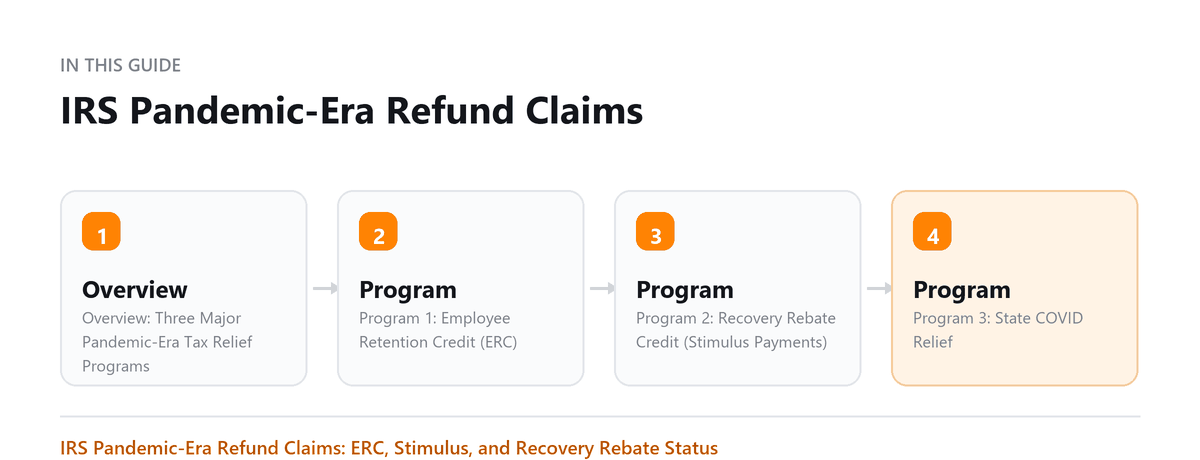
Overview: Three Major Pandemic-Era Tax Relief Programs
The COVID-19 pandemic generated three major IRS refund/credit programs that continue to affect businesses and individuals years later: the Employee Retention Credit (ERC), the Recovery Rebate Credit (stimulus checks), and state COVID relief programs.
Claims from that period are being reviewed years later, and the review lands on the business rather than on whoever prepared the claim. If you made one, find out now whether you still hold the working papers behind it. If you do not, reconstruct them while the underlying records exist.
Anu Gupta, CA, EA, B.Tech · LinkedInProgram 1: Employee Retention Credit (ERC)
What Is the ERC?
The ERC was a refundable payroll tax credit for employers who kept workers on payroll during COVID-19 disruptions in 2020 and 2021. Businesses claimed it via amended payroll tax returns (Form 941-X).
ERC Amounts
| Year | Maximum Credit per Employee |
|---|---|
| 2020 | 50% of up to $10,000 wages = $5,000 per employee per year |
| Q1-Q3 2021 | 70% of up to $10,000 wages per quarter = $7,000 per employee per quarter |
| Q4 2021 (Recovery Startup Businesses only) | $50,000 total |
IRS Moratorium and Fraud Concerns
Due to widespread abuse and fraudulent claims (often promoted by aggressive third-party 'ERC mills'), the IRS paused processing new ERC claims in September 2023.
- IRS processing backlog: hundreds of thousands of pending Form 941-X claims
- ERC Withdrawal Program: allows employers who filed erroneous claims to withdraw before receiving payment
- ERC Voluntary Disclosure Program: allows employers who received erroneous payments to repay at a reduced rate
How to Check ERC Claim Status
- IRS Online Account: log in to view transcript for your payroll tax account
- IRS ERC eligibility checklist: available at IRS.gov/erc
- Contact the IRS Practitioner Priority Line if you have a professional representative
Program 2: Recovery Rebate Credit (Stimulus Payments)
Three rounds of Economic Impact Payments went out in 2020 and 2021. If you did not receive your full payment, you could claim the Recovery Rebate Credit:
| Round | Max Per Person / Where to Claim |
|---|---|
| Round 1 (2020, CARES Act) | $1,200 / Claimed on 2020 Form 1040, Line 30 |
| Round 2 (2020, Consolidated Appropriations Act) | $600 / Claimed on 2020 Form 1040, Line 30 |
| Round 3 (2021, American Rescue Plan) | $1,400 / Claimed on 2021 Form 1040, Line 30 |
Program 3: State COVID Relief
Many states provided their own COVID relief grants, rebates, and payments. Tax treatment varies:
- Some state COVID grants to businesses were taxable at federal level
- Some states provided income tax rebates that may or may not be taxable federally
- IRS issued guidance in 2023 clarifying that many state rebates are not federally taxable
Why These Claims Are Still Being Examined
Programmes of this kind were introduced quickly, promoted heavily and, in several cases, marketed by firms whose interest was the fee rather than the accuracy of the claim. The consequence is that claims from this period are being reviewed years afterwards, and the review lands on the business rather than on whoever prepared the claim.
Two situations account for most of the difficulty. The first is a claim prepared on facts that were never properly established, typically an eligibility condition asserted rather than evidenced. The second is a claim prepared by a firm that has since become uncontactable, leaving the business with a refund it cannot support and no working papers.
If a claim was made, the useful step now is to establish whether you hold the file behind it: the calculation, the eligibility evidence, and the records it was built from. If you do, a review is an inconvenience. If you do not, it is worth reconstructing while the underlying records still exist rather than waiting to be asked.
- Locate the working papers behind any claim made, and store them with the year's file
- Check whether the preparer is still contactable and obtain anything they hold while you can
- Take advice before responding to any enquiry, since the response shapes what follows
- Where a claim now looks wrong, ask about the correction routes currently available rather than waiting
Book a free consultation and we will take the return off your desk.
Frequently Asked Questions
I received an ERC refund. Is it taxable?
Yes. ERC refunds reduce your deductible wage expenses in the year the credit applies (not the year you receive the refund). This means you may need to file amended returns for 2020 or 2021 to reduce wage deductions.
I got a letter from the IRS questioning my ERC claim. What do I do?
Do not ignore IRS letters. Respond by the deadline stated in the notice. If you used an ERC promoter who may have made an unsupported claim, consult a CPA or tax attorney immediately. The IRS is actively pursuing improper ERC claims.
Is there still time to file an ERC claim?
Congress proposed legislation in 2024 to end ERC claims early. The statutory window was originally 3 years from the 941 due date. Check IRS.gov for current eligibility and any legislative changes.
What documentation supports a claim from that period?
The records as they stood at the time: payroll records for the relevant periods, the calculations behind the claim, and evidence of whatever condition the claim relied on, such as the government order or the revenue comparison. Claims from this period are being examined years after the event, so a file assembled then is worth far more than an explanation constructed now.
What should we do if we think a claim we made was wrong?
Take advice and correct it deliberately rather than waiting. There have been specific routes for withdrawing or correcting claims from this period, and using an available route voluntarily generally produces a better outcome than being reassessed. Because these programmes and their deadlines have changed repeatedly, check what is currently available before deciding how to proceed.

Written by
Anu Gupta, CA, EA, B.Tech
Anu works with US businesses on tax and entity questions at Profitjets, from choosing a structure to the filings that follow it. She writes about the decisions owners make once and then live with for years. Connect on LinkedIn
Free consultation
Want the Filing Handled?
Book a free consultation and we will take the return off your desk.