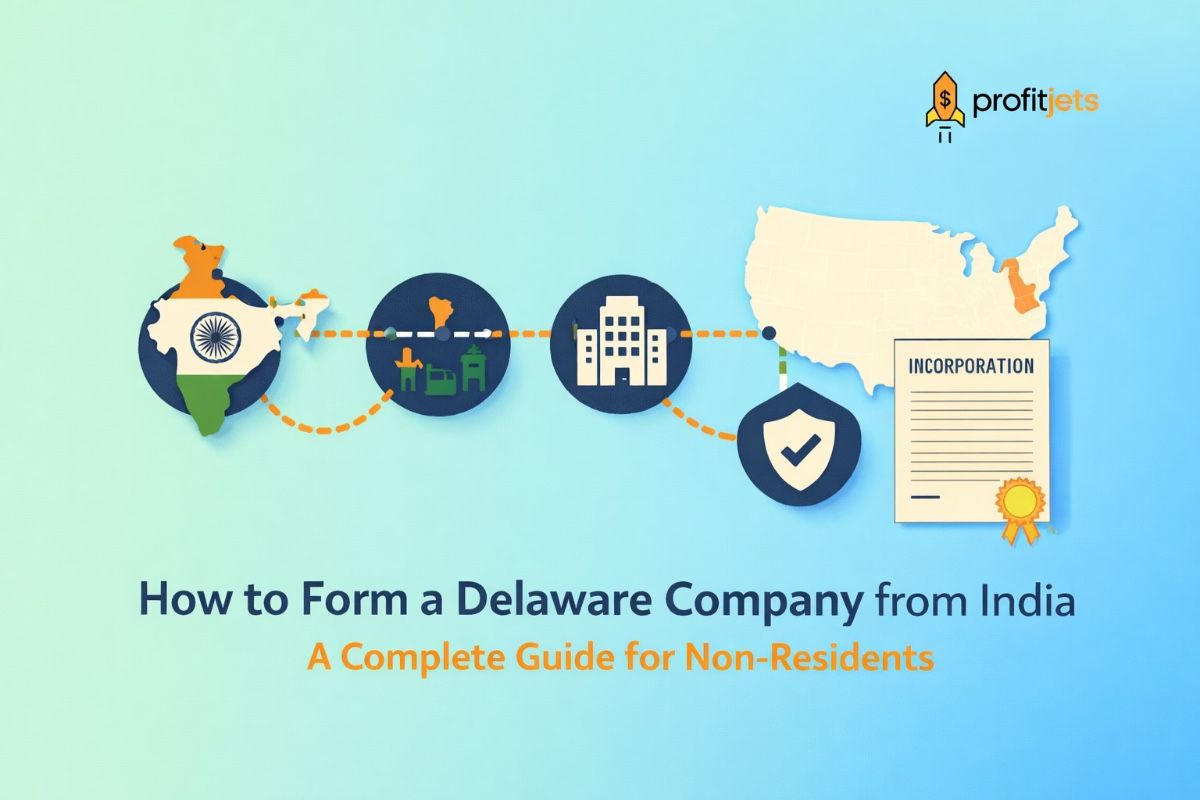
The United States of America remains a top destination for Indian entrepreneurs and early-stage startups seeking global growth. As one recent Profitjets analysis notes, “the USA is one of the most attractive destinations for Indian entrepreneurs looking to expand globally,” thanks to its large consumer market and investor-friendly policies. Incorporating a U.S. company often unlocks easier access to American funding sources and adds instant credibility with international clients. Among U.S. jurisdictions, Delaware stands out as the preferred state for foreign founders. This guide explains why Delaware is so popular with non-residents, outlines the legal steps and compliance for forming a Delaware company, and shows how Profitjets US business services can help you at every stage. Profitjets is a full-service accounting and advisory firm that assists clients with business incorporation and structuring, ongoing compliance and reporting, accounting and bookkeeping, tax filing for foreign-owned U.S. companies, and investor readiness with financial systems. Additionally, this guide will help you understand how to Form a Delaware Company from India.
Benefits of Incorporating in Delaware for Foreigners
Delaware enjoys an “established legal framework” and highly regarded courts that benefit any corporation, whether owned by U.S. citizens or foreign entrepreneurs. It is home to the Delaware Court of Chancery, a specialized business court known for resolving disputes quickly and predictably. These courts interpret Delaware’s well-developed General Corporation Law, providing clarity and flexibility for company governance. As a result, many Fortune 500 companies are Delaware-incorporated – over 60% of the Fortune 500 call Delaware their legal home. This reputation encourages investors and lenders to view Delaware entities as stable and credible.
Delaware offers significant tax and regulatory advantages that particularly benefit non-residents. It imposes no state corporate income tax on corporations that earn income outside Delaware. In addition, Delaware has no sales tax at the state level. Instead, Delaware levies an annual franchise tax, but even this can be minimized for most new companies by choosing the simple calculation method. These policies mean a Delaware company conducting business beyond state borders can often save on state taxes. (For example, an out-of-state limited liability company simply pays a flat $300 franchise tax each year, and Delaware corporations can often use the low Assumed Par Value Capital method.) Many startups appreciate that Delaware’s tax system is equitable and designed to grow with the company.
Privacy and flexibility are additional perks. Delaware does not require public disclosure of company owners or managers in formation documents. Business owners remain anonymous in the public filings, which can be attractive for privacy-conscious founders. Delaware also allows one person to fill multiple roles: a sole founder can be the sole director, officer, and shareholder or member. This means a solo entrepreneur or small team can operate an entire Delaware corporation or LLC with minimal bureaucracy. Compared to many other states (and many countries), this streamlined governance is a clear benefit.
Crucially for international entrepreneurs, Delaware imposes no residency or citizenship requirements for owners, directors, officers, or LLC members. Non-U.S. individuals may freely serve as corporate directors or LLC managers. Delaware also has no minimum age restrictions for owners. In short, foreigners have full legal control of their Delaware companies without needing to move to the U.S. Harvard Business Services – a Delaware formation specialist – confirms, “the State of Delaware permits foreigners… to act as officers [and directors] of a Delaware Corporation or members of a Delaware LLC” with almost no restrictions on citizenship. Profitjets and other service providers simply handle the paperwork.
Delaware’s business-friendly policies attract U.S. investors as well. Venture capitalists and angel investors almost universally prefer funding Delaware companies. Many funding rounds and accelerator programs require a Delaware C-Corp for legal clarity and tax reasons. Indeed, Delaware regularly tops incorporation charts: in 2024, Delaware had roughly 2 million active domestic business entities registered, making it the premier state for company formation. All of these factors – legal stability, tax advantages, privacy, and investor confidence – make the benefits of incorporating in Delaware for foreigners abundantly clear.
Finally, Delaware offers speed and convenience of formation. The state division of corporations processes filings quickly, often within a few business days or even hours with expedited service. Non-residents can complete the entire formation remotely, without traveling to Delaware, and without a Social Security Number. In short, Delaware sets the stage for international founders to launch and grow a U.S. company easily.

Delaware Company Formation Process for Non-Residents
Foreign entrepreneurs can follow a clear set of steps to register their Delaware company. The process is straightforward and can be done fully online. Here is an overview of the key steps in Delaware company formation for non-residents:
- Choose a Business Structure. Most non-U.S. founders form a Delaware Limited Liability Company (LLC), because it is simple and flexible. An LLC provides pass-through taxation and minimal formalities (no mandatory board meetings, for example). Corporations (C-Corps) are also an option – a Delaware C-Corp can be beneficial if you plan to raise venture funding or offer stock. An experienced advisor can help assess which structure fits your goals. As one guide notes, “usually, an LLC… hits the sweet spot for most non-U.S. residents” because it is easier to manage from abroad. However, if you aim to scale quickly or attract institutional investors, a Delaware C-Corp may be more suitable in the long run.
- Reserve a Company Name. Before filing, verify that your desired business name is available in Delaware. The name must be unique and include the appropriate suffix – “LLC” for a limited liability company, or “Inc.” (or similar) for a corporation. Certain words like “bank” or “insurance” are restricted and require approval. (For example, “MyStartup LLC” might be fine, but “MyStartup Bank” would be prohibited.) You can optionally reserve the name with the Delaware Secretary of State before filing, which holds it for 120 days for a small fee.
- Appoint a Delaware Registered Agent. Delaware law mandates that every company have a Registered Agent with a physical street address in Delaware. This agent accepts official mail and legal notices on the company’s behalf. A P.O. box is not allowed. Non-residents cannot serve as their own agent, so most foreign founders hire a professional registered agent service. These firms not only provide the required address, but also keep track of compliance deadlines and forward important documents. As one guide explains, non-resident founders “must hire a professional service” since a Delaware address and continuous availability during business hours are mandatory. These formation services also often include mail forwarding or virtual office support, which helps build a local presence without complicated logistics.
- File Formation Documents. With an agent in place, you file the formal incorporation papers with Delaware. For an LLC, this is called the Certificate of Formation; for a corporation, it’s the Certificate of Incorporation. The documents require the company name, registered agent details, and sometimes a business purpose or stock structure. You can file online or by mail. Typically, Delaware processes new filings in 3–5 business days, but expedited (even same-day) service is available for a fee. In practice, an international formation service handles this seamlessly – providing you a certified Certificate of Formation by email within a week, as one provider notes. Once Delaware approves the documents, your company legally exists.
- Obtain an Employer Identification Number (EIN). After formation, you apply to the U.S. Internal Revenue Service for an EIN (tax ID). This is needed to open bank accounts and handle payroll or vendor payments. Non-U.S. founders can get an EIN from abroad by filing IRS Form SS-4 or through an authorized third party. Many formation packages include EIN registration. As Harvard Business Services explains, they can “help you obtain a Federal Tax ID Number (EIN)” as part of the formation process. You typically receive the EIN by email in a few days.
- Open a U.S. Business Bank Account. To fully operationalize the company, a U.S. bank account is essential. Banks often require the company’s formation documents, EIN, and photo IDs of the signers. For international founders, a common hurdle is that many U.S. banks require an in-person visit to open an account. One solution is to appoint a U.S.-based officer (who already has banking relationships) to open and manage the account. Another approach is to use modern financial platforms: digital banks like Mercury, Wise, or Relay allow non-resident entrepreneurs to apply online with video verification. These fintech options make banking accessible from abroad (though they are not FDIC banks, so review their services). In any case, it is wise to plan the banking step early and choose a partner suited to international use.
With those steps completed, your Delaware company is officially up and running. It’s important to note that you did not need a U.S. visa, social security number, or physical address in America to incorporate. U.S. law requires only a registered agent; everything can be managed remotely. Inkle, a compliance platform, confirms: “Registering a company in the United States from India doesn’t require a U.S. mailing address, and you aren’t obligated to be a U.S. resident or visa holder.” Similarly, Profitjets notes that entrepreneurs can “register a Delaware C corp identical to that for U.S. residents.” In short, foreign founders have a smooth path to form a Delaware LLC or corporation from India or anywhere in the world. The entire process can often be completed in days or weeks, especially with expert assistance.
Special Considerations for Indian Entrepreneurs
Indian founders enjoy the same Delaware benefits, but should be mindful of a few additional rules under Indian law. Forming a U.S. entity from India is treated as an Overseas Direct Investment (ODI) under India’s Foreign Exchange Management Act (FEMA). This means the Reserve Bank of India (RBI) requires certain compliance if you transfer investment from India into the U.S. company. In practice, Indian founders should route any initial capital through an RBI-authorized dealer (AD) bank and file Form FC-1 before transferring funds. You must also report the foreign investment annually. Many founders work around these formalities by funding the U.S. company from non-Indian accounts or by keeping initial contributions minimal. However, ignorance of ODI rules can create problems later, especially if you repatriate profits or take dividends. Entity Inc. cautions that “non-reporting could create issues later,” especially for repatriation, even if funds never physically moved out of India. In short, it pays to consult with an Indian accountant on FEMA compliance and to properly document any equity infusion or loans.
On the flip side, a U.S. company can simplify global operations. Indian founders can open a U.S. business bank account (often through NRI-friendly accounts like NRE/NRO) and transact in dollars. Platforms like Stripe or PayPal work more smoothly with a U.S. entity. The right account structure in India (for example, using NRE accounts) also makes repatriating profits tax-efficient. The U.S.-India tax treaty further reduces double taxation. Just be prepared to report your U.S. ownership in India’s income tax return. In fact, Indian tax law requires that you disclose a foreign company under Schedule FA and any foreign bank accounts in your tax filings. If your foreign assets (including the U.S. company) exceed INR 50 lakh, additional disclosures under the Black Money Act apply.
In summary, you are free to form and own a Delaware company while based in India, but you must follow RBI’s ODI procedure if sending Indian rupees abroad. Importantly, you do not need a special RBI “permission” just to start the company itself. Non-resident Indians typically comply by filing Form FC and routing any required funds through their bank’s Foreign Investment branch. If you avoid putting rupees into the company (for example, use foreign capital or loans), you may legally skip some filings, but it is safer to consult a professional. Profitjets recommends partnering with financial experts who understand both U.S. and Indian regulations, so you can form your Delaware company in full compliance on both sides of the globe.
Ongoing Compliance, Taxes, and Reporting
Forming the company is just the beginning. Delaware companies (even those without U.S. residents) have ongoing compliance duties:
- Registered Agent Maintenance. Delaware law requires your company to keep the registered agent appointment in force at all times. The agent’s annual fee is typically modest, but non-payment can cause administrative dissolution of the company.
- Annual Franchise Tax and Reports. Every Delaware entity must pay franchise tax to the state each year. For an LLC, this is a flat fee (currently $300). Delaware corporations pay tax based on authorized shares or capital (minimum $175, but often $300 if using the assumption method). Additionally, Delaware corporations (but not LLCs) must file an Annual Report each year. Missing either the franchise tax payment or required filings can lead to penalties or loss of good standing.
- Federal Tax Filings. At the U.S. federal level, tax obligations differ by entity type. A Delaware LLC with foreign owners is typically treated as a “pass-through” entity: the LLC itself pays no U.S. tax, but members must report any U.S.-source profits on their own tax returns. A Delaware C-Corporation, by contrast, is taxed on its worldwide income at the corporate rate, and then shareholders pay dividends tax on distributions. Non-resident owners cannot elect S-Corporation status, so foreign-owned U.S. companies will generally be taxed under the standard rules for an LLC or C-Corp.
Importantly, even if the company has no income, U.S. filings are still required. For example, a single-member LLC owned by a non-U.S. individual is treated as a disregarded entity, but U.S. law requires it to file Form 5472 and a pro forma 1120 tax return each year. Failure to file can incur a steep penalty (e.g. $25,000 per violation). On the Indian side, you must list the U.S. company and any U.S. bank accounts in your income tax return Schedule FA. Any dividends or salaries sent to you will need to be declared, and foreign tax credits may apply. Profitjets ensures clients stay on top of these rules, avoiding surprises at tax time.
- Bookkeeping and Accounting. Accurate books are essential. U.S. tax laws are strict, and even small errors can lead to penalties. For Indian founders, bookkeeping spans USD and INR transactions, so good record-keeping is doubly important. In practice, many entrepreneurs engage a professional accounting service. Outsourcing bookkeeping is cost-effective for startups: it avoids hiring an in-house team, and provides expert support on U.S. rules. As one advisory firm notes, outsourced accounting helps avoid IRS audits and double-taxation risks while allowing founders to focus on growth. Profitjets, for instance, handles US bookkeeping on cloud platforms like QuickBooks or Xero, ensuring books are audit-ready.
- Financial Systems & Investor Readiness. Having organized financial statements, dashboards, and forecasts is vital for fundraising. Outsourced accounting firms help prepare investor-ready financials. They ensure GAAP-compliant reports and set up data rooms for due diligence. Profitjets guides founders in implementing the right systems – for example, integrating QuickBooks with reporting tools – so you can monitor burn rate, cash flow, and key metrics (LTV, CAC, churn, etc.) from day one. This establishes credibility with potential investors and supports smarter decision-making.
In short, ongoing Delaware compliance and U.S. tax reporting can be complex for foreign-owned companies. A trusted advisor is essential. Profitjets’ clients benefit from comprehensive compliance monitoring: we pay your Delaware franchise tax and file reports on schedule, prepare and file required U.S. tax forms (like 5472/1120), and help coordinate your Indian tax disclosures. By partnering with experts, founders avoid costly mistakes and keep their Delaware company in good standing.
How to Start a U.S. Company from India
For Indian entrepreneurs, the path to a Delaware company has been smoothed by modern technology and services. You do not need to travel to the U.S. to complete registration. Using an experienced agent, the process can be done entirely online. Here is a quick summary of how to start a U.S. company from India:
- Select a State (Delaware). Many Indians opt for Delaware or Wyoming for easy registration and tax-friendliness. Delaware, in particular, is favored for its court system and low taxes.
- Reserve & File with Agent. Pick a name, appoint a Delaware registered agent, and file your LLC or corporation documents through their platform.
- Get Your EIN. Apply for an Employer Identification Number with the IRS. Agencies or service providers can assist remotely with Form SS-4.
- Open a US Bank Account. Use U.S. fintech banks (Mercury, Wise, etc.) or work with an American partner to open an account without traveling.
- Set Up Operations. Register with payment processors like Stripe and PayPal under your new company, start invoicing clients in USD, and implement accounting software.
This whole sequence can often be done in weeks instead of months. As one expert explains, the company formation, address, EIN, bank account, and even payment platforms can all be set up remotely. Profitjets, for example, can “manage all of this in one place,” from formation filings through post-launch bookkeeping and tax preparation. Thanks to such services, you can go from Indian entrepreneur to Delaware LLC owner with minimal hassle.
Throughout this, remember that FEMA/ODI compliance in India still applies, but it does not block you from forming the company. You won’t require RBI “permission” to incorporate abroad; you simply must follow the ODI route if you inject capital from India. Profitjets’ Indian accounting network can coordinate with you on these filings. Many clients fund their U.S. startup from funds already abroad or through NRE accounts to simplify things. In all cases, clear documentation of transactions keeps both U.S. and Indian regulators satisfied.
Profitjets US Business Services: Supporting Your Success
Profitjets is here to guide non-resident entrepreneurs through every stage of Delaware company formation and growth. Our US business services are designed for founders like you. We offer:
- Business Incorporation and Structuring: We help you choose the right entity (LLC vs. C-Corp), file your formation documents with Delaware, and obtain your EIN quickly. With Profitjets, you get a Delaware Registered Agent and certified company papers in just days. We handle all paperwork so you can focus on your vision.
- Ongoing Compliance and Reporting: Our team monitors franchise tax deadlines, files annual reports, and maintains your corporate records. We prepare and file required U.S. tax returns (including 5472/1120 if applicable) and keep you aligned with Indian reporting obligations. Profitjets ensures your Delaware company remains in good standing, year after year.
- Accounting and Bookkeeping: From day one, Profitjets sets up your financial systems. We use cloud accounting tools (QuickBooks, Xero, etc.) to record transactions, track cash flow, and produce financial statements. Outsourced bookkeeping not only saves on overhead, it provides expert oversight. In fact, our services are cited for being cost-effective and tailored to startups. We can also assist with payroll and bookkeeping needs across USD and INR.
- Tax Filing for Foreign-Owned U.S. Companies: Profitjets handles all U.S. tax filings for you. For example, we’ll file Form 5472 and the necessary corporate tax returns on time. We also coordinate with your Indian tax advisors so that foreign income and assets are properly disclosed. Our experts make sure you leverage treaty benefits and don’t pay penalties.
- Investor Readiness and Financial Systems: We prepare investor-ready financials and dashboards. Profitjets can help implement the right tools and KPIs so you’re ready for due diligence. Whether you need clean GAAP statements, forecasting models, or KPI reports, our fractional CFO and accounting team can build the reports that investors expect. This way, you can raise capital with confidence.
- Virtual CFO and Advisory: Beyond bookkeeping, our virtual CFO services guide your financial strategy. We advise on pricing, budgeting, cash flow management, and more. Our startup clients benefit from having an experienced team on call for financial questions – a resource that can multiply your growth.
In short, Profitjets US business services cover everything a non-resident founder needs. We combine the expertise of accountants, tax specialists, and corporate service providers to make your U.S. expansion seamless. As noted by one industry analysis, outsourced firms like ours “deliver investor-ready financials” and “build investor confidence” from the very first review. By partnering with Profitjets, you get a single point of contact for incorporation, compliance, accounting, tax, and more.
Next Steps: Launch Your Delaware Company
Forming a Delaware company opens the door to U.S. opportunities, but every step matters. Profitjets is ready to assist Indian entrepreneurs and other global founders at every step of the journey. Whether you need help with choosing the right structure, managing compliance, or building investor-ready financials, our team has you covered.
If you’re ready to explore Delaware company formation for non-residents or learn about our Profitjets US business services, we invite you to get in touch. Visit Profitjets or contact our advisors for a free consultation. Let us handle the complexities of accounting, compliance, and strategy so that you can focus on growing your startup.
Your Delaware company can be a powerful asset – let Profitjets help you make it reality.