
How to Open a Stripe Account in India: What Indian Founders Need to Know
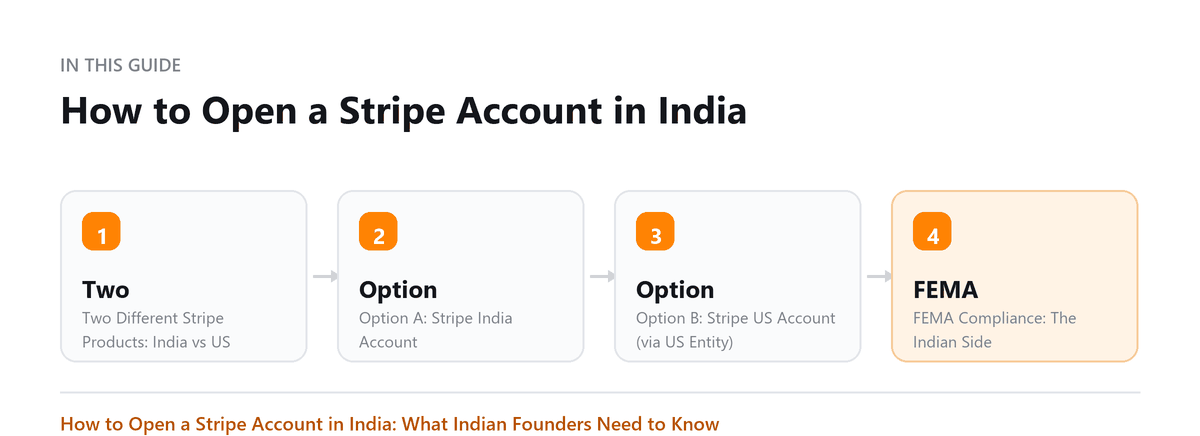
Two Different Stripe Products: India vs US, Option A: Stripe India Account, and Option B: Stripe US Account (via US
Founders in India collecting payments internationally face an early structural question, and it is not really about the payment processor.
It is about which entity is selling. The account has to sit with the company that contracts with the customer and receives the money, and that decision carries consequences on both sides of the border.
This covers the two routes available, what each requires, the compliance that applies on the Indian side, and how to decide which one fits your situation.
Two Different Stripe Products: India vs US
Stripe in India and Stripe in the US are two separate products with different requirements, capabilities, and use cases. Understanding which you need is the first decision.
| Feature | Stripe India | Stripe US (via US Entity) |
|---|---|---|
| Eligibility | Indian-registered business | US-registered entity |
| Currencies | INR (primary) | USD, EUR, GBP, 135+ currencies |
| Payouts | Indian bank account | US bank account |
| FEMA compliance | Built-in | Requires FEMA compliance on remittance |
| Monthly fees | No subscription fee | No subscription fee |
| Processing fees | 2% + INR 2 per transaction | 2.9% + $0.30 per transaction (US cards) |
Decide which entity is actually selling before you open anything. The account has to match the company that contracts with the customer and receives the money, and correcting that afterwards means starting the process again.
Ankit Sagatani, MBA, B.Com · LinkedInOption A: Stripe India Account
What You Need to Open Stripe India
- Indian business registration (Private Limited, LLP, Proprietorship, or OPC)
- PAN (company PAN for Pvt Ltd; personal PAN for sole proprietors)
- GST registration (required for most business types)
- Indian bank account in the company's name
- Business website or app
- KYC documents (director/owner ID + address proof)
What Stripe India Can and Cannot Do
- CAN: Accept Indian cards, UPI, net banking, wallets (Paytm, PhonePe)
- CAN: Accept international cards (Visa, Mastercard, AmEx from any country)
- CAN: Accept PayNow, iDEAL, and other global payment methods
- CANNOT: Hold USD balances (all payouts are in INR)
- CANNOT: Pay out to a US bank account
- CANNOT: Be used by an entity with no Indian registration
Option B: Stripe US Account (via US Entity)
The Stripe Atlas Route
Stripe Atlas is a paid service (~$500) that helps international founders:
- Incorporate a Delaware C-corp or Wyoming LLC
- Obtain an EIN
- Open a Mercury bank account
- Set up a Stripe US account
- Includes standard legal documents (bylaws, shareholder agreement, IP assignment)
After Atlas, you have a US entity with a US bank account and a fully functional Stripe US account. Processing fees are the standard US rates (2.9% + $0.30).
Mercury Bank + Stripe US (Without Atlas)
If you already have a US entity (Delaware LLC or C-corp), you can:
- Open a Mercury or Relay bank account (remote, works for Indian founders)
- Apply for Stripe US at stripe.com using your US entity details
- Connect your Mercury account for payouts
- Start accepting USD payments
FEMA Compliance: The Indian Side
When an Indian resident operates a US entity and earns USD revenue through Stripe US, the money in your US bank account is a foreign asset. FEMA compliance requirements:
- Investment in the US entity: file Form ODI before remitting capital from India
- Revenue earned in the US entity: stays in the US entity (no automatic FEMA issue if not repatriated)
- Repatriation to India: follow FEMA rules, declare foreign income on Indian tax return
- Annual Performance Report (APR): file for each year your US entity is active
Which Option Should You Choose?
Use this decision framework:
- Selling to Indian customers, accepting INR: Stripe India
- Selling to US customers, wanting USD payouts: US entity + Stripe US
- Selling internationally, both INR and USD important: Indian entity (Stripe India) + US entity (Stripe US)
- Building for US market, planning US fundraising: US entity + Stripe US (via Atlas or manual setup)
Book a free consultation and we will get the numbers straight.
Frequently Asked Questions
Can I use Stripe India to charge US customers in USD?
Yes, Stripe India can accept international cards. But the payout will be converted to INR and deposited in your Indian bank account. If you want USD payouts, you need a US entity and Stripe US account.
Does Stripe Atlas guarantee Stripe account approval?
No. Stripe Atlas forms the company and sets up the bank account, but Stripe account approval is subject to Stripe's standard underwriting. Atlas-formed companies have a strong track record of approval, but businesses in certain categories (crypto, gambling, some SaaS models) may still be declined.
Can I convert my Stripe India account to a Stripe US account?
No. These are separate products. You would need to create a new Stripe US account under your US entity.
How much does it cost to maintain a US entity just for Stripe access?
Delaware LLC: ~$90 formation + $300/year franchise tax + $50-200/year registered agent + $500-2,000/year for US CPA (Form 5472). Approximately $1,000-2,500/year for a bare-bones operation. Worth it if you are processing significant USD volume.
What does the payment processor need to see before it will approve us?
In substance, evidence that the business is real and that the entity applying is the one trading. That means a website describing what is actually sold, terms and a refund policy that match it, a bank account in the company's name, and identification for the people who control the company. Most rejections at this stage are not about the country of incorporation, they are about an application made before the business had anything a reviewer could look at.

Written by
Ankit Sagatani, MBA, B.Com
Ankit works with business owners across the US on industry-specific bookkeeping, from real estate to construction and retail. He writes about what each trade's books actually need. Connect on LinkedIn Connect on LinkedIn
Free consultation
Want Books You Can Rely On?
Book a free consultation and we will get the numbers straight.