
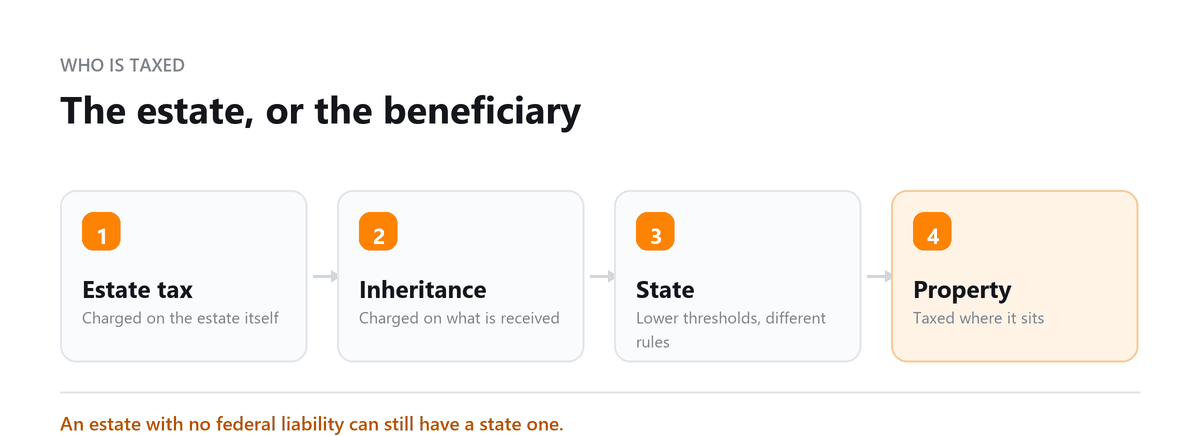
Estate tax and inheritance tax are often used interchangeably by grieving people, and the confusion between the terms is understandable. It's not like either one of them has significant application in most states, and the taxes apply to different events: estate tax is due on the estate itself, while inheritance tax is levied against the heir. In addition, the amount of the tax depends on the relationship between the heir and the decedent.
The number that matters most to most estates is the federal estate tax, and as of 2026, it rarely comes into play. The exemption for a couple is about $15 million per person, $30 million, and it's permanent, not a temporary spike as it was for a few years. So if you're well under that threshold, the main question in this comparison is moot.
The reality for most estates is the state-level tax, which is either of two flavors depending on where the deceased lived at the time of passing.
The mistake I see most with family businesses isn't underestimating the tax at $15M exempt, most owners are fine federally. It's assuming that because there's no tax bill, there's no problem. The business is usually the illiquid asset in the estate, and if ownership isn't structured for transfer before death, the family ends up forcing a sale or a fire-sale buyout just to split things fairly, tax or no tax.
Anu Gupta, CA, EA, B.Tech · LinkedInCore Definitions
- Federal Estate Tax: A tax on the net value of a deceased person's estate before it is distributed to heirs. The US federal government imposes estate tax, but only on estates exceeding the exemption threshold. As of 2025, the federal estate tax exemption is $13,990,000 per individual ($27,980,000 for married couples with portability election). Estates above this threshold pay tax at up to 40%.
- Inheritance Tax: A tax paid by the person who RECEIVES assets from a deceased person's estate. There is NO federal inheritance tax in the United States. However, six states impose their own inheritance tax: Iowa (phasing out), Kentucky, Maryland, Nebraska, New Jersey, and Pennsylvania. The tax rate and exemptions depend on the state and the beneficiary's relationship to the deceased.
Estate Tax vs Inheritance Tax: Comparison
| Dimension | Estate Tax | Inheritance Tax |
|---|---|---|
| Who Pays | The estate (paid before assets are distributed) | The beneficiary (paid when they receive assets) |
| Federal Level | Yes, federal estate tax applies above the exemption threshold | No, no US federal inheritance tax |
| State Level | 12 states + DC have their own estate tax (with lower exemptions than federal) | 6 states have inheritance tax (Iowa, Kentucky, Maryland, Nebraska, New Jersey, Pennsylvania) |
| Tax Base | Total value of the estate above the exemption | Value of assets received by each beneficiary |
| Rate | Up to 40% at federal level | Varies by state: 0 to 18% depending on relationship and amount |
| Exemption | Federal: $13,990,000 per person (2025) | Typically: spouse exempt in all states; children often exempt or lower rate; more distant relatives higher rate |
| Relationship Factor | No, estate tax does not consider who receives the assets | Yes, closer relatives (children, spouse) typically pay less or nothing; distant relatives and non-relatives pay more |
State Estate Tax
12 states plus DC impose their own estate tax, typically with much lower exemptions than federal:
| State | State Estate Tax Exemption (approx.) |
|---|---|
| Connecticut | $13,610,000 (aligned with federal) |
| Hawaii | $5,490,000 |
| Illinois | $4,000,000 |
| Maine | $6,800,000 |
| Maryland | $5,000,000 (also has inheritance tax) |
| Massachusetts | $2,000,000 (one of the lowest, estates over $2M pay tax on the full value, not just the excess) |
| Minnesota | $3,000,000 |
| New York | $7,160,000, note 'cliff' effect |
| Oregon | $1,000,000 (one of the lowest nationwide) |
| Rhode Island | $1,774,583 |
| Vermont | $5,000,000 |
| Washington (state) | $2,193,000 |
| Washington DC | $4,714,700 |
States with Inheritance Tax
| State | Who Pays | Rates |
|---|---|---|
| Iowa | Phasing out, exempt for 2025 if lineal relative; verify | 0 to 15% for non-lineal; phasing out for all by 2025 |
| Kentucky | Non-lineal descendants; spouse and children generally exempt | 4 to 16% for more distant relatives |
| Maryland | Non-lineal relatives; spouse and direct descendants generally exempt | 10% |
| Nebraska | All non-spouse beneficiaries, children at lower rate | 1 to 18% depending on relationship |
| New Jersey | Non-lineal relatives above small threshold; spouse/charity exempt | 11 to 16% |
| Pennsylvania | All non-spouse, non-charity beneficiaries | 4.5% direct descendants; 12% siblings; 15% others |
The relationship factor is the whole story with inheritance tax, and it's the thing tables tend to flatten. In every state that has one, a surviving spouse pays zero. In most of them, children pay zero or close to it too.
The tax exists almost entirely for money going to siblings, in-laws, friends, or unrelated beneficiaries. Nebraska's rate structure makes this explicit: children pay 1% above a $100,000 exemption, while an unrelated heir pays 15% above just $25,000. A $200,000 gift to a son and the same gift to a neighbor produce wildly different tax bills in the same state, from the same estate.
Profitjets has helped clients evaluate more than $50 million in combined financing decisions, including equity raises, bank loans, venture debt, and other working-capital options. In approximately 25% of funding reviews, modelling showed that clients could meet their near-term capital needs without raising additional equity.
We were considering raising another $750,000 in equity to fund a new product launch, but we didn't actually need all of that capital upfront. Profitjets modelled an equity round against a $400,000 business loan and showed us that debt could cover the immediate launch costs without giving up additional ownership. We took the loan, used it for the product and hiring costs, and kept our equity option open for a larger raise later. Seeing the actual repayment cost alongside the dilution made the decision much clearer.
Book a free consultation and we will walk you through the filings.
Frequently Asked Questions
Will I owe tax when I inherit money?
At the federal level, almost certainly not. the exemption covers all but the wealthiest estates. If the death occurred in one of five inheritance-tax states and you're not the spouse or a close relative, you may owe state tax on what you personally receive. Everywhere else, inheriting is tax-free to you as the recipient.
Didn't the estate tax exemption drop in 2026?
No. it was supposed to, under the original TCJA sunset, but Congress replaced that with a permanent $15 million exemption before it took effect. If you read planning advice from 2023 to 2025 warning about a "use it or lose it" deadline, that deadline no longer applies. Some trusts drafted during that window were built around the old assumption and are worth a second look.
Can an estate owe both estate tax and inheritance tax?
Only in Maryland, which is currently the sole state to levy both. Everywhere else, it's one or the other, you're either in an estate-tax state, an inheritance-tax state, or neither.
Does the state I live in matter, or the state where I die?
Generally the state of residence (or where real property is located) at death not where the beneficiary lives. A New York resident's estate can owe New York estate tax even if every heir lives in a state with no death taxes at all.
Is the exemption the same for gifts made while I'm alive?
Yes. the $15M exemption is unified across gift and estate tax, so lifetime gifts count against the same lifetime total. Large gifts still need a gift tax return even when no tax is due.

Written by
Anu Gupta, CA, EA, B.Tech
Anu works with US businesses on tax and entity questions at Profitjets, from choosing a structure to the filings that follow it. She writes about the decisions owners make once and then live with for years. Connect on LinkedIn
Free consultation
Administering an Estate?
Book a free consultation and we will walk you through the filings.