
Ask what the LLC tax is and most will tell you that there is none. An LLC pays no tax on its income by default, at the federal level. The profit made by a sole proprietor LLC is passed to the owner, and the income taxes are due on the same schedule, with the same rates, as the owner's personal taxes.
What surprises most new owners is that the self-employment tax applies to the entirety of the profit amount (not just the salary) and is due on top of the income tax (not instead of it). So an individual owner who had a 22% tax bracket expectation in their first year budget and ended up with a 27% effective federal tax rate when their turn to pay nothing was due was not wrong to be surprised; this is how the math adds up.
This article covers LLC taxation in all classifications, combined burden at realistic profit levels, variation across states, and the value of the S-Corp election.
The costly mistake isn't a rate, it's quarterly estimates. Owners treat the tax bill as an April problem, get hit with an underpayment penalty, and then fund the shortfall out of working capital during their slowest month. Set aside a fixed percentage of every payment received in a separate account, from day one and the whole problem stops existing. It costs nothing to do and it's the difference between a manageable tax year and a cash crisis.
Anu Gupta, CA, EA, B.Tech · LinkedInWhat Is the LLC Tax Rate, and Why Is It Important?
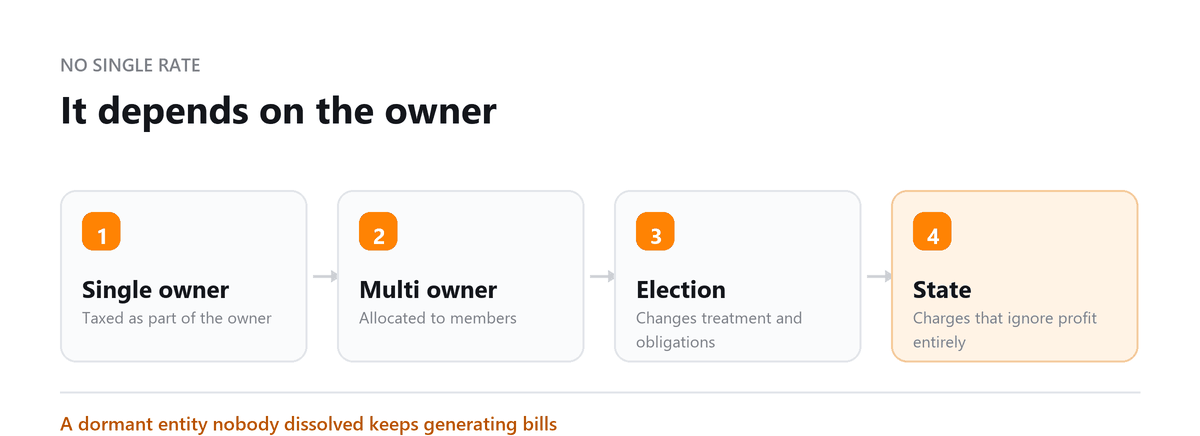
The federal LLC tax rate is not fixed, it depends on the LLC's tax election. By default, LLCs are pass-through entities: the LLC itself pays no federal income tax. Instead, profits flow to the owner(s) and are taxed at the individual's federal income tax rate. The key variable is what that individual rate is, and whether the income is also subject to self-employment tax.
There's no entity-level federal tax by default. Profit flows to the owners and is taxed at their individual rates, which is the defining feature of a pass-through.
What varies is classification:
| Classification | Federal treatment |
|---|---|
| Single-member LLC (default) | Sole proprietorship, Schedule C, income tax plus SE tax on all net profit |
| Multi-member LLC (default) | Partnership, Form 1065, each member taxed on their share |
| LLC electing S-Corp | Form 1120-S, payroll tax on a reasonable salary; distributions escape SE tax |
| LLC electing C-Corp | Form 1120 to 21% at entity level, distributions taxed again as dividends |
State LLC Tax Rates and Additional Fees
State LLC taxes vary significantly:
| State | Income Tax on LLC | Annual Fee / Franchise Tax |
|---|---|---|
| Delaware | None (on out-of-state income) | $300/year (LLC) |
| Wyoming | None | $60/year (minimum) |
| California | 1.5% on net income (S-Corp election) or pass-through to owner at CA rate | $800/year minimum franchise tax |
| Texas | Franchise tax (margin tax): 0.375% for retail/wholesale, 0.75% for others | No income tax; $1M threshold for franchise tax |
| New York | Pass-through to owner + filing fee based on NY gross income | $25 minimum filing fee |
| Florida | None on pass-through LLC income | $138.75/year report fee |
How to Calculate Your LLC Tax Liability
Single-Member LLC Example (no S-Corp election)
| Item | Amount |
|---|---|
| Net LLC profit | $120,000 |
| Self-employment tax (15.3% x $117,000 approx) | $17,901 |
| SE tax deduction (50% of SE tax) | ($8,951) |
| Adjusted gross income | $111,049 |
| Standard deduction (single, 2025) | ($15,000) |
| Taxable income | $96,049 |
| Federal income tax (10/12/22% brackets) | ~$14,800 |
| Total federal tax (income + SE) | ~$32,700 |
The effective total federal tax rate in this example is approximately 27% on $120,000 LLC profit higher than many founders expect, largely due to self-employment tax. An S-Corp election at this income level would typically save $5,000-$8,000/year in SE tax by splitting income between salary and distributions.
When the S-Corp election pays
Electing S-Corp treatment lets you split profit between a reasonable salary subject to payroll tax and distributions, which escape self-employment tax. The saving is roughly 15.3% on whatever moves into the distribution column, up to the wage base.
The threshold where it becomes worth it is lower than nothing and higher than the figures usually quoted. What sits on the other side of the ledger:
- Payroll processing, running all year
- A separate business return (Form 1120-S) plus your personal return
- Higher accountant fees, realistically a few thousand dollars annually
- State-level costs in some states, California charges 1.5% on S-Corp net income
Realistically the election starts paying somewhere in the low six figures of net profit, not at $60,000. The exact crossover depends on what salary is defensible for your role and what your accountant charges, and both vary enough that the only reliable answer comes from modelling your own numbers.
Two constraints worth knowing before you plan around it. "Reasonable salary" is a real standard, and setting it artificially low invites an IRS challenge with back taxes and penalties attached. And S-Corp eligibility requires US persons as shareholders, which rules out non-resident owners entirely.
What owners actually get wrong
Quarterly estimates. Federal estimated payments are due April 15, June 15, September 15, and January 15 of the following year. Those aren't even quarters, the second payment comes two months after the first, and that irregularity is what catches people who assume a three-month rhythm. Underpaying triggers a penalty at a rate the IRS sets quarterly.
Not setting money aside. The fix is mechanical: move a fixed percentage of every payment received into a separate account the moment it arrives. Somewhere around 25 to 30% of net profit covers federal obligations for most owners in the early years, more if your state taxes income. The discipline matters more than the precision.
Treating formation state as tax state. Forming in Wyoming doesn't move your tax liability out of the state you work from. It adds a registration there and changes nothing about where the income is taxed.
Multi-state exposure nobody planned for. Employees, an office, or in some cases just enough sales activity in another state creates filing obligations there. This accumulates quietly as a business grows and surfaces as a problem years later.
Missing the S-Corp window. The election has deadlines, and making it late means waiting a full year. If you're approaching the threshold, have the conversation before the filing season rather than during it.
Common Challenges in Managing LLC Tax Rates
- Quarterly estimated taxes: LLC owners must pay estimated federal and state taxes quarterly (due Jan 15, Apr 15, Jun 15, Sep 15 for the prior quarter). Failing to pay enough triggers underpayment penalties, currently 7% a year, compounded daily
- Self-employment tax surprise: new LLC owners are often unprepared for the 15.3% SE tax on top of income tax. Budget 25-30% of net profit for total federal tax in the early years
- S-Corp timing: the SE tax savings from an S-Corp election typically justify the additional compliance costs (payroll, Form 1120-S) once net LLC profit reaches the low six figures, below that, the savings are usually offset by costs
- State nexus: operating in multiple states creates multi-state filing obligations. An LLC formed in Delaware but with employees in California owes California taxes on California-source income
Book a free consultation and we will work through both layers.
Frequently Asked Questions
What is the tax rate for a small business LLC?
There isn't a single rate. Pass-through income is taxed at the owner's marginal federal rate, which depends on their total income from all sources, and self-employment tax applies on top of that at 15.3% up to the Social Security wage base. Adding state tax, owners at moderate profit levels commonly see a combined effective rate in the region of 30 to 40% of net profit. Model your own position rather than working from a range.
How do LLC tax brackets work?
LLCs don't have brackets of their own. The profit is added to your other income: salary, spouse's income, investment income and the whole amount determines which brackets apply. Two owners with identical LLC profit can face very different rates depending on what else is on their returns.
What's the federal rate if my LLC elects C-Corp treatment?
A flat 21% at the entity level. That can suit a business retaining earnings rather than distributing them, but any distribution is then taxed again as a dividend at the owner's qualified dividend rate. For most small businesses the double layer outweighs the flat rate, which is why the election is uncommon outside specific planning situations.
How much should I set aside for taxes?
As a working rule, 25 to 30% of net profit covers federal income and self-employment tax for most owners in the early years, before state tax. Move it into a separate account as revenue arrives rather than calculating it quarterly, the mechanical version works and the calculated version tends not to.
Do I pay tax where my LLC is formed or where I work?
Where you earn the money and where you live. Formation state affects your filing and fee obligations there, not where the income is taxed. This is the most persistent misconception about out-of-state formation and it costs people real money.

Written by
Anu Gupta, CA, EA, B.Tech
Anu works with US businesses on tax and entity questions at Profitjets, from choosing a structure to the filings that follow it. She writes about the decisions owners make once and then live with for years. Connect on LinkedIn
Free consultation
Unsure What Your LLC Owes?
Book a free consultation and we will work through both layers.