
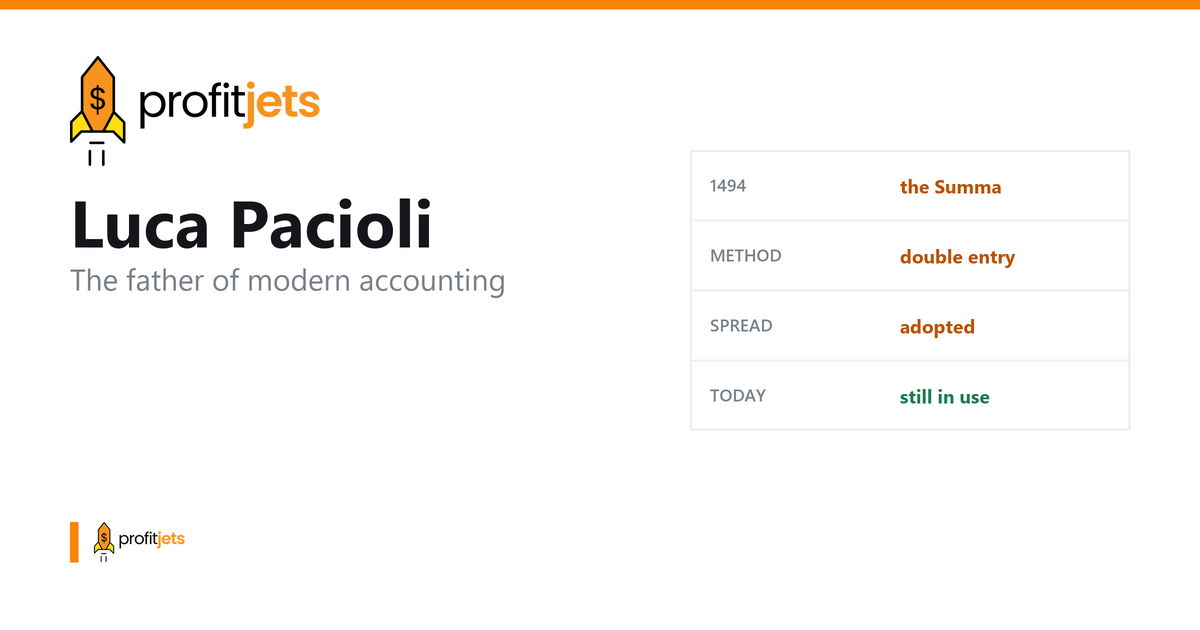
All the financial records and transactions maintained in practice are in reality derived from a system that originated over 500 years ago. Dates back the system was invented by Luca Pacioli, a renowned mathematician from Italy in 1445, commonly known as Father of Accounting. In 1494, the franciscon friar was recognized for recording his guidelines of double entry bookkeeping. His principles in complex topics provided a clear, well-defined ideology to document transactions in a structured manner.
His core theories are still contributing as a foundation for modern accounting systems across the world.
The debt and credit approach in every business today was formalized by Luca Pacioli centuries ago. His principles created a well-organized system that could withstand evolutionary impact. Technology changed drastically but still his logic remains as an anchor for all the business owners.
Pacioli did not just document double-entry bookkeeping, he gave the world a universal language for money. Every modern accounting system, from QuickBooks to enterprise ERP, still runs on the same logic he wrote down in 1494.
Ankit Sarawagi, CPA, CA, MBA · LinkedInEarly Life and Background
Luca Pacioli was born around 1445 in Sansepolcro, a small town in Tuscany, Italy. He became a Franciscan friar and also studied advanced mathematics under the painter Piero della Francesca. Growing up during the Renaissance, an era defined by intellectual curiosity and commercial expansion, Pacioli mastered fields ranging from arithmetic to geometry, and eventually turned his attention to the financial practices of Italian merchants.
The Summa de Arithmetica: Pacioli’s Most Important Work
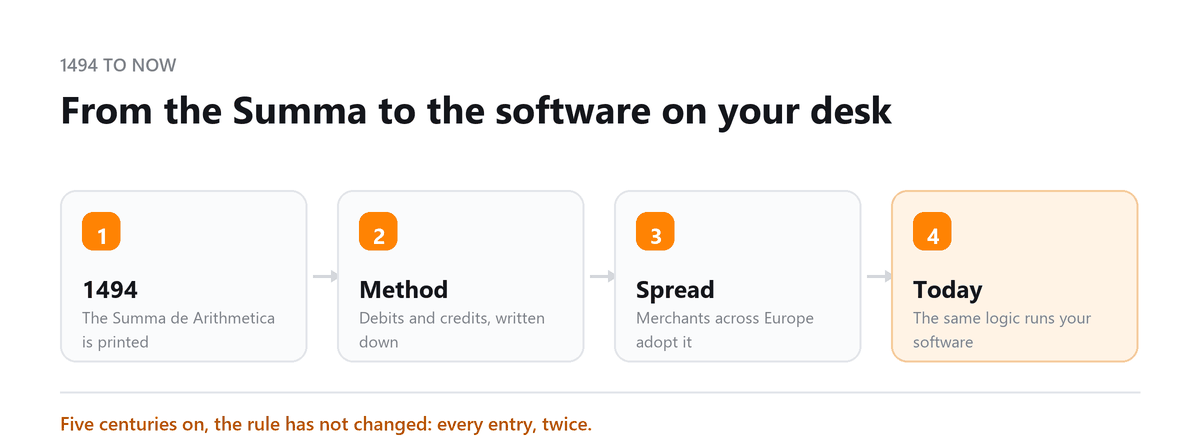
In 1494, Pacioli published his landmark work: Summa de Arithmetica, Geometria, Proportioni et Proportionalita. Among its many sections was a detailed description of the double-entry bookkeeping system that Venetian merchants had been using informally. Pacioli did not invent double-entry bookkeeping, but he was the first to formalise and publish it systematically. This made the method widely accessible and ultimately turned it into the global standard.
What is Double-Entry Bookkeeping?
The core principle is straightforward: every financial transaction must be recorded in at least two accounts, one debit and one credit, and the total debits must always equal total credits. This creates a self-balancing system that makes errors easy to spot. Before Pacioli codified this method, bookkeeping was inconsistent, rudimentary, and unreliable. His systematic framework introduced accuracy and accountability to commerce.
Why Luca Pacioli Still Matters Today
Pacioli’s methods are not historical curiosities. They are active principles running inside every accounting software package, every financial audit, and every balance sheet produced anywhere in the world. The double-entry system he documented enables businesses to:
- Analyse financial health at any point in time
- Prepare tax-compliant financial statements
- Secure funding by presenting reliable records to lenders and investors
- Detect fraud and errors through account reconciliation
The Evolution from Pacioli to Modern Accounting
Historical Context
During the Renaissance, growing trade complexity created demand for systematic transaction recording. Pacioli’s treatise was widely distributed and quickly became the standard practice across Europe. Merchants, banks, and governments all adopted variants of his system.
The Role of Technology
Modern bookkeeping software automates many of the tasks Pacioli described manually. Real-time updates, automated bank feeds, and instant financial reporting are all built on his foundational logic. The arithmetic is handled by machines now, but the debit-credit structure underneath is unchanged.
Strategic Financial Management Today
Today, professional services like fractional CFOs, outsourced bookkeepers, and tax advisors all build their work on Pacioli’s principles. Clean, accurate records based on double-entry bookkeeping are the prerequisite for every piece of strategic financial advice a business owner can receive.
Book a free consultation and we will keep your double-entry books in order.
Frequently Asked Questions
Did Luca Pacioli invent double-entry bookkeeping?
No, Italian merchants were already using double-entry methods before Pacioli. What he did was formalise and publish the system in 1494, making it widely accessible and turning it into the global standard. He is credited as the Father of Accounting for this reason.
Why is double-entry bookkeeping still used today?
Because it works. The self-balancing nature of double-entry bookkeeping makes errors easy to detect and financial statements reliable. Every major accounting standard in the world, GAAP, IFRS, and others, is built on this foundation. No better system has replaced it in over 500 years.
What was the Summa de Arithmetica?
It was a comprehensive mathematics textbook published by Pacioli in 1494. One section of the book described the double-entry bookkeeping system used by Venetian merchants. That section became the most influential piece of accounting literature ever written.
How did Pacioli’s work change commerce?
By giving merchants a reliable, standardised method for tracking transactions, Pacioli’s system enabled more complex trade, easier auditing, and the development of modern banking. It gave businesses a common financial language for the first time.
Is double-entry bookkeeping required by law?
Not always by name, but most accounting standards and tax authorities require the production of financial statements, balance sheets, income statements, cash flow statements, that can only be produced reliably using double-entry bookkeeping. In practice, any registered business of any meaningful size should be using it.
Conclusion
Luca Pacioli’s contribution to accounting is one of the most durable ideas in the history of commerce. His 1494 publication gave the world a financial language that has never needed to be replaced, only refined. Whether you are using pen and paper, a spreadsheet, or enterprise accounting software, you are working within a system he helped build. Understanding that foundation makes you a better steward of your business finances.

Written by
Ankit Sarawagi, CPA, CA, MBA
Ankit leads the finance team at Profitjets, where he has worked with 500+ businesses across the US on bookkeeping, tax and CFO-level strategy. He writes about the habits that keep small business books accurate all year. Connect on LinkedIn
Free consultation
Want the Method Applied to Your Books?
Book a free consultation and we will keep your double-entry books in order.