
Net 30 payment terms give your customer a month from the invoice date to pay in full. Net 30 is the default standard in US B2B, so by default most small businesses offer it without thinking.
That worth considering. Net 30 is a month of work you've done on, and not yet paid for, that is funding your own cash. It's a perfectly acceptable risk for a business with healthy reserves and reliable customers, and it's what the market expects. It's the thing quietly causing the problem for a business with tight cash and a couple of chronically slow payers.
This guide covers what Net 30 really is, how to implement it so that it works, when shorter terms can make more sense and how early payment discounts change the arithmetic on both sides.
The metric that should drive this decision is the gap between your DSO and your DPO. If you're collecting in 45 days and paying suppliers in 25, you're financing your customers for three weeks on every cycle out of your own working capital and no amount of sales growth fixes that, it makes it worse. Net 30 is the right default until that gap opens up. Once it does, shortening terms on new customers costs you less than most owners fear.
Ankit Sagatani, MBA, B.Com · LinkedInWhat Are Net 30 Payment Terms?
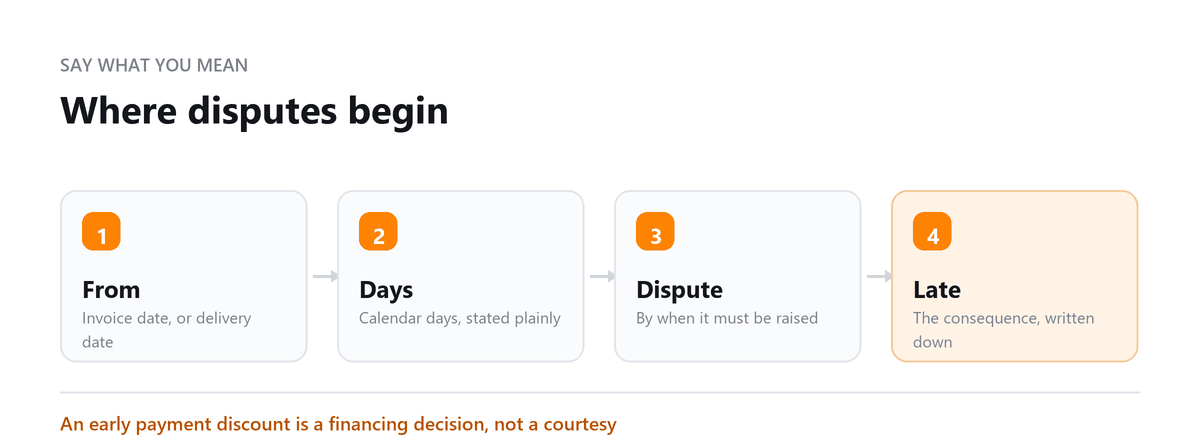
Net 30 means the full invoice amount, "net" of any discounts, is due within 30 calendar days of the invoice date. An invoice dated April 1 is due May 1. Calendar days, not business days, and counted from the invoice date rather than from delivery or from when the customer opens the email.
| Term | Meaning |
|---|---|
| Net 30 | Full invoice due within 30 days of invoice date |
| Net 60 | Full invoice due within 60 days |
| Net 90 | Full invoice due within 90 days |
| 2/10 Net 30 | 2% discount if paid within 10 days; full amount due by day 30 |
| Due on receipt | Payment expected immediately upon receiving the invoice |
| Net 15 | Full invoice due within 15 days |
How to Implement Net 30 Payment Terms Effectively
- State the terms clearly on every invoice: 'Net 30, Payment Due by [date]', spell out the exact due date, do not make the customer calculate it
- Send invoices immediately: Net 30 starts from the invoice date, not the delivery date and not the date the customer opens the invoice. Send the moment delivery is complete
- Set up automated reminders: send a reminder 5-7 days before the due date, on the due date, and at 7 days overdue
- Include payment options: provide multiple payment methods, ACH/bank transfer, credit card, online payment link, to reduce friction
- Have a late payment policy: state on the invoice what happens if payment is late (e.g. 1.5% per month interest on overdue balances). Whether you enforce it or not, stating it in writing establishes your legal entitlement
- Track AR aging: review an AR aging report weekly, invoices over 30 DPO need active follow-up, not passive waiting
Should you be offering Net 30 at all?
Most small businesses offer it because everyone does. Worth checking whether it fits you.
Net 30 makes sense when you're selling to established businesses with their own AP processes, when your competitors offer it and refusing would cost you work, when your cash position comfortably absorbs a month's lag, and when your customers are the kind who pay on terms rather than treating 30 days as a starting position.
Shorter terms make sense when you're a service business with no meaningful cost of goods, when you're working with newer or smaller customers whose payment behaviour you don't know, when a single unpaid invoice would cause you real difficulty, or when your own suppliers want paying faster than your customers pay you.
The uncomfortable version of this: businesses often keep offering generous terms to customers who have already demonstrated they won't honour them. Terms are a commercial decision you're allowed to revisit, and revisiting them for one slow payer while leaving everyone else alone is entirely normal practice.
A middle option that works well, Net 30 as standard, Net 15 or a deposit for new customers until they've paid twice on time. You get the credibility of standard terms without extending credit to someone you've never invoiced before.
How to make Net 30 work
Put the actual date on the invoice.
Not "Net 30", "Payment due 1 May 2026." Nobody should have to calculate anything, and the specific date is harder to be vague about than a term.
Invoice the day the work finishes
The 30 days runs from the invoice date, so a week's delay in raising it is a week of cash you've handed over for nothing. This is the highest-return habit on the page and the one most businesses haven't built.
Send it to whoever actually pays
A large share of late payments are invoices sitting with the person who commissioned the work rather than the person who processes payments. Ask for the AP contact at the start of the relationship.
Set reminders that go out automatically
Five to seven days before the due date, on the due date, and again at seven days past. The pre-due reminder does most of the work, because it arrives while the invoice is still routine rather than awkward.
Make paying easy
ACH, card, and a click-through payment link. A meaningful share of late payment is friction, the invoice needs someone to log into a banking portal and key in details, so it waits for a moment that doesn't come.
State your late payment policy, and get it agreed up front
An interest clause on your invoice is weaker than the same clause in a signed agreement or accepted quote, because terms are supposed to be agreed before the work rather than announced afterward. Put it in your engagement terms, then restate it on the invoice.
Look at aged receivables weekly
Anything past due needs an actual decision rather than more waiting. The collections sequence is covered in our guide to accounts receivable challenges.
The Advantages and Disadvantages of Net 30 Payment Terms
| For the Supplier (you) | For the Buyer (your customer) | |
|---|---|---|
| Advantage | Standard terms most B2B buyers expect; builds relationships; allows you to win customers who need credit | 30-day interest-free credit; time to verify invoice before payment; cash flow flexibility |
| Disadvantage | 30-day cash collection delay; bad debt risk if customer does not pay; DSO impact on working capital | Obligation to track and pay within 30 days; potential penalty for late payment |
Early Payment Discount: 2/10 Net 30
Many suppliers offer an early payment discount to incentivise faster payment: '2/10 Net 30' means the buyer gets a 2% discount if they pay within 10 days, otherwise the full amount is due by day 30.
Example: $5,000 invoice on 2/10 Net 30. Pay within 10 days: $5,000 x 98% = $4,900. Pay on day 30: $5,000 full amount.
From the buyer's perspective, a 2% discount for paying 20 days early is equivalent to approximately 37% annualised return, most businesses with available cash should take it. From the supplier's perspective, the 2% cost of accelerated cash is often worth it to reduce DSO and collection risk.
How Can I Organise Invoices for a Small Business?
- Use accounting software with built-in AR: QuickBooks, Xero, FreshBooks, and Wave all create, send, and track invoices with automatic aging and reminders
- Number invoices sequentially: a consistent invoice numbering system (INV-2026-001, INV-2026-002) makes tracking and reconciliation straightforward
- Keep a single master AR file or dashboard: know at all times what is current, what is due this week, and what is overdue
- Separate AR by customer: know which customers consistently pay on time vs which are slow, and adjust credit terms accordingly
How outsourced bookkeeping helps
The routine half of AR is well suited to being handled outside the business: raising and sending invoices, monitoring aging, running the reminder sequence, following up overdue balances, and reconciling AR against the bank.
There's a second benefit that owners rarely anticipate. When the chase comes from accounts rather than from the person who manages the client relationship, both sides find it easier, it reads as process rather than as a personal request for money. That alone tends to make collections happen more consistently, because the awkward decision about whether to send the reminder disappears.
Profitjets clients see an average 15-day reduction in DSO after implementing structured AR management, with approximately $35,000 in overdue invoices collected within the first 90 days.
If invoices are going out late or chasing keeps slipping down the list, Profitjets handles AR end to end: invoicing, reminders, aging and reconciliation, so collections run on a schedule rather than on whoever remembers.
Book a free consultation and we will tighten the terms and the process.
Frequently Asked Questions
What's the difference between Net 30 and Net 30 EOM?
Net 30 counts 30 days from the invoice date. Net 30 EOM counts 30 days from the end of the month the invoice was issued in, so an invoice dated April 15 on Net 30 EOM is due May 30 effectively 45 days. EOM terms are common in industries that invoice in monthly batches, and worth noticing before you agree to them, because the difference is real money on a large account.
Can I charge interest on late payments?
You can if the term was agreed before the work, which usually means it sits in your engagement letter, contract or accepted quote rather than appearing for the first time on the invoice. Restate it on every invoice as well. Some states set statutory rates for commercial transactions, so check your own state's position and, on anything significant, take legal advice rather than relying on a clause you drafted yourself.
Does Net 30 start from the invoice date or the delivery date?
The invoice date, unless your contract says otherwise. That's precisely why raising invoices promptly matters so much, a week's delay in invoicing is a week added to collection, every time, and it compounds across every customer you have.
Is Net 30 negotiable with customers?
Yes, more than most small businesses assume. Large customers with fixed AP policies often genuinely can't move, but smaller and mid-sized customers frequently will accept Net 15, a deposit, or staged payments if you ask at the start of the relationship. The point to raise it is before the first job, not after they've paid late twice.
What should I do when a Net 30 invoice goes unpaid?
Call at around 35 days rather than sending a fourth email. Silence past the due date looks identical whether the customer is slow or has a dispute they never mentioned, and only a conversation distinguishes them. Disputes stop the payment clock entirely, so the sooner you know one exists, the sooner it can be resolved.

Written by
Ankit Sagatani, MBA, B.Com
Ankit works with business owners across the US on industry-specific bookkeeping, from real estate to construction and retail. He writes about what each trade's books actually need. Connect on LinkedIn Connect on LinkedIn
Free consultation
Customers Paying Late?
Book a free consultation and we will tighten the terms and the process.