
NetSuite and QuickBooks are fundamentally different products. NetSuite is an ERP (Enterprise Resource Planning), a complete suite of accounting, inventory, CRM (customer relationship management), and commerce tools for complex business operations that involve dozens of entities. QuickBooks is a simple accounting software for small businesses.
The reason, why you have read this article is because you have heard that NetSuite is better for larger organizations or those growing quickly, and you are trying to understand if/when you should make the transition.
All that they actually need is to re-engineer their accounting workflows, update chart of accounts (CoA) that was designed 4 years ago, and optimize revenue and expense reports that no one understands. This is typically a much simpler and cheaper process than transitioning to a full-blown ERP.
With that being said, there are definitely scenarios where QuickBooks will become a bottleneck no matter what. In this article, I will provide you with actionable advice and analysis that will help you separate the two cases.
Revenue isn't the trigger, complexity is. The real test is whether your month-end close involves someone manually consolidating things outside the system. If it does, and that manual work is growing rather than stable, you're approaching the threshold. If your close is slow but everything happens inside one system, the problem is usually the setup, not the platform.
Anu Gupta, CA, EA, B.Tech · LinkedInYou can find our feature comparison here. And below is the information that you won’t find elsewhere.
Platform Overview
| NetSuite | QuickBooks Online | |
|---|---|---|
| Type | Full ERP (accounting + CRM + inventory + e-commerce) | Accounting software (+ optional payroll add-on) |
| Target Business | Mid-market to enterprise (typically $5M+ revenue) | Startups to SMBs (typically under $5M revenue) |
| Deployment | Cloud-only | Cloud (Online) or legacy Desktop |
| Customization | Extensive, custom fields, workflows, dashboards | Limited, mainly via third-party integrations |
| Scalability | Built for global, multi-entity, high-transaction volume | Scales well within SMB range; may require migration at growth stage |
Cost Comparison
The honest summary: NetSuite is a six-figure commitment over three years for most implementations once licence, implementation, training and internal time are counted. QuickBooks is a few thousand.
That gap is the whole decision. It's justified when the operational complexity genuinely requires it, and it's a serious misallocation when it doesn't.
Two costs that don't appear in vendor quotes. Internal time, an implementation consumes months of your finance team's attention, and someone has to own it. And the risk of a stalled implementation, which happens more often than the industry admits and leaves you paying for a system you're not using while still running the old one.
| Cost Element | NetSuite | QuickBooks Online |
|---|---|---|
| Starting Cost | ~$999/month base licence + ~$99/user/month | ~$38/month (Simple Start) to ~$340/month (Advanced) |
| Implementation | $10,000 to $100,000+ for professional setup | Minimal, self-serve or accountant-assisted |
| Training | Significant, dedicated training required | Generally minimal for basic features |
| Customisation | Additional cost for custom workflows/reports | Mostly free via built-in tools |
| Ongoing Support | SuiteSuccess or third-party NetSuite partner | QuickBooks support plans or ProAdvisor |
| Total 3-Year Cost (estimate) | $150,000 to $500,000+ for typical implementation | $3,000 to $10,000 |
Feature Comparison
The multi-entity row is the one that most often drives a genuine migration. Everything else has a workaround; consolidating several entities in QuickBooks means separate company files and consolidation happening outside the system, usually in a spreadsheet or a third-party consolidation tool.
That workaround is more viable than this kind of page usually admits plenty of businesses run three or four entities this way for years. It becomes untenable when the consolidation is complex enough to take days rather than hours, or when intercompany transactions are frequent.
| Feature | NetSuite | QuickBooks Online |
|---|---|---|
| Core Accounting | Advanced, multi-entity, multi-currency, consolidation | Strong for SMB, single entity standard |
| Inventory | Built-in with full supply chain management | Basic to moderate (Plus plan) |
| CRM | Built-in CRM module | No built-in CRM, requires third-party integration |
| E-commerce | SuiteCommerce built-in | Integration via Shopify, WooCommerce, etc. |
| Payroll | Via SuitePeople (add-on) | Via QuickBooks Payroll (add-on) |
| Reporting | Highly customisable, real-time dashboards | 100+ standard reports; less granular than NetSuite |
| Multi-Entity | Native, consolidated reporting across entities | Not natively supported, requires workarounds |
| Integrations | Wide enterprise integrations | 750+ integrations via App Marketplace |
| User Limit | Based on licence count | Limited per plan tier |
When to Choose Each
| Choose NetSuite if… | Choose QuickBooks Online if… |
|---|---|
| Revenue exceeds $5 to 10M and complexity has outgrown QuickBooks | Revenue is under $5M and accounting is the primary need |
| You need multi-entity or multi-subsidiary reporting | You need a single, simple company accounting view |
| You need CRM, inventory, and e-commerce in one system | Third-party integrations are sufficient for non-accounting needs |
| You have international operations with multiple currencies | You need fast, affordable setup with minimal IT overhead |
| You are planning for rapid scale or IPO readiness | Your accountant/bookkeeper is QuickBooks-trained |
Have you actually outgrown QuickBooks?
Before pricing an ERP, work through this. In our experience most businesses asking the question find their answer here.
Is your close slow because of manual work outside the system, or inside it? Manual consolidation, manual allocations, manual intercompany entries, those point toward a platform limit. A slow close where everything happens inside QuickBooks usually points at process or setup.
Is your chart of accounts still fit for the business? This is the most common cause of "our reporting is useless." A chart built for a simpler version of the business produces reports that answer questions nobody asks any more. Rebuilding it is days of work, not months.
Are your integrations doing their job? Inventory, CRM and commerce all integrate with QuickBooks. If the integration is badly configured or was never finished, the symptom looks identical to an outgrown platform.
Is the problem volume or complexity? High transaction volume alone rarely breaks QuickBooks. Multiple entities, multi-currency consolidation, complex inventory costing and heavy intercompany activity do.
Would a competent cleanup fix the complaint? Honestly asked. If the answer is maybe, do that first, it costs a fraction of an implementation and you'll know within a quarter.
When NetSuite is genuinely the answer
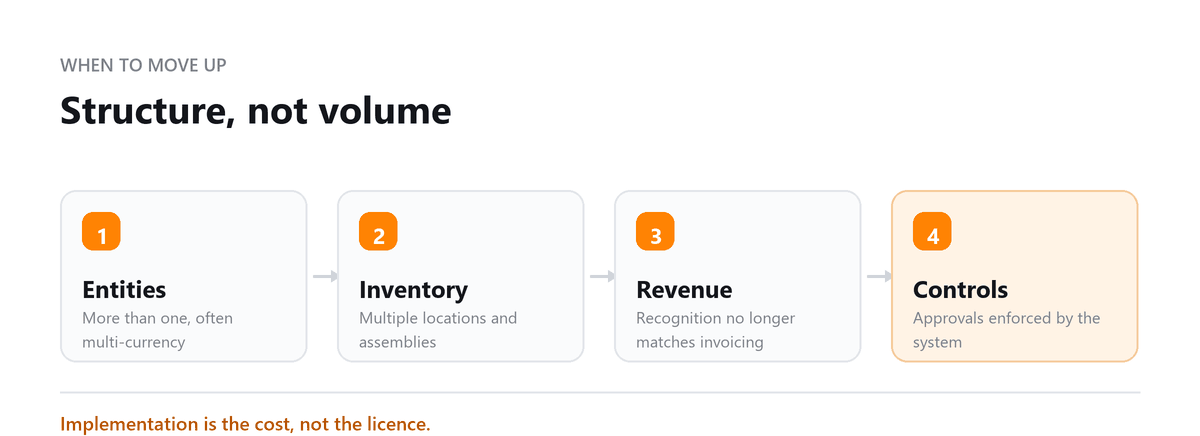
Multiple entities needing consolidated reporting, particularly across currencies or jurisdictions. This is the clearest case.
Complex inventory: multi-location, landed costs, manufacturing, assemblies, where QuickBooks and an inventory integration are both straining.
You need accounting, CRM, inventory and commerce in one system, and the integration sprawl between separate tools has become its own problem.
International operations with multi-currency consolidation and local statutory requirements.
You're preparing for scale or an IPO and need audit-grade controls, segregation and reporting that stand up to institutional scrutiny.
When QuickBooks is still right
Single entity, or a small number of entities you can consolidate outside the system without it dominating your close.
Accounting is the primary need, and CRM, commerce and inventory are handled well enough by dedicated tools.
You want to be running properly within days rather than months.
Your bookkeeper or accountant already works in it, which matters more than it sounds, because the pool of NetSuite-capable finance people is far smaller and more expensive.
Book a free consultation and we will look at where your time actually goes.
Frequently Asked Questions
Is NetSuite better than QuickBooks?
For most small and mid-sized businesses QuickBooks is the right answer. NetSuite becomes right when operational complexity: multiple entities, serious inventory, consolidated multi-currency reporting genuinely exceeds what QuickBooks plus integrations can handle. The trigger is complexity, not a revenue figure.
How long does a NetSuite implementation take?
Typically three to six months with a qualified partner, and six to twelve for complex configurations involving multi-entity setup or migration from legacy systems. Budget for your own team's time as well as the partner's someone internal has to own it, and implementations that lack that owner are the ones that stall.
Can I migrate from QuickBooks to NetSuite?
Yes, and it's a well-trodden path with established partners. What migrates cleanly is your chart of accounts, customers, vendors and open balances. Detailed transaction history often doesn't move in full, and most businesses keep QuickBooks accessible in read-only form for historical reference. Plan the cutover at a period end.
Will NetSuite fix our reporting problems?
Only if the problem is platform capability. If your reports are unhelpful because the chart of accounts doesn't reflect how the business actually works, NetSuite will produce the same unhelpful reports with better formatting. Fix the structure first, you'll either solve the problem or know for certain that you didn't.
Do we need a NetSuite partner, or can we implement it ourselves?
A partner, realistically. NetSuite is configured rather than installed, and the configuration decisions are difficult to reverse later. Self-implementation is where the worst outcomes come from. Choose the partner as carefully as the platform implementation quality varies more than the software does.

Written by
Anu Gupta, CA, EA, B.Tech
Anu works with US businesses on tax and entity questions at Profitjets, from choosing a structure to the filings that follow it. She writes about the decisions owners make once and then live with for years. Connect on LinkedIn
Free consultation
Wondering If You Have Outgrown It?
Book a free consultation and we will look at where your time actually goes.