
A startup's accounting has a different job from an established business's: it has to survive examination by investors who have not invested yet.
That means equity records that reconcile, a revenue policy that can be defended, and a runway figure that is updated rather than remembered. A tidy expense analysis matters considerably less.
This covers why the requirements differ, what is needed from the first month, how the service should change by stage, when to bring it inside, and how to choose a firm.
Why Startups Need Different Accounting Than Established Businesses
Startups operate in a world of high uncertainty, rapid change, and investor scrutiny. The accounting function must keep pace with equity events, headcount changes, and monthly investor demands, none of which a standard bookkeeper is equipped to handle.
A startup's accounting has to survive a diligence process it has not had yet. Clean equity records, a defensible revenue policy and a cap table that reconciles matter more at this stage than a tidy expense analysis, because those are what get examined.
Abhinav Gupta, CPA, CA, MBA · LinkedInCore Accounting Needs from Day One
Accrual-Basis Books
Investors and boards expect GAAP-compliant accrual accounting. Cash-basis books will need to be restated before any institutional raise, costing time and money. Outsourced accounting firms set up accrual from the start.
Cap Table Accounting
Every equity event, founder shares, SAFEs, priced rounds, option grants, must be reflected in the equity section of the balance sheet. Outsourced firms experienced with startups reconcile the cap table (managed in Carta or similar) to the GL monthly.
Equity Compensation (ASC 718)
Stock option expensing under ASC 718 requires a 409A valuation, a Black-Scholes calculation, and a monthly journal entry. Errors here create audit adjustments and restatements. An outsourced firm handles ASC 718 treatment as routine.
Investor Reporting
VC-backed startups typically owe investors monthly or quarterly financials: P&L, balance sheet, cash flow statement, and often a KPI summary. Outsourced accounting teams produce these packages on schedule.
Burn Rate Tracking and Runway Forecasting
Gross burn (total spend) and net burn (spend minus revenue) drive the most important conversation a startup has: how many months of runway remain. An outsourced CFO layer translates the actuals into a rolling 12-month forecast.
Term Sheet Financial Review
Before signing a term sheet, a startup needs to understand the cap table math, dilution, liquidation preference stack, and anti-dilution implications. An outsourced accounting firm with startup experience can model these scenarios.
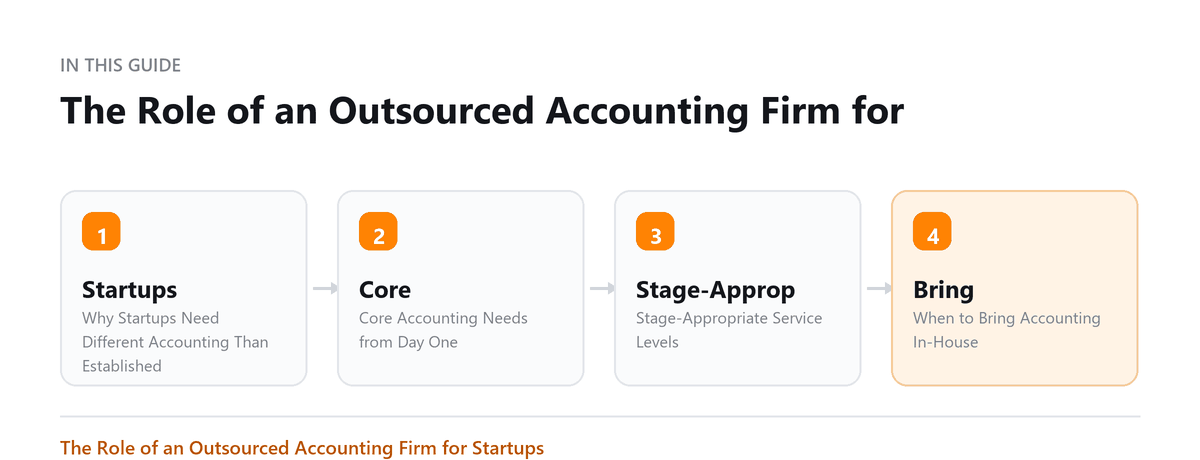
Stage-Appropriate Service Levels
| Stage | Services Needed |
|---|---|
| Pre-seed / Bootstrapped | Chart of accounts setup, monthly close, basic investor reports |
| Seed ($500k-$2M raised) | Accrual books, payroll, ASC 718, monthly board package |
| Series A ($2M-$15M raised) | Full close, multi-entity, fractional CFO layer, audit readiness |
| Series B+ (>$15M raised) | Consider in-house controller; outsourced CFO advisory only |
When to Bring Accounting In-House
Most startups should consider hiring an in-house controller or VP Finance when:
- Revenue exceeds $10M-$15M annually with complex revenue recognition
- The company has 50+ employees and multi-state payroll complexity
- Series B or later: institutional investors may expect a dedicated finance hire
- Daily operational finance questions require someone embedded in the business
Pro Tip: The transition is not all-or-nothing. Many Series B companies hire an in-house controller and keep outsourced CFO advisory for strategic work.
How to Choose an Outsourced Accounting Firm for Your Startup
- Ask for startup-specific references, not just SMB clients
- Confirm experience with ASC 718, SAFE accounting, and 409A coordination
- Check which software they use: QuickBooks Online, Xero, or NetSuite
- Understand their close schedule and how they deliver board packages
- Confirm availability for fundraising due diligence support
Book a free consultation and we will put senior eyes on your numbers.
Frequently Asked Questions
How much does outsourced accounting cost for a startup?
Typically $1,500-$5,000 per month for seed-stage startups, rising to $5,000-$15,000 per month for Series A companies with payroll, multi-entity structures, and monthly board reporting.
Can an outsourced firm handle our audit?
Outsourced accounting firms prepare audit-ready financials and work with your chosen auditor, but they do not conduct the audit themselves. The relationship is collaborative.
When should we hire a fractional CFO alongside the accounting firm?
Add a fractional CFO when you are 3-6 months from a fundraise, entering a new market, or your board is asking strategic finance questions the accounting team cannot answer.
What changes as we move from one funding stage to the next?
The audience. Early on the accounts exist so the founders know where they stand. After a priced round they exist so an investor and a board can hold you to a plan, which raises the standard of both the numbers and the timetable. Later they exist so a lender, an auditor or an acquirer can rely on them. Each shift asks for more discipline rather than a different set of books.
What does the firm need from us to do its job properly?
One person who answers questions, documents delivered on an agreed day rather than when remembered, and advance notice of anything that changes the shape of the company. A new country, a first employee, an equity grant or a change of entity each create work with its own timing, and the cost of hearing about them late is almost always higher than the cost of mentioning them early.

Written by
Abhinav Gupta, CPA, CA, MBA
Abhinav works with business owners across the US on industry-specific bookkeeping, from dental practices and restaurants to construction and e-commerce. He writes about what each trade's books actually need. Connect on LinkedIn
Free consultation
Want CFO-Level Clarity?
Book a free consultation and we will put senior eyes on your numbers.