
Outsourced accounting covers a wide range of arrangements, from somebody processing transactions to a full finance function operating outside the business.
The one thing that does not move is responsibility. Whoever signs a return answers for it, and the arrangements that work are clear from the start about who does what and whose name goes on which document.
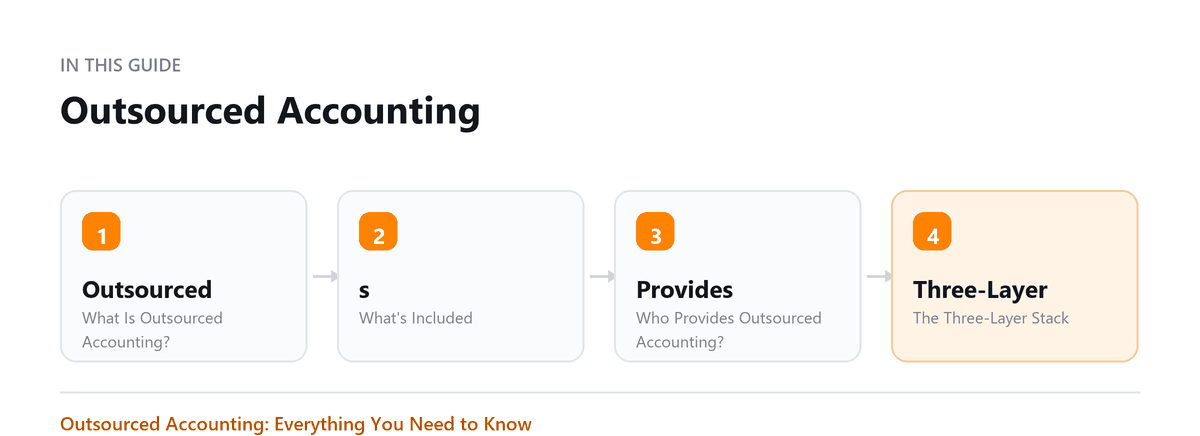
This covers what the term actually means, what is included, who provides it, how the layers stack, how domestic and offshore models compare, who signs, and how data is handled.
Outsourced accounting is a business model where a third-party provider handles some or all of your company's accounting and finance functions. It has evolved from offshore data entry to a full-service model that includes bookkeeping, controller services, CFO advisory, tax prep, and payroll, delivered by a US-aligned team with specialist expertise.
What Is Outsourced Accounting?
Outsourced accounting means your accounting and finance work is handled by an external provider rather than in-house staff. The scope can range from basic bookkeeping to a full fractional finance department. The provider uses your accounting software (or recommends one) and delivers reports, tax filings, and financial advice as if they were internal employees.
Whoever signs the return is responsible for it, and outsourcing does not move that. Ask early which work is done by a licensed professional, which is done by a preparer under review, and whose name goes on what.
Abhinav Gupta, CPA, CA, MBA · LinkedInWhat's Included
- Bookkeeping: recording and categorizing transactions, bank feed reconciliation
- Accounts payable: invoice processing, payment approvals, vendor management
- Accounts receivable: invoicing, payment tracking, collections
- Month-end close: accruals, prepayments, depreciation, reconciliations
- Financial statements: P&L, balance sheet, cash flow
- Payroll processing: payroll runs, tax deposits, W-2 and 1099 filings
- Sales tax: nexus tracking, return prep and filing
- Tax preparation: federal and state business income tax returns
- CFO advisory: budgeting, forecasting, fundraising support
Who Provides Outsourced Accounting?
| Provider Type | Characteristics |
|---|---|
| Full-service firms (e.g. Profitjets) | Team model: bookkeeper + controller + CFO; industry specialization |
| Bookkeeping platforms (e.g. Bench) | Software + human combo; limited to bookkeeping and basic reporting |
| Staffing platforms (e.g. Paro) | Matches you with individual contractors; you manage the relationship |
| Traditional CPA firms | Tax-first; some offer bookkeeping; limited CFO advisory |
| Offshore back-office firms | Cost-competitive; quality varies; US oversight is critical |
The Three-Layer Stack
Outsourced accounting typically has three functional layers:
- Bookkeeping layer: transaction recording, bank reconciliation, basic AP/AR
- Controller layer: month-end close, financial statements, internal controls, audit prep
- CFO layer: strategy, forecasting, fundraising, board reporting, tax strategy
You can buy one layer, two, or all three from the same provider or from different providers. Most small businesses start with the bookkeeping layer and add controller services as they grow.
US vs Offshore vs Hybrid
| Model | Pros and Cons |
|---|---|
| US-based only | Same timezone, cultural alignment; typically 30-50% more expensive |
| Offshore only | Lowest cost; quality and timezone challenges; higher oversight burden |
| Hybrid (offshore prep + US review) | Best value; offshore handles data entry, US CPA reviews and advises; Profitjets model |
Compliance: Who Signs the Return?
Your US CPA (PTIN holder) signs your federal and state income tax returns, regardless of who prepared them. If your outsourced provider prepares the return but is not a licensed CPA firm, they are non-signing preparers. The signing CPA is responsible for the return and should review it thoroughly.
Data Security
Your financial data is sensitive. Evaluate any outsourced provider on:
- Encryption: 256-bit AES minimum for data in transit and at rest
- Access controls: role-based access with MFA required
- Certification: SOC 2 Type II is the standard; ask for the report
- Offboarding: confirm data is returned and deleted when the engagement ends
- NDA: all team members with access to your data should have signed NDAs
How to Choose an Outsourced Accounting Provider
- Define your scope: what do you need (bookkeeping only? full-service? CFO?)
- Identify industry expertise: your provider should have clients like you
- Evaluate software: they should work in your existing systems
- Check references: ask for 2-3 clients at your size and industry
- Review security posture: ask for SOC 2 report and data handling policy
- Understand SLAs: response time, close timeline, report delivery schedule
- Compare pricing: total cost of all layers you need
Book a free consultation and we will put senior eyes on your numbers.
Frequently Asked Questions
How long does it take to onboard?
Typically 2-4 weeks to complete data access setup, review the chart of accounts, and run the first reconciliation. The first clean financial package is usually delivered at the 30-45 day mark.
What if I want to bring accounting back in-house later?
All your data remains in your accounting software (QuickBooks, Xero, NetSuite) and is portable. Your provider should be able to hand off a clean, documented set of books at any time.
Can an outsourced accounting firm represent me in an IRS audit?
A CPA or Enrolled Agent (EA) can represent you before the IRS. If your outsourced firm employs CPAs or EAs, yes. If not, you will need to engage a CPA for audit representation separately.
What service levels are worth agreeing in writing?
The date the monthly accounts are delivered, the turnaround on a query, who covers when the named person is away, and what happens when you supply something late. That last one is the fairest and most often missed: a delivery date only means something if it is conditional on inputs arriving by a stated date. Without it, every late month becomes a disagreement about whose fault it was.
How do we keep control of the parts that matter?
Keep the bank access, the payment approvals and the filing signatures inside the business, and give the provider the access they need to prepare rather than to execute. The distinction is worth being precise about, because it is the difference between an arrangement where somebody else does the work and one where somebody else can move your money.

Written by
Abhinav Gupta, CPA, CA, MBA
Abhinav works with business owners across the US on industry-specific bookkeeping, from dental practices and restaurants to construction and e-commerce. He writes about what each trade's books actually need. Connect on LinkedIn
Free consultation
Want CFO-Level Clarity?
Book a free consultation and we will put senior eyes on your numbers.