
Sending preparation work offshore is now ordinary practice for firms facing more returns than their people can absorb in a season.
The commercial case is usually clear. What needs attention is everything around it: the professional obligations that stay with the firm whoever does the work, the client consents required, and how client data is handled and where it sits.
This covers why firms do it, the economics, how the working day is used across time zones, the process flow, the regulatory framework, and the quality controls that make the arrangement defensible.
Why India Has Become the Default Destination for Tax Outsourcing
India produces more than 700,000 accounting graduates annually. The country has a deep tradition of commerce education, English-language proficiency, and a large population of Chartered Accountants and CPAs trained in US tax. Combined with a 10-12 hour time zone offset that enables overnight turnaround, India offers a structural cost and capacity advantage.
The obligations stay with the firm, so the agreement has to reflect them rather than the provider's standard terms: what may be done with client data, where it is held, who can see it, and what happens when the engagement ends. Add your own review step, and the consents your regulator requires.
Anu Gupta, CA, EA, B.Tech · LinkedInThe Economics: Cost Differential
| Role | US Cost vs India Cost (Annual) |
|---|---|
| Staff Accountant (Tax) | US: $55k-$75k | India: $8k-$15k equivalent |
| Senior Tax Associate | US: $75k-$110k | India: $12k-$25k equivalent |
| Tax Manager | US: $110k-$160k | India: $20k-$40k equivalent |
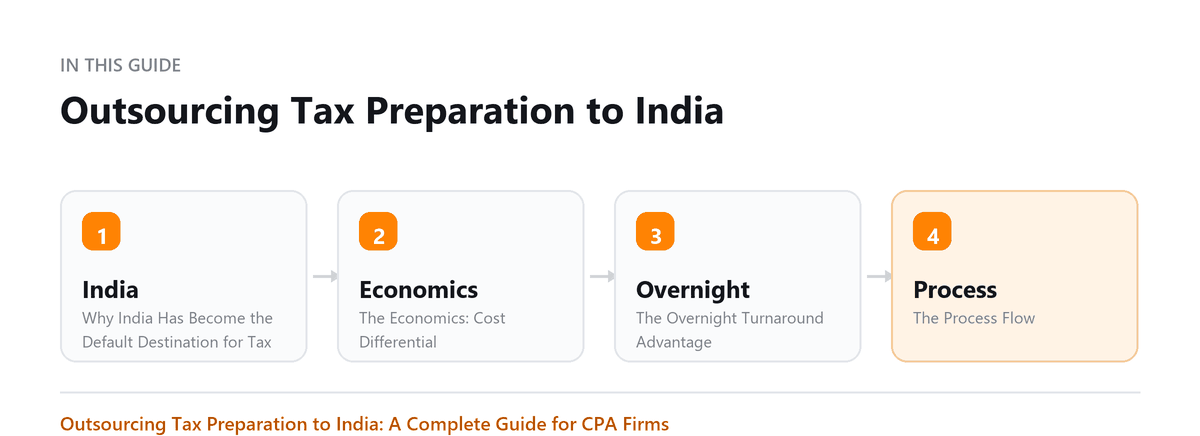
The Overnight Turnaround Advantage
A US CPA firm that sends returns to India at 6 PM EST receives completed or reviewed work by 9 AM EST the next morning. This allows CPA firms to extend their effective working day without overtime costs and to handle volume spikes at peak season.
The Process Flow
- Client sends source documents to US CPA firm (tax organizer, prior return, supporting docs)
- CPA firm uploads documents to a secure portal
- India team downloads documents after US business hours
- India team prepares the return overnight (1040, 1120, 1065, etc.)
- Completed draft return is uploaded before start of US business day
- US CPA reviews the prepared return, makes adjustments, signs as preparer
- Return is delivered to client by US CPA
Regulatory Compliance: Circular 230
Treasury Circular 230 governs practice before the IRS. The US CPA or EA signs the return as the responsible party, the India team is a preparation resource. The US firm is responsible for the quality and accuracy of all returns filed.
IRC Section 7216: Client Consent
Section 7216 requires client consent before tax return information is disclosed to a third party for purposes of tax return preparation. CPA firms must obtain written consent from clients before outsourcing their returns to India. The consent must describe the specific information to be disclosed, the purpose, and the recipient.
Data Security Requirements
- SOC 2 Type II certification from the India provider
- ISO 27001 information security management certification
- Encrypted file transfer (no email attachments of unencrypted client data)
- Non-disclosure and confidentiality agreements with the India entity and all team members
- Access controls: India team accesses only files assigned to them
- Prohibition on personal devices and screen capture for client data
Quality Control Framework
- India team lead reviews all returns before delivery to US firm
- US CPA reviewer checks all returns before signing
- Standardized checklists for each return type (1040, 1120S, 1065)
- Variance tracking: flagging returns where India preparation required significant US correction
- Annual quality review meeting between US firm and India provider
Book a free consultation and we will put senior eyes on your numbers.
Frequently Asked Questions
Do clients need to know their return is being prepared in India?
The IRC 7216 consent process effectively discloses this. Most clients do not object when they understand the US CPA is reviewing and signing the return.
What types of returns are commonly outsourced to India?
Individual 1040s are the most common. Business returns (1120, 1120S, 1065) are also common. Complex estate returns and returns requiring significant judgment are less commonly outsourced.
How do I find a reputable India outsourcing provider?
Look for providers with specific US tax preparation experience (not just Indian CA work), SOC 2 certification, references from US CPA firms, and a defined quality control process. Organizations like the AICPA have resources on offshore outsourcing.
How should the arrangement be documented?
With a written agreement covering confidentiality, what the provider may and may not do with client data, where that data is stored, who has access, how long it is retained and what happens to it when the engagement ends. Add the review and sign-off steps on your side, and the consents your own regulator requires you to obtain from clients. The obligations are on the firm, so the agreement has to reflect them rather than the provider's standard terms.
How do we make the time difference an advantage rather than a friction?
By being disciplined about handover points. The gain comes from work progressing while your office is closed, and that only happens if the day's queries are answered before you finish rather than the next morning. Agree a fixed cut-off for questions and a fixed time for the return of completed work, then hold both sides to it. Without that, the time difference adds a day to every exchange instead of removing one.

Written by
Anu Gupta, CA, EA, B.Tech
Anu works with US businesses on tax and entity questions at Profitjets, from choosing a structure to the filings that follow it. She writes about the decisions owners make once and then live with for years. Connect on LinkedIn
Free consultation
Want CFO-Level Clarity?
Book a free consultation and we will put senior eyes on your numbers.