
The Role of a Virtual CFO for Startups: What They Do and When You Need One
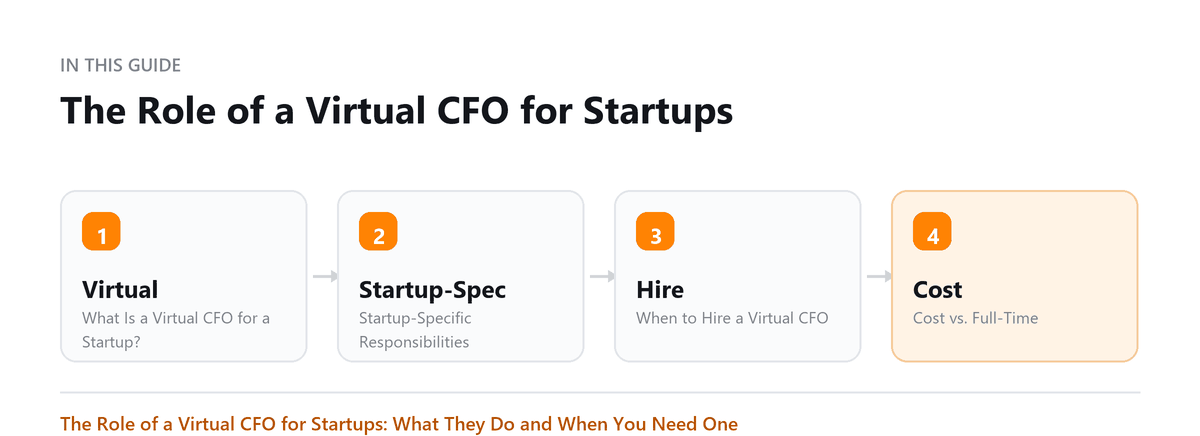
What Is a Virtual CFO for a Startup, Startup-Specific Responsibilities, and When to Hire a Virtual CFO
Startups need senior financial judgement earlier than they can afford to employ it, which is why this arrangement is so common at this stage.
The first output that matters is a runway figure that is maintained rather than remembered. Almost every other decision a startup makes, hiring, pricing, when to start raising, is downstream of knowing how many months are left.
This covers what the role is at this stage, the responsibilities specific to startups, when it is worth bringing in, and how the cost compares with employing somebody.
What Is a Virtual CFO for a Startup?
A virtual CFO (vCFO) provides fractional, remote Chief Financial Officer services to a startup on a part-time basis. The term 'virtual' refers to the delivery model (remote), while 'fractional' refers to the time commitment (part-time). Many vCFOs are both virtual and fractional.
The first thing this role should produce is a cash runway you believe and update. Everything else is downstream of knowing how many months you have, because that number decides hiring, pricing and when to start raising.
Abhinav Gupta, CPA, CA, MBA · LinkedInStartup-Specific Responsibilities
Financial Modeling for Fundraising
A vCFO builds the financial model investors scrutinize during diligence. This includes a bottom-up revenue build, expense model, headcount plan, and three-statement model (P&L, balance sheet, cash flow) with scenarios.
KPI Dashboard
Every startup has a handful of metrics that drive the business. A vCFO identifies, defines, and tracks the right KPIs: MRR/ARR, CAC, LTV, churn, burn, runway, gross margin. These feed the board deck and investor updates.
Burn Rate and Runway Monitoring
Burn rate is the rate at which a startup consumes cash. Runway is months of cash remaining at the current burn rate. A vCFO tracks both in real time and builds a rolling 12-month forecast that updates monthly with actuals.
Hiring Plan Financial Impact
Every hire has a fully-loaded cost (salary, benefits, equipment, recruiting, training) that is 1.3-1.5x base salary. A vCFO models the impact of the hiring plan on burn, cash, and runway before offers are made.
Option Pool Management
The vCFO tracks the option pool: authorized shares, granted shares, exercised options, expired options, and remaining available grants. This feeds the cap table and the ASC 718 accounting done by the accounting team.
Investor Update Financials
Monthly or quarterly investor updates require accurate, well-formatted financials. A vCFO produces the financial section of investor updates and reviews the narrative for consistency with the numbers.
Due Diligence Preparation
When a new round is imminent, a vCFO prepares the data room: historical financials (3 years), cap table, revenue contracts, payroll records, tax returns, and any legal items with financial implications.
When to Hire a Virtual CFO
| Trigger | Why It Matters |
|---|---|
| First institutional raise (Seed or Series A) | Investors expect financial rigor from the outset |
| Board formation | Board members need professional financial reporting |
| Revenue exceeds $500k ARR | Finance function complexity increases significantly |
| 3-6 months before next raise | Model and data room need to be investor-ready |
| New financial system needed | System selection and implementation requires CFO oversight |
Cost vs. Full-Time
A full-time startup CFO costs $200,000-$400,000 per year in total compensation plus 0.5-1.5% equity. A vCFO engagement costs $3,000-$12,000 per month ($36,000-$144,000 per year) with no equity.
Pro Tip: Preserve equity by using a vCFO until a full-time hire is truly necessary. At a $30M Series B valuation, 1% equity is $300,000.
Book a free consultation and we will put senior eyes on your numbers.
Frequently Asked Questions
Does a virtual CFO attend board meetings?
Yes, board meeting attendance is a standard part of a vCFO engagement. They present the financial section and field questions from board members.
Can a virtual CFO help with the SAFE or convertible note math?
Yes. SAFE mechanics, conversion math, pro-forma cap tables post-conversion, and dilution analysis are standard vCFO work.
How is a virtual CFO different from a controller?
A controller manages the accounting function: close, compliance, audit. A vCFO manages strategic finance: planning, fundraising, board. You need both, or a vCFO who oversees an accounting team.
What access should they have, and what should stay with the founders?
Read access to everything and approval rights over nothing, as a starting position. They need the accounting system, the bank data, the cap table and the contracts to do the work. Payment approval and filing signatures belong with the founders or the board. Where the engagement later extends to executing rather than advising, widen it deliberately and in writing rather than by habit.
How do we tell whether the engagement is working?
By whether decisions are getting easier. Concretely: the board pack arrives before the meeting rather than during it, the runway number does not change every time somebody recalculates it, and the questions investors ask are ones you have already asked yourselves. If after two quarters the founders still cannot answer a cash question without a call, the engagement is producing reports rather than capability.

Written by
Abhinav Gupta, CPA, CA, MBA
Abhinav works with business owners across the US on industry-specific bookkeeping, from dental practices and restaurants to construction and e-commerce. He writes about what each trade's books actually need. Connect on LinkedIn
Free consultation
Want CFO-Level Clarity?
Book a free consultation and we will put senior eyes on your numbers.