
Reliable Bookkeeping Services for Startups: What to Look For
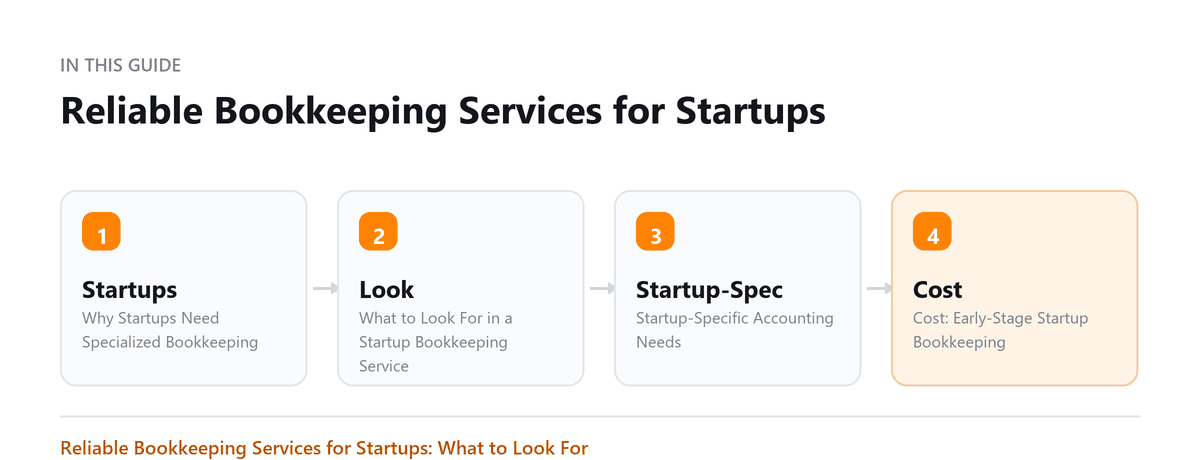
Why Startups Need Specialized Bookkeeping, What to Look For in a Startup Bookkeeping Service, and Startup-Specific
Startup bookkeeping differs from small business bookkeeping in one respect that changes everything: it gets examined by outsiders far sooner.
That examination looks at particular things. Equity records that reconcile, a revenue policy that can be explained, and a runway figure that is maintained rather than recalled when asked.
This covers why the requirements differ, what to look for in a provider, the accounting needs specific to this stage, and what it costs early on.
Startup bookkeeping is not the same as small business bookkeeping. The financial complexity of a venture-backed or high-growth startup, equity transactions, convertible notes, deferred revenue, stock compensation, requires a service that understands the startup ecosystem, not just debits and credits.
Why Startups Need Specialized Bookkeeping
- Investor-ready financials: VCs and angels expect GAAP-basis accrual financials, not cash-basis QuickBooks reports
- Cap table impact: equity issuances, option grants, and SAFE conversions hit the balance sheet and require precise accounting treatment
- Burn rate and runway: investors ask about these weekly; clean books are the only source of truth
- Due diligence readiness: a clean financial history is non-negotiable when a lead investor sends a term sheet
- Tax positions specific to startups: R&D credits (Section 41), Section 174 capitalization, 83(b) elections for founders
A startup's books get examined by outsiders far sooner than a small business's do. Clean records, a defensible equity history and a runway number that is maintained rather than remembered are what that examination actually looks at.
Ankit Sagatani, MBA, B.Com · LinkedInWhat to Look For in a Startup Bookkeeping Service
Startup Experience
Has the firm worked with venture-backed companies? Do they understand SAFEs, convertible notes, preferred stock, and option pool accounting? Ask specifically about their experience with companies at your stage.
Cloud-Native Tools
Any serious startup bookkeeper should work in QuickBooks Online or Xero, connected to your bank feeds. If they ask for Excel exports or paper statements, keep looking.
Scalability
Your bookkeeping needs change fast. A service that handles you at pre-revenue should be able to scale with you through a Series A without you needing to switch providers.
CPA Review Included
Bookkeeping records the transactions. A CPA reviews them to ensure GAAP compliance, catches errors, and handles tax strategy. The best startup bookkeeping packages include a monthly or quarterly CPA review, not just a bookkeeper.
Payroll Integration
Once you have employees, payroll is your largest and most compliance-sensitive expense. Your bookkeeping service should integrate with a payroll platform (Gusto is the startup standard) to ensure journal entries, tax deposits, and benefit deductions are reflected correctly.
Startup-Specific Accounting Needs
| Startup Transaction | Accounting Consideration |
|---|---|
| SAFE or convertible note issuance | Liability or equity treatment; bifurcation of derivative features |
| Series A preferred stock | Equity section structure; preferred dividends; liquidation preference disclosure |
| Stock option grants | ASC 718 stock compensation expense; Black-Scholes valuation |
| Deferred revenue (SaaS or prepaid contracts) | Revenue recognition per ASC 606; monthly recognition schedule |
| R&D payroll | Documentation for Section 41 R&D credit; QRE tracking |
| Section 174 R&D capitalization | Post-2022 requirement to capitalize R&D over 5 or 15 years |
Cost: Early-Stage Startup Bookkeeping
Most startups in the pre-revenue to $1M ARR range spend $300-$1,000/month on bookkeeping, depending on transaction volume and whether payroll and CPA review are included. This is one of the best investments a startup can make, clean books are a competitive advantage at fundraising time.
Book a free consultation and we will bring them current.
Frequently Asked Questions
Do I need accrual accounting as a startup?
If you are raising venture capital or have deferred revenue (common in SaaS), yes. Cash basis will not give investors or auditors what they need. Start on accrual from the beginning if you can.
When should a startup hire a full-time controller or CFO?
Most startups can use a fractional CFO and outsourced bookkeeping through Series A. A full-time controller makes sense around $5M ARR or when financial complexity (multi-entity, international, complex revenue recognition) justifies dedicated headcount.
What happens to our books if we raise a round?
Your lead investor's counsel will conduct financial due diligence. They will request 2-3 years of financial statements, a cap table, bank statements, and tax returns. Clean, reconciled, accrual-basis books make this process significantly faster and cheaper.
What should we ask a provider before signing?
Four things: who will actually do the work and what else they carry, what the monthly timetable is and what they need from you to hit it, what happens if that person leaves, and how the relationship ends if it is not working. The last one is the most revealing. A provider who has a clear, unemotional answer about handing your data back has thought about the relationship as a service rather than as a lock-in.
How much of this can wait until after the first funding round?
Less than founders hope, because the round itself is what tests the records. Diligence asks for monthly accounts, a cap table that agrees with the corporate records, and an explanation of every material balance, and assembling that retrospectively under a deadline is where deals slow down. Keeping the books current from the start is cheaper than reconstructing them at the exact moment your attention is needed elsewhere.

Written by
Ankit Sagatani, MBA, B.Com
Ankit works with business owners across the US on industry-specific bookkeeping, from real estate to construction and retail. He writes about what each trade's books actually need. Connect on LinkedIn Connect on LinkedIn
Free consultation
Books Behind?
Book a free consultation and we will bring them current.