
Small business bookkeeping is a short list of practices done consistently, and most of the difficulty is in decisions made at the very start.
How the accounts are structured, whether entries are recorded in pairs, and which basis you report on all set what your numbers can tell you later. Changing any of them mid-year is what makes periods incomparable.
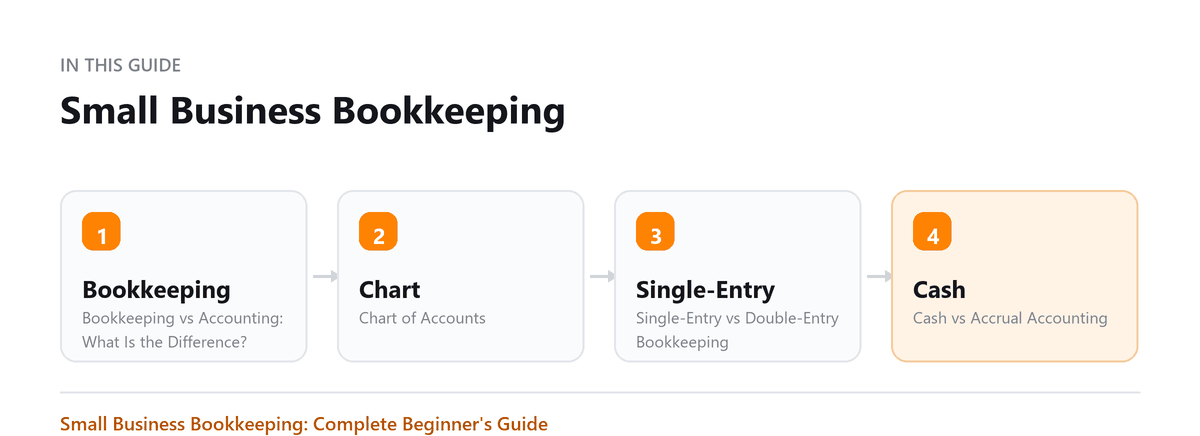
This covers how bookkeeping differs from accounting, how to set up the chart of accounts, the two recording methods, the two accounting bases, what to track, a monthly close checklist, and the reports it all produces.
If you just started a business and someone told you that you need to do bookkeeping, this guide explains exactly what that means, what you need to track, which software to use, and when to get help. No jargon. Practical from the first page.
Bookkeeping vs Accounting: What Is the Difference?
| Bookkeeping | Accounting |
|---|---|
| Recording daily transactions | Analyzing and interpreting financial data |
| Reconciling bank statements | Preparing tax returns |
| Categorizing expenses | Financial planning and forecasting |
| Generating invoices | Advising on business structure |
| Producing basic reports | Filing payroll tax returns |
Bookkeeping is the foundation. Accounting builds on it. Most small businesses need both, though the bookkeeping can often be handled by a non-CPA or software, while the accounting requires a licensed professional.
Set the chart of accounts up for the questions you want answered, then leave it alone. Accounts added mid-year to solve a one-off problem are what make comparisons across periods meaningless.
Ankit Sagatani, MBA, B.Com · LinkedInChart of Accounts
The chart of accounts is a categorized list of every account in your financial system. Every transaction gets coded to an account. The five main categories:
- Assets: what you own (cash, accounts receivable, equipment, inventory)
- Liabilities: what you owe (accounts payable, loans, credit cards, payroll taxes due)
- Equity: what is left for the owner (paid-in capital, retained earnings, owner draws)
- Revenue: money earned from selling your product or service
- Expenses: costs of running the business (rent, payroll, supplies, software)
Pro Tip: Start with the default chart of accounts in QuickBooks or Xero and only add accounts as you genuinely need them. Businesses with 200 accounts are not more sophisticated, they are harder to manage.
Single-Entry vs Double-Entry Bookkeeping
Single-entry: record one line per transaction (like a checkbook register). Simple but limited, does not produce a balance sheet. Double-entry: every transaction hits at least two accounts (debit one, credit another). This is GAAP-compliant, produces full financial statements, and catches errors through the balance requirement. Any accounting software uses double-entry automatically.
Cash vs Accrual Accounting
| Cash Basis | Accrual Basis |
|---|---|
| Record when cash changes hands | Record when transaction occurs |
| Simpler, fewer entries | More complex, more accurate |
| Good for very small, simple businesses | Required for inventory businesses |
| Cannot produce true accounts receivable/payable | Full balance sheet |
| IRS allows for businesses under $27M in gross receipts | Standard for investors and banks |
What to Track
- All income: sales, service revenue, interest, other income
- All business expenses: get a receipt for everything
- All bank and credit card transactions
- Accounts receivable: invoices you have sent but not been paid
- Accounts payable: bills you have received but not yet paid
- Payroll: wages, employer taxes, benefits
- Assets purchased: equipment, vehicles, computers
- Loans and debt: opening balance, payments, remaining balance
Monthly Close Checklist
- Categorize all bank feed transactions
- Enter any bills not captured via bank feed
- Send and follow up on outstanding invoices
- Reconcile all bank and credit card accounts
- Review P&L: does revenue look right? Any expenses that seem wrong?
- Review Balance Sheet: does equity make sense?
- File payroll taxes if due
- Pay sales tax if due
Basic Financial Reports
- Profit and Loss (Income Statement): revenue minus expenses = net income
- Balance Sheet: snapshot of assets, liabilities, and equity at a point in time
- Cash Flow Statement: how cash moved in and out during the period
- Accounts Receivable Aging: who owes you money and for how long
- Accounts Payable Aging: what you owe and when it is due
Software Options
| Software | Best For |
|---|---|
| QuickBooks Online | Most US small businesses; largest support ecosystem |
| Xero | International or businesses wanting unlimited users |
| FreshBooks | Service businesses and freelancers |
| Wave | Freelancers and very small businesses (free) |
When to Hire Help
- When you are spending more than 5 hours per month on your own books
- When you have employees
- When you carry inventory
- When you cannot reconcile your bank account
- When a lender or investor asks for financial statements
- When you are behind on taxes or unsure about sales tax obligations
Book a free consultation and we will bring them current.
Frequently Asked Questions
Do I need a separate business bank account?
Yes, absolutely. A dedicated business account is the most important bookkeeping decision you can make. It creates a clear record, simplifies tax preparation, and protects you legally.
How long should I keep financial records?
IRS recommends keeping business records at least 3-7 years. Keep tax returns indefinitely. For records relating to property, keep them as long as you own the property plus 7 years.
What is the difference between a bookkeeper and a CPA?
A bookkeeper records and categorizes transactions. A CPA (Certified Public Accountant) is a licensed professional who can prepare tax returns, conduct audits, provide financial planning advice, and represent you before the IRS.
How much of this can realistically be done by the owner?
More than most people expect, for longer than most people expect, provided two conditions hold: the business has one bank account it uses for everything, and the owner does the reconciliation every month without fail. The point at which it stops working is rarely complexity. It is time: the hour a month becomes three, then gets skipped, and three skipped months is a far larger job than the nine that were kept current.
What records need to be kept, and for how long?
The supporting evidence behind every figure, not only the figures themselves: invoices issued and received, bank statements, payroll records, contracts, and anything documenting an asset you own. Retention periods are set by the tax authority and by your state, and they differ by record type, so take the period from their current guidance rather than from a rule of thumb. Storing them digitally is generally accepted and is far easier to search.

Written by
Ankit Sagatani, MBA, B.Com
Ankit works with business owners across the US on industry-specific bookkeeping, from real estate to construction and retail. He writes about what each trade's books actually need. Connect on LinkedIn Connect on LinkedIn
Free consultation
Books Behind?
Book a free consultation and we will bring them current.