
Virtual Assistants for CPA Firms: What They Can Do and How to Find One
What Virtual Assistants Can Do for CPA Firms, What Virtual Assistants Cannot Do, and Where to Find a VA for Your CPA
Accounting firms carry a great deal of administrative work that does not require a licence, and delegating it has become common practice.
What does not delegate is responsibility for client data. The controls that apply to an employee apply to anybody else touching those files, and they have to be in place before the first document is shared.
This covers what this kind of support can genuinely take on, what it cannot, where firms find people, what it costs, the confidentiality obligations involved, and what the engagement letter should say.
CPA firms are chronically understaffed during tax season and chronically underutilize virtual assistants during the rest of the year. A skilled VA can offload a meaningful share of the administrative burden, without taking on work that requires a CPA license.
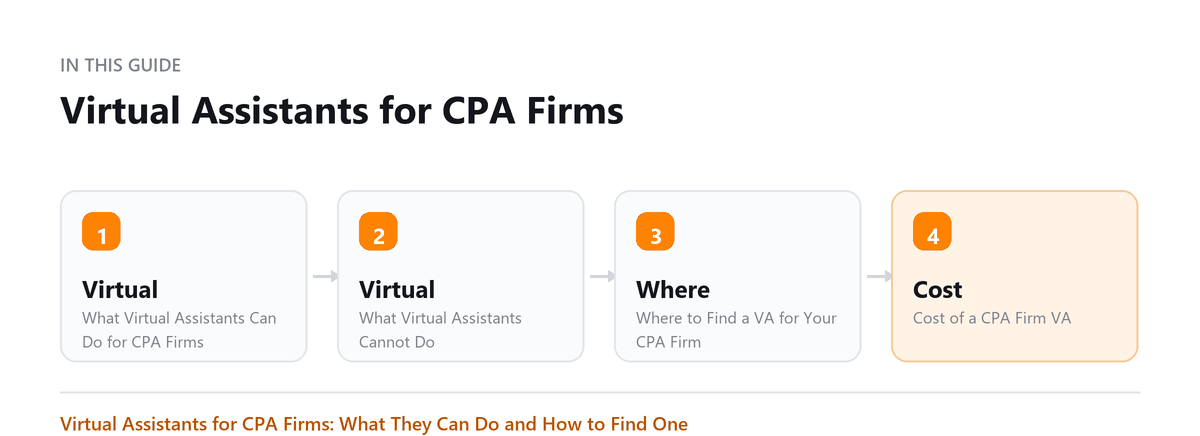
What Virtual Assistants Can Do for CPA Firms
- Document collection: follow up with clients who have not uploaded W-2s, 1099s, or bank statements; log what has arrived and what is missing
- Client follow-up: send reminder emails, schedule calls, confirm appointments
- Scheduling: manage the CPA's calendar, book client consultations, set up video calls
- Data entry: input information from source documents into tax organizers or data collection forms (not tax software)
- Tax organizer distribution: send organizers, track completion, send reminders for missing pages
- Administrative support: invoice clients, track payments, update CRM records
- Research: look up IRS publication references, state tax agency contact information, fee schedules (factual research, not tax advice)
- Social media and content scheduling: post pre-approved content, manage the firm's LinkedIn or email newsletter calendar
Client data leaving the firm needs the same controls whether the person handling it is employed or not. Confidentiality terms, restricted access and a written engagement come before the first file is shared, not after.
Ankit Sagatani, MBA, B.Com · LinkedInWhat Virtual Assistants Cannot Do
- Provide tax advice or answer client tax questions
- Prepare or review tax returns
- Make representations to the IRS on behalf of clients
- Sign tax documents
- Exercise professional judgment on accounting or tax positions
- Access client financial data beyond what is necessary for their administrative task
Where to Find a VA for Your CPA Firm
| Source | Notes |
|---|---|
| Upwork | Freelance marketplace; wide price range; verify bookkeeping or admin experience |
| BELAY | US-based VAs; vetting included; more expensive but higher reliability |
| Time Etc | UK-based, US clients; experienced professionals; flat monthly pricing |
| Boldly | Premium subscription VA service; dedicated assistant model |
| MyOutDesk | Real estate and professional services focus; trained VAs |
| Fiverr Business | Entry-level tasks; use for specific, bounded deliverables only |
Cost of a CPA Firm VA
Rates range from $15/hour (offshore, general admin) to $50/hour (US-based, specialized). Most CPA firms use offshore VAs for pure administrative tasks and US-based VAs for client-facing roles where communication quality matters. A dedicated part-time VA at 20 hours/week runs $1,200-$4,000/month depending on market.
Privacy and Confidentiality Considerations
Client tax and financial information is highly sensitive. Before engaging a VA, ensure:
- The VA signs a Non-Disclosure Agreement (NDA) covering client data
- The VA only accesses systems and data necessary for their specific tasks
- Client portal access is limited and logged
- The VA does not store client data on personal devices
- The arrangement complies with any state-level CPA firm confidentiality regulations
Engagement Letter for the VA Relationship
Treat the VA like a subcontractor. Issue a written agreement that specifies: scope of tasks, authorized data access, confidentiality obligations, NDA, payment terms, and termination process. Some CPA firms also require clients to acknowledge that a VA (or other administrative staff) may assist with document collection, this is good practice for transparency.
Book a free consultation and we will bring them current.
Frequently Asked Questions
Does a CPA need to supervise a VA?
Yes. The CPA firm is responsible for all work product and client interactions that flow through the firm. Supervise VA work, review client-facing communications before they go out, and audit access logs periodically.
Can a VA use tax software like ProConnect or UltraTax?
A VA should not access tax software to input return data. That crosses into tax preparation. Data entry into client-facing organizer forms or CRM systems is different. Draw a clear line and document it in your VA's scope of work.
Is it cheaper to hire a VA than a part-time staff member?
Often yes, for pure administrative tasks. A VA has no payroll taxes, no benefits, and no physical office cost. For any role requiring client judgment or confidentiality responsibility, a vetted employee may be the safer choice.
What does the firm remain responsible for when work is delegated?
All of it. Delegating a task does not delegate the professional obligation attached to it, so the firm remains responsible for the quality of the work, for the confidentiality of client information, and for the review that catches an error before it reaches a client. That is not a reason to avoid delegating; it is the reason the review step has to be real rather than nominal.
What should the client be told?
What your professional body and your engagement terms require, which varies, and it is worth checking rather than assuming. As a matter of practice, clients tend to react badly to discovering an arrangement rather than to the arrangement itself. Saying plainly in the engagement letter that some work is performed by contracted staff under the firm's supervision, with confidentiality obligations in place, removes the problem before it arises.

Written by
Ankit Sagatani, MBA, B.Com
Ankit works with business owners across the US on industry-specific bookkeeping, from real estate to construction and retail. He writes about what each trade's books actually need. Connect on LinkedIn Connect on LinkedIn
Free consultation
Books Behind?
Book a free consultation and we will bring them current.