
Several reliefs reduce what a Texas property owner pays, and most of them are not applied automatically simply because somebody qualifies.
They have to be claimed, several have to be claimed in the year eligibility first arises, and the circumstances that create eligibility are exactly the ones when people are least likely to be thinking about a form.
This covers the reliefs available, who qualifies for each, how and when to apply, and what happens to them when a property changes hands or an owner's circumstances change.
Overview: Texas Property Taxes
Texas has no state income tax, but property taxes are among the highest in the nation. The average effective property tax rate is around 1.6-1.8%, making relief programs essential for homeowners and landowners.
Good news: Texas lawmakers passed SB 2 and HB 3 in 2023, significantly expanding relief options. Here is a complete guide to every program available to you.
Reliefs here are not applied automatically simply because you qualify. Most require an application, and several have to be claimed in the year you first become eligible. Check what you are entitled to when circumstances change rather than waiting for a bill to prompt you.
Anu Gupta, CA, EA, B.Tech · LinkedIn2023 Legislative Changes: SB 2 and HB 3
Senate Bill 2 (SB 2) increased the homestead exemption from $40,000 to $100,000 for school district taxes. This applies to your primary residence and takes effect for the 2023 tax year and forward.
- Homestead exemption for school taxes raised to $100,000
- Additional $10,000 exemption for over-65 and disabled homeowners on school taxes
- HB 3 provided $12.7 billion in property tax relief statewide
- Appraisal increases for non-homestead properties capped at 20% annually (temporary)
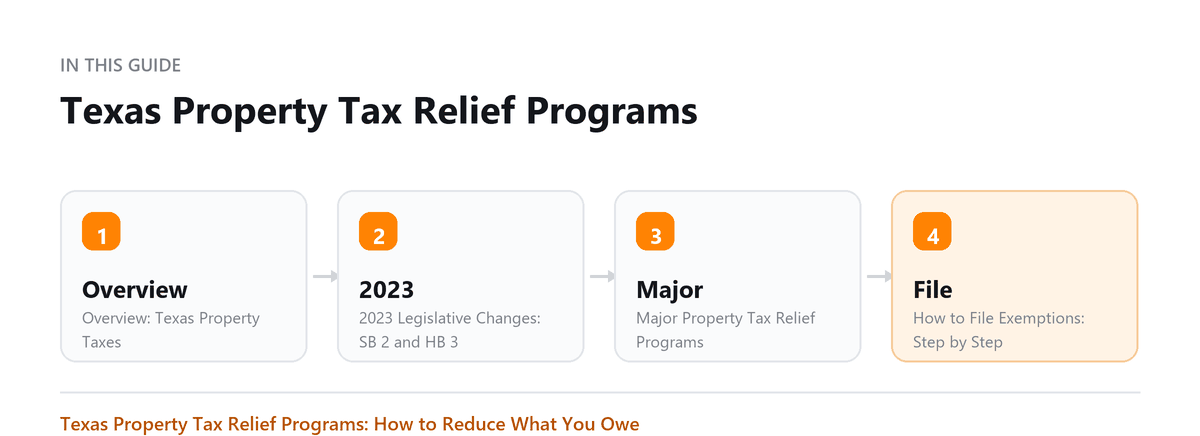
Major Property Tax Relief Programs
1. Homestead Exemption
The homestead exemption reduces the appraised value of your primary residence for tax purposes. You must own and occupy the home as your principal residence on January 1 of the tax year.
- School district exemption: $100,000 (as of 2023)
- County optional exemption: up to 20% of appraised value (minimum $5,000)
- City optional exemption: varies by municipality
- File Form 50-114 with your county appraisal district (CAD)
- No annual renewal required once approved
Pro Tip: The homestead exemption is the single most valuable property tax break for most Texas homeowners. File as soon as you move in.
2. Over-65 Exemption
Homeowners who are 65 or older receive an additional $10,000 school district exemption on top of the standard homestead exemption. More importantly, they receive a tax freeze.
- Additional $10,000 school district exemption
- School taxes are frozen at the level when you turn 65 (or when you first qualify)
- If improvements are made, freeze may be recalculated
- Surviving spouse (55 or older) can maintain the freeze
- Apply with Form 50-114 including proof of age
3. Disability Exemption
Homeowners with a qualifying disability receive the same benefits as the over-65 exemption: additional $10,000 school exemption plus a tax freeze.
- Must be classified as disabled under Social Security Act standards
- Alternatively, 100% VA disability rating qualifies
- Cannot receive both over-65 and disability exemptions simultaneously (take the more beneficial)
- Apply with Form 50-114 plus proof of disability
4. Agriculture Exemption (1-d-1 Open Space Appraisal)
Agricultural land can be appraised based on its productive capacity rather than market value, resulting in dramatically lower assessments.
- Land must have been used for agriculture for at least 5 of the preceding 7 years
- Covers: farming, ranching, timber, beekeeping, wildlife management
- Rollback tax applies if land use changes (taxes for up to 5 prior years plus interest)
- Apply via Form 50-129 with the county appraisal district
- Renewal may be required annually
Pro Tip: Beekeeping can qualify even small suburban lots for ag exemption in some Texas counties. Minimum 5-20 acres depending on county.
5. Protest Your Appraised Value
Every Texas property owner has the right to protest their appraised value with the Appraisal Review Board (ARB). The deadline is typically May 15 or 30 days after receiving your appraisal notice, whichever is later.
Grounds for protest:
- Market value: your property is appraised above what it would sell for
- Unequal appraisal: your property is appraised higher than comparable properties
- Exemption denial
- Incorrect property description
Protest Tips
- Gather comparable sales (comps) from Zillow, HAR, NTREIS, or your county records within the last 6-12 months
- Look up neighboring properties in the CAD database and compare assessments per square foot
- Document any deficiencies: foundation issues, roof condition, outdated systems
- File a timely protest and request the informal hearing first
- Escalate to the ARB if the informal resolution is unsatisfactory
- Arbitration is available if ARB value exceeds $1 million and you dispute by more than the lesser of $500k or 25%
Pro Tip: Third-party protest services typically work on contingency (they keep 25-50% of savings). Worth it if you don't want to do the legwork yourself.
6. Installment Payment Plans
Texas allows installment payments for certain taxpayers:
- Homeowners over 65, disabled, or with a disability rating: can pay in 4 installments
- First installment due by January 31, remainder quarterly
- No additional fee if on-time
- Contact your county tax assessor-collector to set up
7. Deferral for Seniors and Disabled Homeowners
Seniors (65+) and disabled homeowners can defer payment of property taxes on their homestead indefinitely. A lien remains on the property and interest accrues at 5% per year, but no foreclosure can occur while the deferral is in effect.
- File Form 50-126 with the county appraisal district
- Deferral ends when the property is sold or the qualifying owner dies
- Estate must then pay the deferred taxes plus interest
- Interest is 5% per year (much lower than most financing alternatives)
How to File Exemptions: Step by Step
- Identify your county appraisal district (e.g., HCAD for Harris County, DCAD for Dallas)
- Download the appropriate exemption form (Form 50-114 for homestead)
- Attach required documents: driver's license showing property address, proof of age/disability if applicable
- Submit by April 30 of the tax year (late applications accepted through the end of the year in some cases)
- Check your next appraisal notice to confirm the exemption was applied
Book a free consultation and we will take the return off your desk.
Frequently Asked Questions
Can I get both homestead and over-65 exemptions?
Yes. The over-65 exemption stacks on top of the homestead exemption.
What if I miss the protest deadline?
You can file a late protest for certain reasons (e.g., newly discovered evidence), but the May 15 deadline is firm for most cases.
Do exemptions transfer when I buy a new home?
No. You must re-apply at your new primary residence.
Is the homestead exemption automatic?
No. You must file Form 50-114 with your county appraisal district.
How much can I save with a protest?
Savings vary widely. Successful protests average $400-$1,200+ per year depending on property value and county.

Written by
Anu Gupta, CA, EA, B.Tech
Anu works with US businesses on tax and entity questions at Profitjets, from choosing a structure to the filings that follow it. She writes about the decisions owners make once and then live with for years. Connect on LinkedIn
Free consultation
Want the Filing Handled?
Book a free consultation and we will take the return off your desk.