
Top 10 Businesses to Start in 2026 (With Financial Reality Checks)
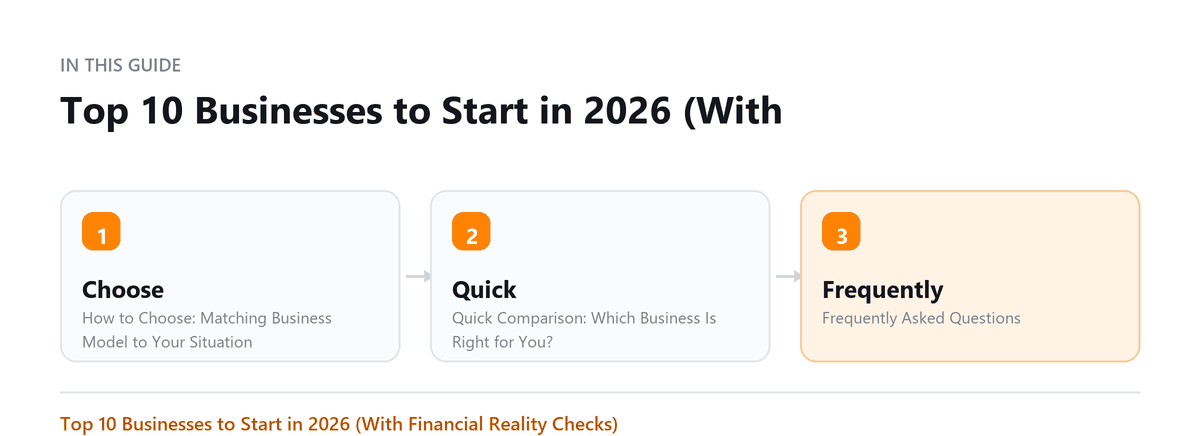
How to Choose: Matching Business Model to Your Situation and Quick Comparison: Which Business Is Right for You
Lists of businesses to start are usually ranked by what they can earn, which is the least useful way to read them.
What decides whether you last long enough to find out is different: how much capital is needed before anything comes back, how long until the first payment, and whether the thing can run when you are not there.
This covers each option against those criteria rather than against revenue potential alone, and how to match a model to your own situation.
How to Choose: Matching Business Model to Your Situation
The best business to start depends on your capital, skills, risk tolerance, and time horizon. This guide evaluates the top 10 business types on startup cost, profit margins, scalability, and the honest challenges most guides gloss over.
1. Agency (Marketing, Accounting, Recruiting, or Consulting)
Startup cost: Very low ($2,000-$10,000 for software, website, and tools). Margins: High (40-70% gross margin if you are the primary provider). Scalability: Medium, scales with people, but people are hard to manage.
- Low capital barrier, primarily your expertise and time
- Fastest path to $10k/month for skilled professionals
- Challenge: revenue is tied to you personally until you can systematize and delegate
- Key financial metric: revenue per billable hour or revenue per employee
Pro Tip: Start a service agency in the field you have the most expertise. Accountants who start accounting firms, marketers who start marketing agencies, expertise creates pricing power.
2. E-Commerce (Physical Products)
Startup cost: Medium ($5,000-$50,000 for inventory, branding, and initial ads). Margins: Variable (20-50% gross margin; lower for competitive categories). Scalability: High, products can sell while you sleep.
- Amazon and Shopify lower the barrier to global sales
- Challenge: customer acquisition cost and inventory capital are significant
- Working capital intensive: you pay for inventory before you receive payment
- Key risk: a single product failure or Amazon policy change can wipe your investment
3. SaaS (Software as a Service)
Startup cost: High ($50,000-$500,000+ to build and launch; lower with no-code tools). Margins: Very high once built (60-80% gross margin). Scalability: Extremely high, one software instance serves thousands.
- Long initial runway needed: 12-24 months before meaningful revenue is common
- Requires either technical co-founder or outsourced development budget
- Best financial model: recurring subscription, predictable LTV
- Key metric: CAC payback period and net revenue retention
4. Freelance or Independent Consulting
Startup cost: Very low (under $2,000). Margins: Very high (80%+ if you are solo). Scalability: Low, capped by your hours unless you productize or hire.
- Fastest to first dollar
- No business to sell later, selling your practice requires significant systemization
- Health insurance, retirement, and benefits must be self-funded
- Key metric: effective hourly rate (total income / total hours including non-billable)
5. Real Estate Investment
Startup cost: High ($50,000+ for down payments; varies by strategy). Margins: Moderate (net yields of 6-12% on well-selected properties). Scalability: Medium (leveraged with debt; BRRRR method accelerates portfolio growth).
- Long-term wealth builder; not a replacement for income immediately
- Requires capital, credit, and patience
- Property management is a real cost, self-management is a job
- Tax benefits: depreciation, 1031 exchanges, mortgage interest deduction
6. Restaurant or Food Business
Startup cost: High ($150,000-$1,000,000+ for full-service restaurant). Margins: Very low (3-9% net margin is considered healthy). Scalability: Hard.
- Highest failure rate of any business category (60%+ close within Year 1 per industry data)
- Labor-intensive: managing kitchen and front-of-house staff is extraordinarily difficult
- Better entry points: food truck ($50,000-$100,000), ghost kitchen, catering
- Key financial metric: food cost percentage (target under 30%) and labor cost percentage
7. Cleaning Services (Residential or Commercial)
Startup cost: Low ($2,000-$15,000 for equipment, supplies, insurance, and vehicle). Margins: Good (30-50% gross). Scalability: Good, hire cleaners, build recurring route.
- Recurring revenue: weekly and bi-weekly clients create predictable cash flow
- Low tech barrier: operational discipline and reliability win customers
- Growth lever: commercial contracts (offices, medical facilities) provide volume
- Key challenge: worker turnover, quality control, and customer complaints
8. Tutoring or Coaching Business
Startup cost: Very low (under $5,000). Margins: High (70%+ if solo). Scalability: Medium (group programs, online courses, cohort-based learning).
- High-demand categories: test prep (SAT, GRE, GMAT, CPA), skills training, career coaching
- Online delivery removes geography constraints
- Premium pricing available for niche expertise
- Scale challenge: you are the product; replace yourself with system or hire coaches
9. Content Creation (YouTube, Podcast, Newsletter)
Startup cost: Low ($1,000-$5,000 for equipment). Margins: Very high once monetized. Scalability: High, content compounds.
- Long ramp time: 12-24 months before meaningful monetization for most creators
- Revenue diversification: ads, sponsorships, courses, communities, consulting
- Powerful long-term business asset: audience is a moat
- Most people quit before reaching monetization threshold
10. Franchise
Startup cost: High ($100,000-$1,000,000+). Margins: Varies by brand and operations. Scalability: Good if you can open multiple units.
- Proven business model with brand recognition and support system
- Royalties and brand restrictions reduce your flexibility and margin
- SBA financing widely available for franchise businesses
- Due diligence: read the FDD carefully, especially Item 19 (financial performance) and Item 21 (financial statements)
Start from what the business demands of you rather than from what it earns. Capital needed, time before the first payment, and whether it can run without you present are what decide whether you can actually hold on long enough to find out if it works.
Abhinav Gupta, CPA, CA, MBA · LinkedInQuick Comparison: Which Business Is Right for You?
| Business Type | Best For |
|---|---|
| Agency/consulting | Skilled professionals with expertise to sell |
| E-commerce | Product-focused operators with inventory capital |
| SaaS | Technical founders with long runway tolerance |
| Freelance | Quickest income; solo operators |
| Real estate | Capital-rich, long-term wealth builders |
| Restaurant | Passionate operators who know the industry reality |
| Cleaning services | Operators who want recurring revenue with low tech |
| Tutoring/coaching | Subject matter experts who want flexibility |
| Content creation | Patient brand builders with long-term vision |
| Franchise | Operators who want a proven system with support |
Book a free consultation and we will put senior eyes on your numbers.
Frequently Asked Questions
What business can I start with $5,000 or less?
Freelance consulting, agency, tutoring/coaching, content creation, or cleaning services can all be launched for under $5,000. Avoid e-commerce, real estate, SaaS, restaurant, and franchise at this capital level.
Which of these businesses can I run part-time?
Freelancing, content creation, real estate investing, and e-commerce are most compatible with part-time operation. Agency, cleaning services, and restaurants require more active involvement, especially early.
How do I know if my business idea will be profitable?
Before investing capital, build a simple one-page financial model: estimated revenue per unit, cost per unit, monthly fixed overhead, and break-even volume. If your break-even requires an unrealistic number of customers, revisit the model before launching.
What should be in place before taking the first payment?
A decision on the entity and, if you have formed one, the paperwork behind it; a bank account in the business name; a way to invoice; and a clear idea of what you will owe and when. That last one catches most people out, because the first year's obligations arrive after the money has been spent. Setting aside a proportion of every receipt from the first one is the simplest protection against it.
How do we test an idea without committing to it?
Sell it before you build it, in whatever form that takes: take a deposit, run a small paid pilot, or fulfil the first orders manually rather than automating anything. The information you want is whether somebody will pay, and that is only answered by somebody paying. Surveys, interest and encouragement from people who are not buying tell you almost nothing, and they are the cheapest evidence to collect, which is why they are the most common.

Written by
Abhinav Gupta, CPA, CA, MBA
Abhinav works with business owners across the US on industry-specific bookkeeping, from dental practices and restaurants to construction and e-commerce. He writes about what each trade's books actually need. Connect on LinkedIn
Free consultation
Want CFO-Level Clarity?
Book a free consultation and we will put senior eyes on your numbers.