
US Company Registration Guide: Everything You Need to Register a Business
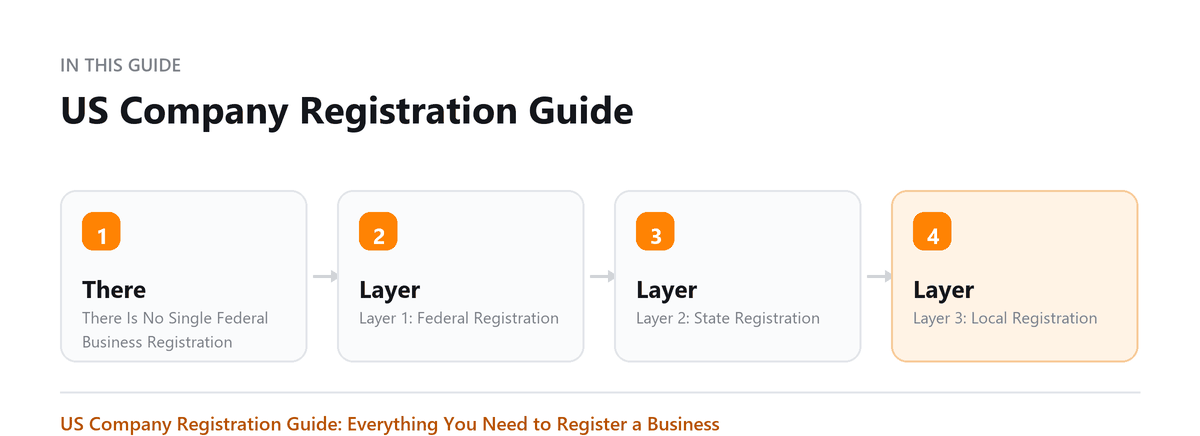
There Is No Single Federal Business Registration, Layer 1: Federal Registration, and Layer 2: State Registration
There is no single registration that puts a business on the record, which is the thing people most often assume.
Registration happens in layers, federal, state and local, and each has its own requirements and its own timing. A properly formed company can still be operating without a permit it needed from the first day of trading.
This covers each layer in turn, what is registered where, when a trading name has to be recorded separately, when a sales tax permit is required, and what hiring adds to the list.
There Is No Single Federal Business Registration
Unlike many countries, the US has no central federal business registry. Registering a US business means navigating federal, state, and sometimes local requirements, each with different rules, fees, and timelines.
There is no single registration that covers everything, and that is what catches people out. Federal, state and local each have their own requirements, and a business can be properly formed and still be operating without a permit it needed from day one.
Abhinav Gupta, CPA, CA, MBA · LinkedInLayer 1: Federal Registration
At the federal level, there is no registration of the business entity itself. Instead, you register with federal agencies for specific purposes:
| What You Need | Federal Agency/Form |
|---|---|
| Tax ID (EIN) | IRS, Form SS-4 or online application |
| Employer registration (if hiring) | IRS, Form 941 payroll tax registration |
| Federal business license (industry-specific) | Varies, ATF (firearms), TTB (alcohol), FCC (broadcasting), SEC (investment) |
| Trademark registration | USPTO |
| Patent registration | USPTO |
| Import/Export | US Census Bureau AES, CBP |
| BOI Report | FinCEN (Financial Crimes Enforcement Network) |
Layer 2: State Registration
This is where your business entity is created. Every business operates under the authority of a state:
Entity Formation
File formation documents with the state where you want to be incorporated:
- LLC: Articles of Organization (or Certificate of Formation in Delaware/California)
- Corporation: Articles of Incorporation (or Certificate of Incorporation in Delaware)
- Partnership: Certificate of Limited Partnership (for LPs)
- Sole proprietorship: No filing required (but register a DBA if using a business name)
Foreign Qualification
If you incorporate in Delaware but operate in another state (have employees, offices, or ongoing business activity), you must register as a foreign entity in the operating state:
- File a Statement of Foreign Qualification (or Certificate of Authority) with the operating state
- Appoint a registered agent in the operating state
- Pay the operating state's filing fees and ongoing taxes
- File annual reports in both states
Pro Tip: Delaware + California is the most common combination for startups. If you have employees, offices, or significant sales in California, you must register there. Minimum $800 annual California franchise tax applies.
State Tax Registrations
Once your entity is formed, register for state-level taxes that apply:
- State income tax withholding: Required if you have employees. Register with the state department of revenue.
- Sales tax permit: Required if you sell taxable goods or services and have nexus in the state.
- Unemployment insurance (SUTA): Required if you have employees. Register with the state workforce agency.
- State corporate income tax: Most states require an annual corporate return separate from federal.
Layer 3: Local Registration
Cities and counties may require:
- Local business license: Many cities require a general business license ($50-$500/year). Examples: Los Angeles, New York City, Chicago.
- Home occupation permit: If operating from a residential address
- Zoning compliance: Certain business types have zoning restrictions
- Building permits: For physical storefronts or offices with construction
- Health department permits: Restaurants, food businesses, childcare
- Fire department inspection: Restaurants, public venues
DBA (Doing Business As) / Fictitious Business Name
A DBA allows your business to operate under a name different from its legal name. A sole proprietor named 'John Smith' can operate as 'Smith Digital Marketing' by filing a DBA. An LLC named 'Acme Holdings LLC' can operate as 'Acme Software' via a DBA.
- Filed at the county or state level (varies by state)
- Cost: $10-$100 typically
- Does not create a separate legal entity, just registers the name
- Required to open a bank account under the DBA name
- Some states require publication of DBA in a local newspaper
Sales Tax Permit Registration
If you sell taxable products or services and have nexus (physical or economic) in a state, you must register for a sales tax permit before making taxable sales:
- Physical nexus: Office, employees, inventory, or significant property in the state
- Economic nexus: $100,000 in sales or 200 transactions in the state (post-Wayfair, applies in 45 states)
- Registration: Most states offer online registration through their department of revenue
- Permit is usually free or low cost
- Must collect and remit sales tax on taxable sales in the state
Employer Registration (If Hiring)
Hiring your first employee triggers a cascade of registrations:
- Get EIN from IRS (required for employer)
- Register for federal payroll tax deposits (EFTPS account)
- Register with each state's income tax agency for withholding
- Register with each state's unemployment agency for SUTA
- Set up workers' compensation insurance
- File new hire report within 20 days
- Verify I-9 employment eligibility for every new hire
Annual Compliance After Registration
| Requirement | Typical Deadline |
|---|---|
| State annual report | Varies by state: January-April for most |
| Delaware franchise tax | March 1 (C-corp) / June 1 (LLC) |
| Federal tax return (C-corp Form 1120) | April 15 (extend to October 15) |
| Federal tax return (LLC/Partnership Form 1065) | March 15 (extend to September 15) |
| Sales tax returns | Monthly, quarterly, or annually by state |
| BOI report updates | Within 30 days of any change in ownership/control |
| Registered agent renewal | Annual (pay your registered agent) |
Book a free consultation and we will get the numbers straight.
Frequently Asked Questions
Do I need to register my business if I am a solo freelancer?
Not for the entity itself, sole proprietors operate legally without filing. But you should: get an EIN (to avoid giving out your SSN), file a DBA if using a business name, and register for sales tax if selling taxable services or products.
How long does business registration take?
Delaware LLC or C-corp: same day online. EIN (online): instant. Sales tax permit: 1-5 business days online. State foreign qualification: 1-4 weeks depending on state.
Can I operate in multiple states without registering in each?
No, if you have nexus in a state (employees, offices, or economic nexus for sales tax), you must register there. Operating without registration can result in fines, back taxes, and inability to sue in that state's courts.
Is there a national business registry I can search?
Not for all businesses. Each state has its own business entity search. The USPTO has a trademark database. FinCEN's BOI database is not publicly searchable. For comprehensive searches, use state-level databases or commercial services like Dun and Bradstreet.
How do we know when an activity in a new state triggers a registration?
The trigger is doing business there, and each state defines that for itself, so the answer is genuinely state by state rather than general. What reliably raises the question is having people, premises or stock in the state, and increasingly a volume of sales into it. Because the definitions differ and they change, check the state's own revenue department before you assume, particularly for anything involving employees, since that is the fact pattern that most often creates an obligation.

Written by
Abhinav Gupta, CPA, CA, MBA
Abhinav works with business owners across the US on industry-specific bookkeeping, from dental practices and restaurants to construction and e-commerce. He writes about what each trade's books actually need. Connect on LinkedIn
Free consultation
Want Books You Can Rely On?
Book a free consultation and we will get the numbers straight.