
Virtual CFO Compliance Calendar: Key Dates for Finance Leaders
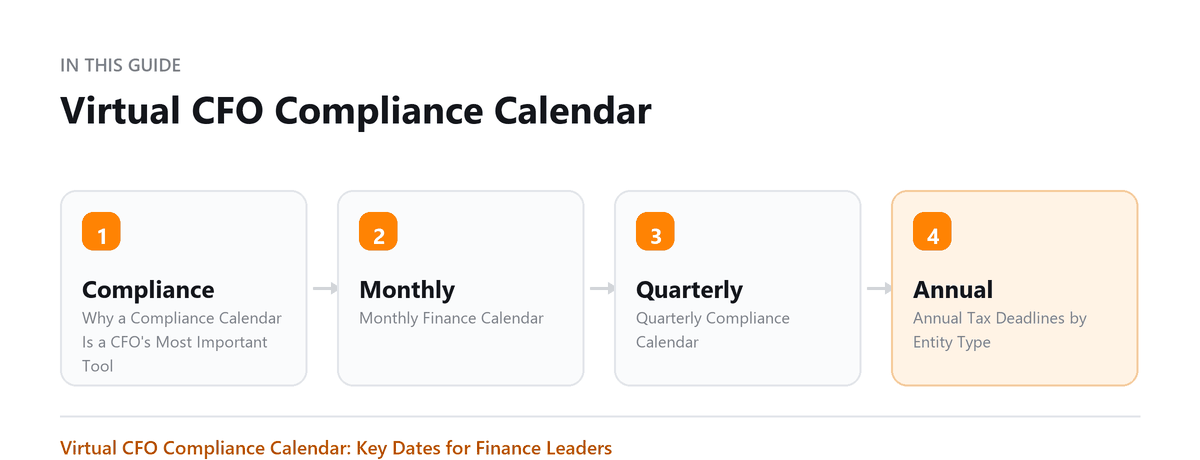
Why a Compliance Calendar Is a CFO's Most Important Tool, Monthly Finance Calendar, and Quarterly Compliance Calendar
A finance function is largely a set of things that must happen on particular dates, and most failures are failures of scheduling rather than of competence.
A calendar only works if every line has a named owner. A date with no owner is not a control, and missed filings are usually assumed to belong to somebody else rather than genuinely forgotten.
This covers the monthly, quarterly and annual cycles, the tax deadlines by entity type, the state obligations that vary, and the valuation requirement that catches companies granting equity.
Why a Compliance Calendar Is a CFO's Most Important Tool
Missing a compliance deadline creates penalties, interest, and management distraction. A virtual CFO maintains a master calendar that tracks every deadline, federal, state, and internal, and ensures the finance team is never caught off guard.
Build the calendar once and attach a named owner to every line. A deadline with a date and no owner is not a control, and most missed filings are not forgotten so much as assumed to belong to somebody else.
Abhinav Gupta, CPA, CA, MBA · LinkedInMonthly Finance Calendar
| Day of Month | Task |
|---|---|
| 1-3 | Prior month bank statements available; begin close process |
| 5-10 | Bookkeeping reconciliation complete; financial statements drafted |
| 10-15 | Final financial statements issued to management and board |
| 15 | Federal payroll tax deposit due (semi-weekly depositors vary) |
| 15 | Monthly board report distributed |
| 20 | Monthly FP&A review: actuals vs budget, forecast update |
| Last day | Sales tax due in many states (varies by state and filing frequency) |
Quarterly Compliance Calendar
| Quarter End | Task |
|---|---|
| Q1: April 15 | Federal estimated tax payment (individuals, S-corps, partnerships) |
| Q1: April 30 | Form 941 due (federal payroll taxes for Q1) |
| Q2: June 15 | Federal estimated tax payment |
| Q2: July 31 | Form 941 due (Q2) |
| Q3: September 15 | Federal estimated tax payment |
| Q3: October 31 | Form 941 due (Q3) |
| Q4: January 15 | Federal estimated tax payment (Q4, or file return by Jan 31) |
| Q4: January 31 | Form 941 due (Q4) |
Annual Tax Deadlines by Entity Type
| Entity Type | Federal Return Due Date (Standard) |
|---|---|
| S-Corporation (Form 1120-S) | March 15 (extension to September 15) |
| Partnership (Form 1065) | March 15 (extension to September 15) |
| C-Corporation (Form 1120) | April 15 (extension to October 15; fiscal year corps differ) |
| Individual (Form 1040) | April 15 (extension to October 15) |
| 401(k) Plan (Form 5500) | July 31 (extension to October 15) |
Annual Finance Function Calendar
- October-November: Budget preparation for following fiscal year
- December: Budget finalized and board-approved
- January: 1099-NEC issued to contractors (January 31)
- January: W-2 issued to employees (January 31)
- February-March: Audit fieldwork (if calendar year audit)
- March-April: Tax return preparation and filing
- June: 409A valuation update (if equity grants planned)
State Compliance: Sales Tax
Sales tax filing frequency depends on the state and the volume of taxable sales. Most states require monthly filing for companies with significant nexus; smaller sellers may file quarterly or annually.
Cap Table Compliance: 409A Valuation
A 409A valuation establishes the fair market value of common stock for stock option pricing. The IRS requires options to be priced at FMV at grant date to avoid adverse tax treatment under IRC Section 409A.
- Initial 409A required before first option grants
- Subsequent 409A required after any material event (fundraise, major contract, significant revenue change)
- Valuation is considered reliable for 12 months or until a material event
Book a free consultation and we will put senior eyes on your numbers.
Frequently Asked Questions
What happens if we miss a federal estimated tax payment?
Underpayment penalties apply: currently 8% annualized. The penalty is calculated on the amount underpaid for the period. It is not catastrophic but is avoidable with a compliance calendar.
Does the virtual CFO manage state registrations?
A good vCFO tracks when the company creates nexus in a new state (remote employee, new office, sales threshold) and coordinates registration for payroll tax, sales tax, and income tax.
How far in advance should we file for audit?
Engage your audit firm 3-4 months before your fiscal year end to ensure they are on calendar. Quality audit firms book up early, especially for March-April year-end audits.
Who should own the calendar inside the business?
One named person, with a deputy, and the name should be written next to each item rather than assumed. Shared ownership of a compliance calendar reliably produces the same failure: everyone believes somebody else is watching a date and nobody is. Where the work is done externally, the internal owner is still accountable for the date being met, because the obligation belongs to the entity.
How do we keep it current as the business changes?
Review it whenever something structural changes rather than only at the year end. A new state, a first employee, a new entity, a change of accounting period or a funding round can each add obligations with their own timing. The dates themselves also move, so take each one from the authority's own current guidance when you build the year rather than rolling last year's calendar forward unchecked.

Written by
Abhinav Gupta, CPA, CA, MBA
Abhinav works with business owners across the US on industry-specific bookkeeping, from dental practices and restaurants to construction and e-commerce. He writes about what each trade's books actually need. Connect on LinkedIn
Free consultation
Want CFO-Level Clarity?
Book a free consultation and we will put senior eyes on your numbers.