
Buying senior finance capability without employing it has gone from unusual to ordinary in a fairly short period.
Remote working and cloud systems made it practical, but they are not why it happened. Investors began expecting rigour at a stage where companies cannot afford to employ anybody capable of delivering it, and something had to fill that gap.
This covers what drove the shift, how each factor contributed, how the market has grown, and which kinds of business are actually using these arrangements.
The Rise of the Virtual CFO
Ten years ago, outsourced CFO services were a niche offering. Today, fractional and virtual CFO services are a fast-growing segment of the accounting and finance advisory market, driven by technology, investor expectations, and a structural mismatch between CFO supply and SMB demand.
What actually changed is that investors now expect rigour at a stage when companies cannot employ somebody to deliver it. The arrangement grew because that gap is real, not because remote working made it convenient.
Abhinav Gupta, CPA, CA, MBA · LinkedInDriver 1: Remote Work Normalization
The shift to remote work demonstrated that senior finance work can be done effectively without physical presence. CFOs who previously would only consider full-time, in-office roles now offer fractional services remotely. The talent pool expanded; so did the market.
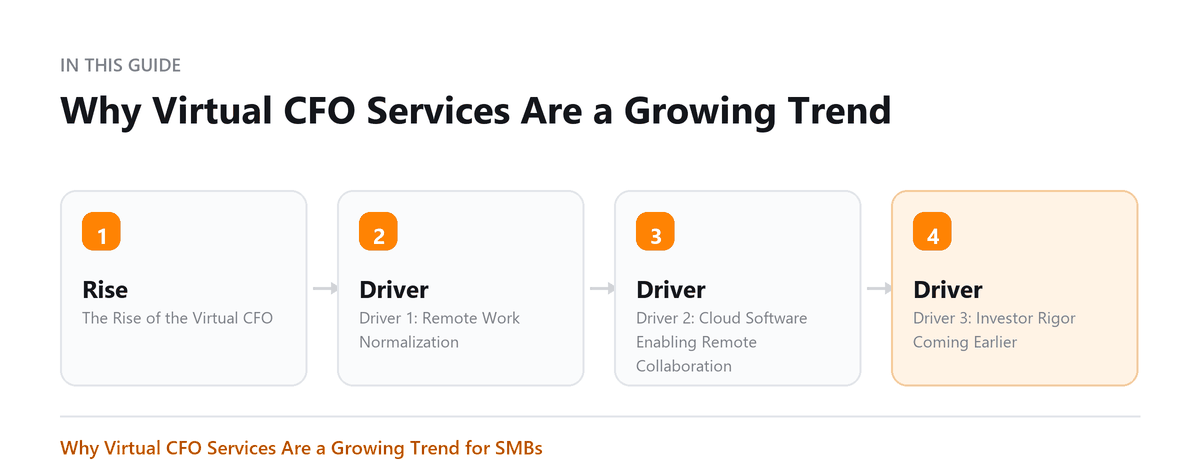
Driver 2: Cloud Software Enabling Remote Collaboration
A virtual CFO in 2015 struggled with access to financial data. Today, QuickBooks Online, Xero, NetSuite, Stripe, Gusto, and Carta are all cloud-native. A virtual CFO can review a live P&L, update a forecast model, and pull a cap table report from anywhere. The technology made the model feasible.
Driver 3: Investor Rigor Coming Earlier
Angel investors and seed funds now expect GAAP-compliant financials, a cap table on Carta, and a functional board reporting process from the earliest stages. A founder without finance support cannot meet these expectations alone. The vCFO fills the gap at a cost founders can afford.
Driver 4: Cost Pressure on SMBs
CFO compensation has increased significantly. The median CFO salary at a public company exceeds $400,000; private company CFOs command $200,000-$350,000. SMBs and growth-stage startups cannot justify this cost at early stages. Fractional models deliver senior expertise within budget.
Market Growth
The fractional executive market broadly is growing rapidly. Demand is driven by VC-backed startups, PE-backed SMBs, and founder-owned businesses that have outgrown DIY finance.
Who Uses Virtual CFO Services?
| Company Profile | Typical Need |
|---|---|
| VC-backed startup (Seed-Series A) | Board reporting, fundraising model, burn/runway management |
| PE-backed SMB | EBITDA optimization, debt covenant compliance, exit prep |
| Founder-owned business ($2M-$10M revenue) | Growth planning, banking relationships, acquisition readiness |
| Professional services firm | Partner profitability, billing rate analysis, capacity planning |
| Nonprofit | Grant accounting, 990 oversight, audit readiness |
Virtual vs Fractional: Clarifying the Terms
These terms are often used interchangeably but have distinct meanings:
- 'Virtual' refers to the delivery model: remote, not on-site
- 'Fractional' refers to the time commitment: part-time, not full-time
- A virtual fractional CFO is remote AND part-time, the most common model today
- An interim CFO is full-time but temporary, not fractional
Book a free consultation and we will put senior eyes on your numbers.
Frequently Asked Questions
Is a virtual CFO right for a main street business?
If the business has $1M+ in revenue, is considering a bank loan, has complexity in its financials, or wants to grow, a virtual CFO relationship (even at 10 hours per month) adds measurable value.
How does the virtual CFO deliver their work?
Primarily through a combination of cloud software access, regular video calls (weekly or bi-weekly with management, monthly with board), shared document workspaces, and email communication.
What is the difference between a virtual CFO and a financial advisor?
A financial advisor (wealth/investment context) manages personal or business investments. A virtual CFO manages the finance function of the business: accounting oversight, planning, fundraising, board management, and strategic decisions.
Does working remotely change what the role can actually do?
It changes how, not what. Analysis, forecasting, board reporting and lender conversations all work at a distance, and in many businesses the finance lead was already working largely through systems rather than through corridors. What genuinely needs presence is the informal information: what people are worried about, what is being worked around, what nobody has put in writing yet. A remote arrangement has to replace that deliberately, usually with more structured contact than an in-person role would need.
Is this a good fit for a business that is not a technology startup?
Often yes, and the fit depends on the questions rather than the sector. A manufacturer deciding on capacity, a practice deciding whether to buy another, a family business planning a succession all need the same kind of thinking. What matters is whether the business has decisions that justify the capability and records good enough to support it. Where the records are not there yet, fixing that comes first.

Written by
Abhinav Gupta, CPA, CA, MBA
Abhinav works with business owners across the US on industry-specific bookkeeping, from dental practices and restaurants to construction and e-commerce. He writes about what each trade's books actually need. Connect on LinkedIn
Free consultation
Want CFO-Level Clarity?
Book a free consultation and we will put senior eyes on your numbers.