
Usually, small businesses manage only one side of the invoice process, leaving the other completely uncontrolled. In most cases, companies focus on the management of the accounts payable side, leaving the accounts receivable side completely unattended. This occurs simply because suppliers have constant pressure on the purchasing department of an enterprise, while customers do not have such pressure.
Thus, an enterprise pays debts on time while waiting for the payment of its own, the worst possible scenario for the working capital of a small business.
The guide below will cover the details of small business invoice management, explain why this process is often worse within the sphere of small business ownership and highlight the points most commonly out of control.
The mistake I see most often isn't on the payables side at all. It's businesses with tight AP discipline and no AR process: invoices raised a week after the work finishes, no follow-up until something is sixty days overdue, and nobody able to say what's currently outstanding.
Ankit Sagatani, MBA, B.Com · LinkedInThey're effectively lending money to their customers at no interest while paying their own suppliers on time, and they usually discover it during a cash squeeze that has nothing to do with profitability.
What is invoice management?
Invoice management is the end-to-end process of handling incoming and outgoing invoices from receipt or creation through to payment or collection and record-keeping. For small businesses, effective invoice management is the difference between accurate cash flow visibility and a constant scramble to understand what is owed and when. This guide covers both the AP side (supplier invoices you owe) and the AR side (customer invoices owed to you).
The concept of invoice management refers to the management of all the invoices payable or receivable by the company, as well as their subsequent recording and preservation for subsequent presentation during the tax audit. It splits into two functions that share almost nothing operationally.
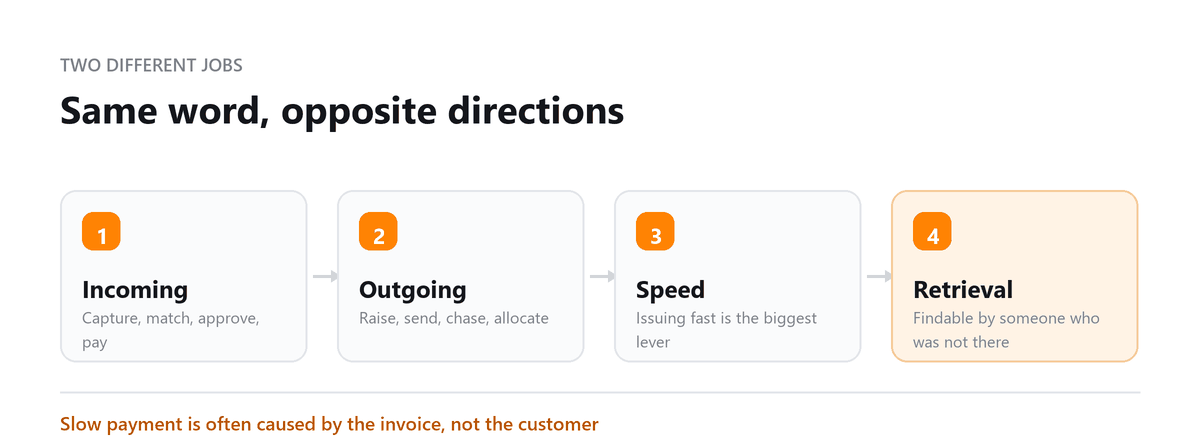
Accounts payable invoice management covers supplier invoices you owe: receiving them, checking them, getting them approved, and paying within terms. This is the harder side for most small businesses because invoices arrive in dozens of formats from dozens of vendors and each one needs matching, coding, approval and scheduling.
Accounts receivable invoice management covers customer invoices you're owed: raising them accurately, sending them promptly, tracking what's been paid, and chasing what hasn't. Simpler mechanically. Neglected more often.
For most small businesses, AP invoice management is the more complex and error-prone side: supplier invoices arrive in various formats from multiple vendors and require matching, coding, approval, and payment within agreed terms.
Key Components of Invoice Management
| Component | Description |
|---|---|
| Invoice receipt / creation | AP: invoices received from suppliers. AR: invoices created and sent to customers |
| Invoice verification | AP: match invoice to PO and goods receipt. AR: confirm services/goods delivered before invoicing |
| Invoice coding | Assign the correct GL account codes, department, and project codes to each invoice |
| Approval workflow | Route for approval based on amount and department; enforce approval thresholds |
| Payment / collection | AP: execute payment by due date. AR: collect payment, monitor overdue and follow up |
| Record-keeping | Store all invoices (and supporting documents) in a searchable digital archive |
| Reconciliation | Match AP invoices to bank payments and bank statements monthly |
Why it matters for small businesses
Cash flow visibility
Profitable businesses run out of cash for one reason: money goes out before it comes in, and nobody was tracking the gap. Knowing what's owed and when, in both directions, is what turns that from a surprise into a plan.
Supplier relationships
Paying late costs more than any fee attached to it. Terms tighten at renewal, priority drops when stock is short, and the flexibility you'd want during a difficult quarter stops being offered. None of this is announced.
Customer relationships
Invoices sent late or with errors delay payment and create disputes over work that was done correctly. An invoice arriving three weeks after delivery invites the customer to question the detail, because they've stopped thinking about it.
Tax compliance
The IRS requires you to keep records supporting a return for at least three years from filing, longer in specific circumstances, six years if income was substantially understated, and indefinitely for an unfiled or fraudulent return. Property records run for the life of the asset plus the period after disposal. Most accountants recommend seven years across the board, because sorting documents by category is more work than keeping everything.
Audit readiness
A searchable archive with invoices and supporting documents attached turns an audit into a document request rather than a reconstruction project. The cost difference is measured in weeks.
Where invoice management breaks
Invoices arriving in four inboxes. Supplier invoices sent to whoever the vendor happens to have an address for. Nobody can see the full picture, things get missed, suppliers resend, and the resent copy gets paid alongside the original.
Manual errors that survive. Wrong amount, wrong vendor, wrong GL code. The first two get caught. The third doesn't, the payment is correct in every respect except which account it lands in, and it surfaces at year end when your comparatives turn out to be wrong.
Approval delay. Invoices sitting with approvers who have no deadline. This is the single largest recoverable cost in most small business AP, and it's free to fix.
AR sent late and chased inconsistently. Invoices raised whenever someone gets to it, follow-up only once something is badly overdue.
Documents that disappear. Paper filed somewhere, emailed PDFs deleted with the thread, nothing searchable. The exposure only materialises when someone asks for a specific invoice from three years ago.
How Outsourced Bookkeeping Services Simplify Invoice Management
Outsourced bookkeeping teams handle the routine elements of invoice management, coding invoices to the correct GL accounts, reconciling AP to supplier statements, following up on overdue AR, and maintaining the digital invoice archive. This frees founders and finance managers to focus on higher-value decisions while ensuring the process is handled consistently and accurately.
Manual vs Automated Invoice Management
| Factor | Manual | Automated |
|---|---|---|
| Invoice capture | Typed manually, 5-15 min/invoice | AI extraction, seconds/invoice |
| Error rate | 3 to 5% | <1% |
| Approval tracking | Email chains, no visibility | Dashboard, real-time status |
| Duplicate detection | Manual check, easy to miss | Automatic, flags before approval |
| Document archive | Paper files or inbox search | Searchable digital archive |
| Month-end close | 3-7 days AP close | 1-2 days AP close |
The threshold for automation being worth it sits around 20 to 30 invoices a month. Below that, a disciplined manual process performs about as well for nothing. More on that in our guide to AP software for small businesses.
How outsourced bookkeeping fits
Outsourced teams take the routine half: coding invoices to the right accounts, reconciling AP against supplier statements, following up overdue receivables, and keeping the archive current.
It also solves something structural. Segregation of duties: the person approving an invoice shouldn't be the one releasing payment normally requires enough staff to split the roles. When approval stays with you and processing sits outside, you get that control without the headcount.
What it depends on is communication. Your provider knows about a new supplier, a cancelled service, or a change in approval authority when someone tells them, and that's where these arrangements most often fall short.
Where to start
Three things, in order, none of which cost anything:
Route every supplier invoice to one monitored address. Write down a single approval threshold. Reconcile against supplier statements monthly.
Then add the AR equivalent: a fixed invoicing schedule and a monthly look at aged receivables. The detailed AP version is in our six accounts payable best practices, and the full process breakdown is in our guide to the accounts payable cycle.
Book a free consultation and we will get them out on time.
Frequently Asked Questions
How long should a business retain invoices?
At least three years from the filing date of the return they support, which is the general IRS period. Six years applies where income was understated by more than 25%, and there's no limit on an unfiled or fraudulent return. Records relating to property should be kept for as long as you own the asset plus the retention period after you dispose of it. Seven years across the board is the practical standard most accountants use, because deciding which documents fall into which category costs more than storing everything.
What's the difference between invoice management and accounts payable?
Accounts payable is one side of it, what you owe suppliers. Invoice management covers both that and accounts receivable, what customers owe you. AP and AR are the two halves; invoice management is the process running across them.
Which side should a small business fix first?
Accounts receivable, usually, and it's the opposite of what most businesses do. AP problems announce themselves because suppliers chase; AR problems stay silent while cash sits uncollected. If you can't currently produce an aged receivables report in under a minute, start there.
Do I need software to manage invoices properly?
Not at low volume. Under about 20 supplier invoices a month, a single monitored inbox, a written approval rule and monthly reconciliation will do the job. What software adds above that volume is routing, duplicate detection, and visibility into where everything sits, none of which you can replicate manually once the numbers climb.
Can invoice management be outsourced entirely?
The processing can. Approval authority shouldn't be, you decide what gets paid, your provider handles intake, coding, reconciliation and collections follow-up. That split is also what gives you segregation of duties without hiring for it. What stays with you is telling them when things change.

Written by
Ankit Sagatani, MBA, B.Com
Ankit works with business owners across the US on industry-specific bookkeeping, from real estate to construction and retail. He writes about what each trade's books actually need. Connect on LinkedIn Connect on LinkedIn
Free consultation
Invoices Out Late Every Month?
Book a free consultation and we will get them out on time.