
Spending any amount of time in the US startup scene will introduce you to a pattern: that most venture backed companies are organized as Delaware C-Corporations. This is true regardless of where the personal residence of the founders are, or where the company operates.
While there are some practical advantages to this, they are less important than factors that may appear to be advantages but are not. The state of Delaware has a corporate law framework that has been developed and tested over more than a century, resulting in a well established set of precedents that most business litigation is likely to find relevant. The state of Delaware is home to roughly two-thirds of the Fortune 500 as well as the great majority of VC backed startups.
However, most of these considerations are of little interest to most individual founders. The primary reason a founder has to incorporate in Delaware rather than their state of residence is narrower: the people who will be funding your company expect that. The documents for a Series A term sheet, a SAFE, or a convertible note will all be written in a way that assumes a Delaware entity.
This guide will outline the features that are actually relevant to most individual founders, explain what the Delaware franchise tax is and why it may be surprisesome, and examine the cases where incorporation in Delaware is the wrong choice to make.
The Delaware Advantage
Delaware has spent over a century building a legal environment designed specifically for businesses. More than 60% of Fortune 500 companies and the vast majority of US venture-backed startups are incorporated in Delaware. The reasons are structural, not promotional.
Nobody chooses Delaware for the tax treatment, whatever the formation sites suggest. You choose it because every investor document in the ecosystem assumes it, and because when a co-founder dispute or an acquisition goes sideways, you want a judge who has seen your exact situation four hundred times. The founders I've seen regret it are the ones who never raised, they took on Delaware's compliance for a round that didn't happen.
Anu Gupta, CA, EA, B.Tech · LinkedInEstablished Legal Framework: The Court of Chancery
Delaware's Court of Chancery is a specialised business court that has operated for over 200 years. It handles only corporate and business disputes, has no jury trials, and is staffed by judges (called Vice Chancellors) who are experts in corporate law. For founders and investors, this means:
- Predictable outcomes, hundreds of years of case law means fewer grey areas in disputes
- Speed, business cases are resolved faster than in general-purpose courts
- Expertise, judges understand complex equity structures, fiduciary duties, and M&A mechanics
This matters most when things go wrong: a co-founder dispute, a hostile acquisition attempt, or a breach of fiduciary duty claim. In Delaware, the law is well-tested and the process is efficient.
Business-Friendly Environment
- The Delaware General Corporation Law (DGCL) is the most permissive and flexible corporate statute in the US, founders can structure boards, equity classes, and governance almost any way they choose
- Delaware allows corporations to limit or eliminate director liability for certain breaches of duty, important protection for attracting experienced board members
- No residency requirement: directors, officers, and shareholders can be anywhere in the world
Tax Benefits for Startups
No State Income Tax for Out-of-State Operations
Delaware does not impose state income tax on income earned outside Delaware. For a Delaware-incorporated startup that operates in California, New York, or Texas, this means no Delaware corporate income tax on revenue earned in those states, though you will still owe state income tax where you actually do business.
Absence of Sales Tax
Delaware has no state sales tax. This benefits startups with physical operations or retail sales in Delaware, though it is largely irrelevant for software companies or businesses without Delaware-based customers.
Favorable Franchise Tax Structure
Delaware charges an annual franchise tax based on either the number of authorised shares (Authorised Shares Method) or the assumed par value capital method. For startups with many authorised shares but low assets, the assumed par value method typically produces a much lower tax bill, often $400-$500/year for early-stage companies. The key is knowing which method to use.
What Delaware doesn't do for you
Worth stating plainly, because formation services are vague about it.
It doesn't reduce your tax bill. You pay income tax where you earn the money and where you operate. Delaware incorporation changes nothing about that.
It doesn't exempt you from registering where you work. Operating from California means registering there as a foreign corporation and paying California's $800 minimum franchise tax annually on top of Delaware's costs, not instead of them. Same in most states, at varying amounts.
It doesn't protect you from your own operating agreement or bylaws. Delaware's flexibility means the documents govern, so a badly drafted founders' agreement is badly drafted in Delaware too. The state gives you good law to work with, not good documents.
It doesn't help if you never raise. This is the one that costs founders money. If you build a profitable services business, never take outside capital and never sell, you've carried Delaware's compliance and a second state registration for years to get benefits you never used. A home-state LLC would have done the job for a fraction of it.
Why investors insist on it
Attracting Venture Capital
Effectively every US term sheet assumes a Delaware C-Corp. Series A preferred terms, SAFEs, convertible notes: the standard documents are drafted for Delaware law. Asking a fund to adapt its paper to a Wyoming LLC or a Florida corporation adds legal cost, time and friction to a process where you have the least leverage. Most funds will simply make reincorporation a condition of closing, which means you pay for the conversion at the worst possible moment..
Over 68% of Profitjets startup clients that raised VC had incorporated in Delaware or reincorporated there ahead of their funding round.
Facilitating Public Offerings
Most US IPOs run through Delaware corporations. Underwriters, exchanges and acquirers' counsel all know the terrain. Preferred-to-common conversion, anti-dilution provisions, drag-along rights: all well-tested, which means diligence asks fewer questions.
Privacy and Flexibility
Anonymity for Business Owners
Delaware does not require disclosure of shareholder names in public corporate filings. Only the registered agent and the organiser (often the formation attorney) appear in public records. This provides meaningful privacy for founders who do not want their equity stake publicly visible before an IPO or acquisition.
On structure, the DGCL is what makes startup financing mechanics work cleanly. Multiple preferred classes with different liquidation preferences, anti-dilution rights, protective provisions, information rights, all straightforward to create. That's the actual reason SAFEs and convertible notes default to Delaware, rather than any tax consideration.
Simplified Corporate Structure
Delaware law allows flexible equity structures essential for startup financing: multiple classes of preferred stock with different liquidation preferences, anti-dilution rights, protective provisions, and information rights can all be created cleanly under DGCL. This is why SAFE agreements and convertible notes default to Delaware.
Potential Drawbacks
Additional Costs for Out-of-State Operations
If your startup is incorporated in Delaware but operates in California, you must also register as a foreign corporation in California and pay California's minimum franchise tax ($800/year). This double-registration cost is a real expense for early-stage companies, factor it in when comparing Delaware vs your home state.
The Role of Outsourced Accounting Services
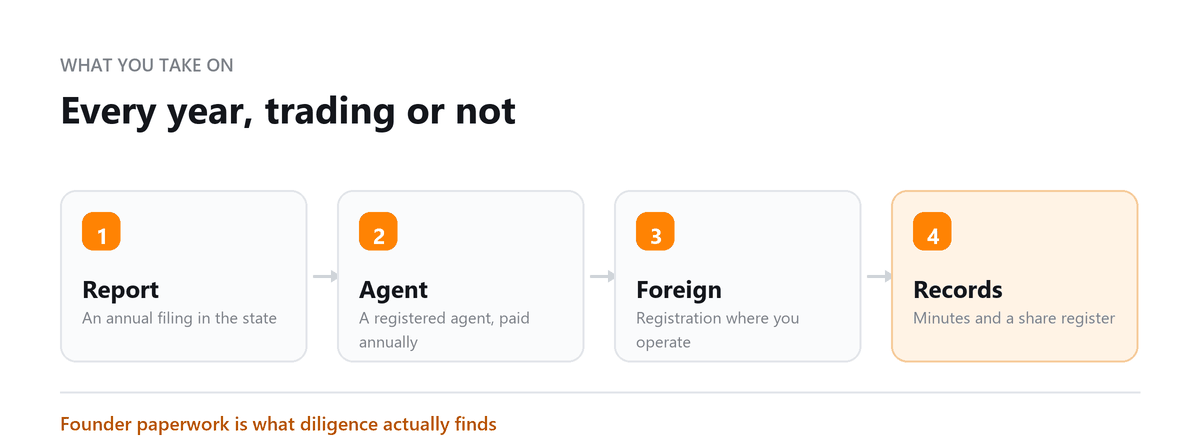
Delaware incorporation means regular compliance obligations: annual franchise tax filings, registered agent fees, corporate record maintenance, and potentially multi-state tax filings. Many early-stage startups outsource this to a bookkeeping or accounting firm from day one, the cost of a compliance mistake (penalties, missed filings, loss of good standing) far exceeds the cost of professional support.
Book a free consultation and we will get the paperwork right first.
Frequently Asked Questions
Do I have to live in Delaware to incorporate there?
No. There's no residency or physical presence requirement of any kind. You need a registered agent with a Delaware address, which runs somewhere between $50 and $300 a year depending on provider. Founders incorporate in Delaware from anywhere in the world and most never visit.
What is the Delaware franchise tax for a startup?
LLCs pay a flat $300 a year. C-Corporations pay under whichever of the two methods produces the lower figure: the authorised shares method or the assumed par value capital method. Delaware bills under authorised shares by default, so the notice that arrives may be wildly higher than what you actually owe. Recalculate every year rather than paying what's on the letter.
When should I not incorporate in Delaware?
When institutional capital isn't part of the plan. A solo founder building a profitable services business, a consultancy, an agency with no exit ambitions: all of them are better served by a home-state LLC. Delaware's advantages are concentrated in raising money, issuing equity to employees, and exiting. If none of those are on your roadmap, you're paying for optionality you won't exercise.
Does Delaware incorporation mean I pay less tax overall?
No, and this is the most persistent misconception on the topic. You pay income tax where you earn money and where you operate, and Delaware incorporation doesn't change either. What it can add is a second set of state fees, since you'll typically register as a foreign corporation wherever you actually do business. Choose Delaware for legal and investor reasons, not tax ones.
Delaware C-Corp or Delaware LLC?
If you're raising institutional money or issuing employee equity, a C-Corp is what the ecosystem is built around funds generally can't invest in an LLC for their own tax reasons. If you're self-funded and profitable, an LLC avoids double taxation and is simpler to run. The comparison between states is a separate question from the entity type, and we cover it in Delaware LLC vs Wyoming LLC.

Written by
Anu Gupta, CA, EA, B.Tech
Anu works with US businesses on tax and entity questions at Profitjets, from choosing a structure to the filings that follow it. She writes about the decisions owners make once and then live with for years. Connect on LinkedIn
Free consultation
Incorporating Before a Raise?
Book a free consultation and we will get the paperwork right first.