
Ask a CPA firm partner what is holding him back from growing his practice and he will not mention a shortage of clients. More often than not, the culprit is capacity. Good bookkeepers are hard to find and even harder to retain.
The busy season always seems to stretch on and on. And that partner you hired to handle your clients now finds himself spending his evenings studying reconciliations. Raising rates only goes so far, and cutting into the profits of the US-based employees will eat into that rate increase.
This is why more and more accounting firms in the US are turning to India for their bookkeeping needs, and it is not just because of the lower costs.
India has a large talent pool of finance and accounting graduates, many of whom are proficient in the US-specific accounting software and have strong English language skills from years of working with international clients.
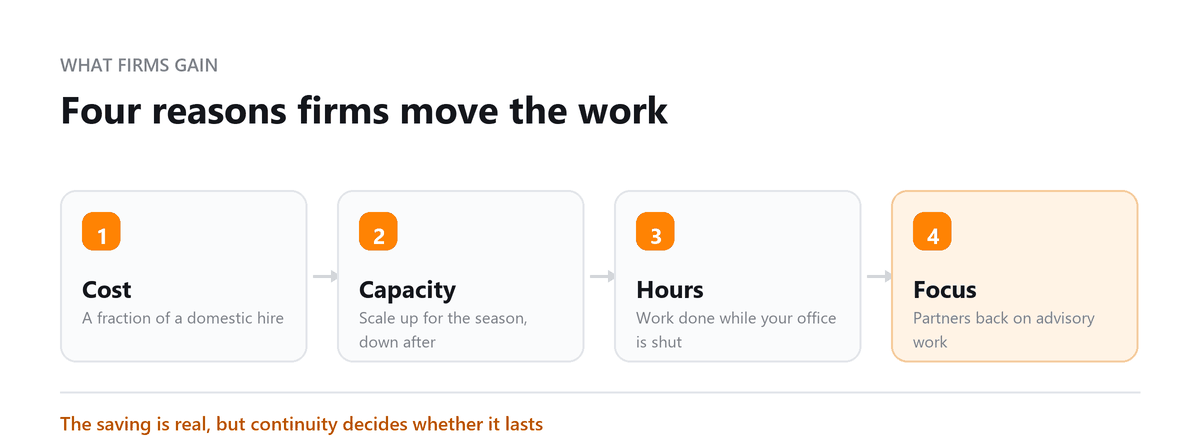
With the time zone difference, it is also possible to get round-the-clock productivity, with tasks being performed when the domestic office is asleep. For many firms that are considering outsourcing, the cost differential is anywhere between 30 and 50% in favor of firms that outsource to India.
This guide covers what bookkeeping outsourcing involves, the benefits of choosing India, a side-by-side cost comparison, the work that can be outsourced, and the software India-based teams typically use.
What is Bookkeeping Outsourcing?
Bookkeeping outsourcing means handing routine accounting work, like data entry, reconciliations, and reporting, to an outside provider. That provider can be onshore, in the US, or offshore, with a team overseas.
For US CPA firms outsourcing to India, the work usually includes transaction coding and general ledger posting, bank reconciliations, accounts payable and receivable, payroll entries, month-end close support, and financial statement preparation.
The CPA firm stays in control of what matters most. Review, client communication, tax strategy, and signing authority all remain with the firm.
The single biggest factor in making India outsourcing work is treating the offshore team as an extension of your own staff, not a vendor you send files to. That means proper onboarding, clear review standards, and someone onshore who owns the relationship. When it fails, it's almost always because a firm handed over work without documentation and expected the team to figure out each client on their own.
Ankit Sarawagi, CPA, CA, MBA · LinkedInBenefits of Outsourcing Bookkeeping to India
| Benefit | Detail |
|---|---|
| Cost savings | 30-50% cost reduction vs US-based equivalent headcount, including salary, benefits, payroll taxes, and overhead |
| Qualified talent | India produces 800,000+ commerce and finance graduates annually; CPA/ACCA/CA-qualified professionals available |
| English proficiency | India has one of the world's largest English-speaking professional workforces |
| Time zone coverage | IST is approximately 9.5-12.5 hours ahead of US time zones (East to West coast), enabling overnight turnaround on work submitted end-of-US-day |
| Technology infrastructure | Indian outsourcing firms work with all major US accounting platforms: QuickBooks, Xero, NetSuite, Sage, Drake, Lacerte |
| Scalability | Scale up during tax season, scale down in off-season, without the fixed costs of permanent hires |
| Focus on advisory | CPA partners free from routine bookkeeping can focus on higher-margin advisory, planning, and client relationship work |
Cost Benefits of Outsourcing to India
The 30-50% cost savings cited for India outsourcing reflect the total employment cost comparison:
| Cost Component | US In-House Bookkeeper | India Outsourced (per equivalent) |
|---|---|---|
| Base salary | $45,000-$65,000/year | $15,000-$25,000/year (billed rate) |
| Benefits (30% of salary) | $13,500-$19,500 | Included in service fee |
| Payroll taxes (8%) | $3,600-$5,200 | Not applicable |
| Software licenses | $1,200-$3,000 | Often included |
| Training and management | $2,000-$5,000 | Managed by provider |
| Total annual cost | $65,000-$97,000+ | $18,000-$30,000 |
The dollar savings allow CPA firms to either lower pricing (competing on value) or improve margins while delivering the same service quality to clients. Firms use those savings in different ways. Some pass part of it on through more competitive pricing. Others keep pricing steady and improve margins while delivering the same quality of work.
Bookkeeping Services That Can Be Outsourced to India
Most routine, process-driven bookkeeping work is a good fit. That includes recording and coding transactions from bank feeds, credit card statements, and receipts, along with bank and credit card reconciliations.
Accounts payable work like invoice entry and payment scheduling moves easily, as does accounts receivable, including invoicing, payment matching, and aging reports. Payroll journal entries and reconciliations based on your payroll provider's reports are also common.
Further up the process, India-based teams can handle month-end close procedures and adjusted trial balances, prepare financial statements including the P&L, balance sheet, and cash flow statement, and support tax season with data compilation, schedule preparation, and write-up work for quarterly and annual clients.
Software Used by India-Based Bookkeeping Teams
Established India-based outsourcing firms are generally experienced with QuickBooks Online, QuickBooks Desktop, Xero, NetSuite, Sage Intacct, Wave, and FreshBooks on the bookkeeping side, and Drake, UltraTax CS, Lacerte, and ProConnect on the tax side.
Before signing with any provider, confirm they have hands-on experience with the specific platforms your firm and your clients use.
Outsourcing bookkeeping to India isn't just a way to spend less. For US CPA firms, it's a way to add capacity without the hiring struggle, turn work around overnight, and give partners and senior staff back the time they need for advisory work. The firms that get the most from it choose a provider with the right security and software experience, invest in proper onboarding, and keep review and client ownership firmly onshore.
Book a free consultation and we will scope the work with you.
Frequently Asked Questions
Is data security a risk when outsourcing bookkeeping to India?
It's a fair concern and one to address during vendor selection. Look for SOC 2 Type II or ISO 27001 certification, signed NDAs and data processing agreements, encrypted file transfer, and clear policies on where data is stored and who can access it. If the work involves tax return information, you'll also need client consent before it's shared with a team outside the US under IRS rules.
What is the typical turnaround time for bookkeeping outsourced to India?
Work sent at the end of the US business day is usually completed by the start of the next one, because the India-based team works while your office is closed. Urgent same-day work is possible too, but it may require arranging overlapping hours or dedicated staff.
How much can a CPA firm save by outsourcing bookkeeping to India?
Most firms see savings of around 30 to 50 percent on routine bookkeeping compared with the full cost of US staff. The exact figure depends on the type of work, the level of experience required, and how much management and review stays onshore.
Will my clients know their work is being outsourced?
That depends on your engagement terms, but transparency is the safer approach. Many firms mention offshore support in their engagement letters, and for tax work, written client consent is required before sharing return information outside the US. Clients generally care most about quality, security, and turnaround, all of which a well-run arrangement should improve.
How should a CPA firm get started with outsourcing to India?
Start small. Choose a well-defined, high-volume task, such as bank reconciliations or transaction coding for a handful of clients, and run it for a few months. Track accuracy, turnaround, and how many questions come back, then refine your process before expanding to more clients and more complex work.

Written by
Ankit Sarawagi, CPA, CA, MBA
Ankit leads the finance team at Profitjets, where he has worked with 500+ businesses across the US on bookkeeping, tax and CFO-level strategy. He writes about the habits that keep small business books accurate all year. Connect on LinkedIn
Free consultation
Firm Capacity Maxed Out?
Book a free consultation and we will scope the work with you.