
Business owners view tax season as a necessary evil. Receipts are gathered in March, the bookkeeper or family friend who knows tax software files the return, and everyone files it away to forget until next year. Until the IRS sends a notice, a state you did not think you owed money to sends a bill, or a new accountant reviews last year's return and sees deductions that were not taken.
The technicality of business tax returns have increased. Multi state sales, pass through entity taxation, depreciation elections, payroll tax reconciliations, and credits that change every year, can all impact the tax liabilities of your business. Getting it wrong has consequences. Getting it only partially right can allow for years of quietly overpaying.
Outsourcing tax preparation to experts takes that burden and that risk away. For CPA firms, outsourcing can also be a way to increase capacity during tax season without the investment of a permanent employee who will be underutilized the remaining 9 months of the year.
This guide compares in-house and outsourced tax preparation, walks through the main benefits, covers the signs it's time to outsource, and explains how specialists handle the most common tax problems businesses run into.
Tax Preparation In-House vs. Outsourcing
| Factor | In-House / Self-Prepared | Outsourced to Specialists |
|---|---|---|
| Technical depth | Limited to the preparer's knowledge, often missing complex deductions, credits, or structuring opportunities | Specialists stay current on tax law changes, credit programmes, and depreciation strategies |
| Capacity | Fixed, creates bottlenecks at deadlines; peak season stress | Scales for peak season without permanent hires |
| Cost | Staff salary + software + CPE + benefits | Fee for service, no fixed cost in slow periods |
| Accuracy | Higher error risk with non-specialists | Specialist review processes and quality controls |
| Deadline management | Risk of extensions and late filing penalties when understaffed | Dedicated deadline tracking as part of service |
When we review returns that were self-prepared or done by a generalist, the problem is rarely a dramatic error. It's the things that were never looked at: an S-corp election nobody considered, depreciation left on the table, QBI deductions calculated wrong, a state filing that should have been made. Individually they look small. Added up over a few years, they're often worth far more than what the owner saved by not using a specialist.
Anu Gupta, CA, EA, B.Tech · LinkedInKey Benefits of Outsourcing Tax Preparation
- Tax law expertise: tax law changes constantly, qualified outsourced tax preparers stay current on federal, state, and local law changes, new credits (R&D credit, ERC, Section 179 elections), and changing depreciation rules that create savings opportunities
- Reduced risk of errors: tax return errors trigger IRS notices, audits, and penalties. Specialist teams with multi-reviewer quality control processes have lower error rates than solo preparers
- Time savings: outsourcing frees the owner or in-house team from the time-intensive work of tax document gathering, return preparation, and correspondence, time that goes back to the business
- Strategic tax planning: the best tax outcomes come from planning throughout the year, not from preparing the return after the year ends. Outsourced tax advisors often identify planning opportunities (entity structure changes, timing of deductions, retirement plan contributions) during the engagement
- Multi-state compliance: businesses with economic nexus in multiple states face complex multi-state apportionment, nexus studies, and state-specific filing requirements. Specialists handle this; generalists often miss it
Profitjets tax preparation services have helped clients identify and address cash-flow gaps early, with businesses typically filing ontime after implementing tighter forecasting, collections, and expense controls.
When to Consider Outsourcing Tax Preparation
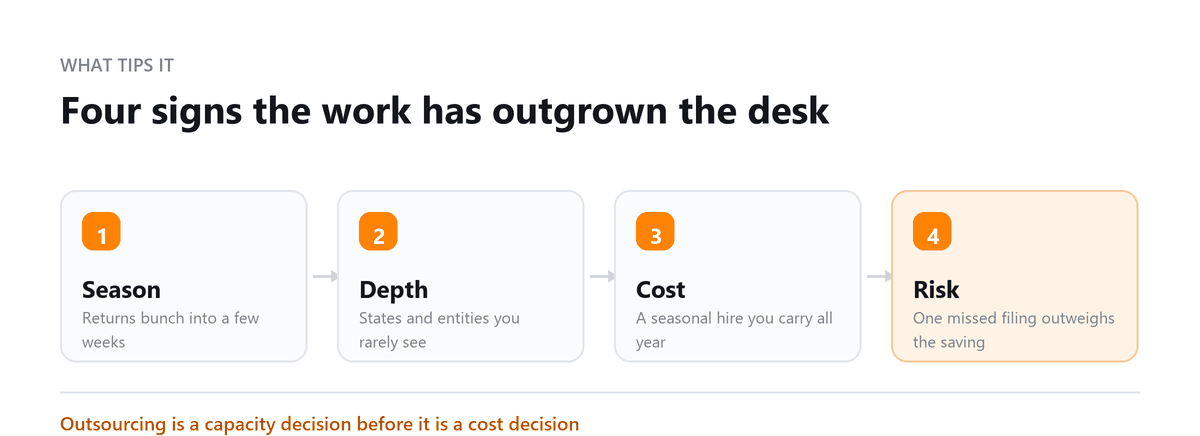
- Business taxes have become more complex: multi-state operations, international transactions, pass-through entity taxes, or equity compensation
- You have received an IRS notice or been audited, a signal that prior returns need specialist review
- You are spending too much time gathering documents and responding to preparer questions
- Your prior-year return was prepared by a general bookkeeper, not a qualified CPA or enrolled agent
- Your business has changed significantly: new entity structure, new state, new partners, or a major capital event
- You want proactive year-round tax planning, not just return preparation after the year ends
Common Tax Preparation Challenges Solved by Outsourcing
| Challenge | How Outsourcing Solves It |
|---|---|
| Missed deductions | Specialists systematically review all available deductions, home office, vehicle use, depreciation elections, qualified business income (QBI) |
| Multi-state filing | Nexus studies, state apportionment, and multi-state filing managed by specialists in each jurisdiction |
| Quarterly estimated taxes | Automated reminders and calculation service, eliminates underpayment penalties |
| Payroll tax reconciliation | W-2, 940, and 941 reconciled to payroll records before filing, common source of IRS notices |
| Entity structure optimisation | CPA-level review of whether current entity structure (LLC, S-corp, C-corp) is optimal for current revenue and owner compensation |
Book a free consultation and we will take the returns off your desk.
Frequently Asked Questions
Can I outsource tax preparation and still keep my local CPA?
Yes. Many businesses use an outsourced team to handle the preparation work and keep a local CPA for advice and strategy. The outsourced team gathers the data and prepares the return, and the local CPA reviews it and advises on planning. It works well as long as both have a clear scope and talk to each other directly.
Is outsourced tax preparation secure?
It should be. Reputable firms use encrypted file transfers, secure client portals, and tight controls over who can access your data. Ask any provider about security certifications such as SOC 2 or ISO 27001 and how they handle data. If any preparation work happens outside the US, the provider should explain how they comply with IRS rules on disclosing taxpayer information, including getting your written consent where required.
How much does outsourced tax preparation cost?
It depends on your entity type, how many states you file in, the condition of your books, and how much planning you want included. For most businesses it costs less than keeping a qualified in-house tax specialist all year, since you pay for the work rather than a salary. Clean, up-to-date books usually keep the fee lower.
What documents will an outsourced tax preparer need?
Typically your year-end financial statements, bank and credit card statements, payroll reports, prior-year returns, fixed asset purchases and sales, 1099s issued and received, loan statements, and records of owner contributions or distributions. A good provider will send a checklist tailored to your business so nothing gets missed.
Can an outsourced tax team help if I've already received an IRS notice?
Yes. A specialist team can review the notice, compare it against your filed return and records, and prepare a response. If the notice points to a larger problem, they can review past returns and, where needed, file amended returns. Representing you before the IRS itself requires a CPA, enrolled agent, or tax attorney, so confirm the provider has one available.

Written by
Anu Gupta, CA, EA, B.Tech
Anu works with US businesses on tax and entity questions at Profitjets, from choosing a structure to the filings that follow it. She writes about the decisions owners make once and then live with for years. Connect on LinkedIn
Free consultation
Tax Season Outgrowing Your Team?
Book a free consultation and we will take the returns off your desk.