
Founders learn about Brex right after they have raised a round. One person in their investor circle knows about it, it takes an afternoon to apply, and there is no personal guarantee needed. A week later, the founder has cards to distribute and receives receipts that automatically sync with their accounting system. This is the value proposition of Brex, and it works for the companies Brex targets.
The second-order effects are where some founders get surprised when they sign up. Finance teams learn the card has to be paid in full, that the limit depends on the cash position of the company, and that the beautiful accounting synchronization requires a person to check the category of each expense at month-end. Nothing wrong with that, but none of that would be necessary if you had a traditional corporate card.
Brex is a corporate card and spend management platform that unbundles corporate cards, expense management, payment, and business cash accounts. It is not a bank, even if it is now part of Capital One Business Banking, but it is targeted at venture-backed startups and scale-ups and not at Main Street.
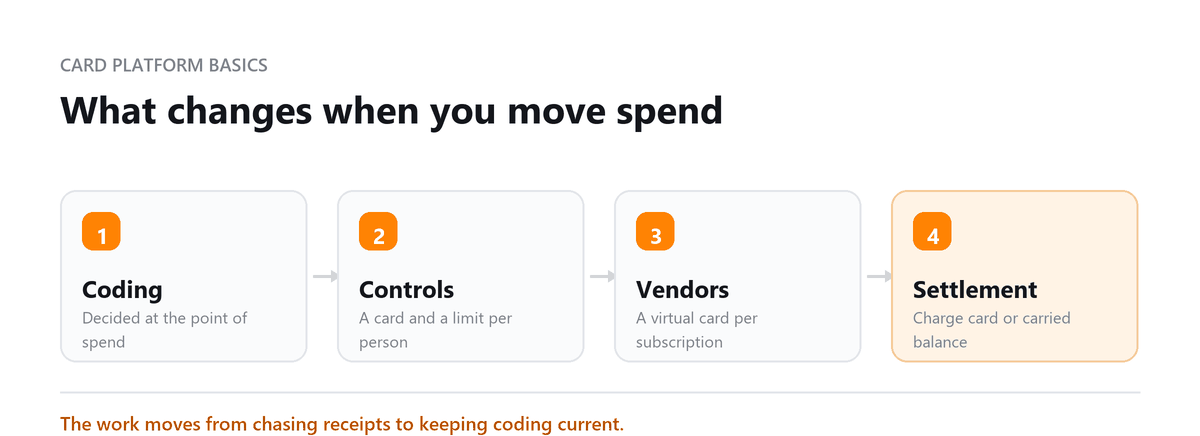
The mistake I see most with Brex is treating the card sync as if it were bookkeeping. Transactions flow into QuickBooks or NetSuite with a merchant name and a suggested category, and founders assume the books are done.
Then the month-end close turns up software subscriptions coded to travel, prepaid annual contracts expensed in one month, and a stack of employee charges with no receipts. Brex removes a lot of manual work, but someone still has to own the review. Set up your policies, receipt rules, and category mapping in the first week, not the first quarter.
Ankit Sagatani, MBA, B.Com · LinkedInWhat is Brex?
Brex is a US-based financial technology company that offers corporate credit cards, business banking, expense management, and travel management products designed for startups, venture-backed companies, and their employees. It differentiates from traditional business banking by requiring no personal guarantee on credit cards, offering high credit limits, and integrating directly with accounting software used by startups (QuickBooks, Xero, NetSuite, Sage Intacct).
Brex operates as a corporate card and spend management platform, not a traditional bank. Key product lines:
| Product | Description |
|---|---|
| Brex Card | Corporate charge card with no personal guarantee; credit limits based on company cash, not personal credit score; auto-pay in full each month (charge card, not revolving credit) |
| Brex Cash | Business bank account (FDIC-insured via partner banks) with high-yield sweep option; supports ACH, wire, bill pay |
| Brex Expense Management | Real-time expense tracking, receipt capture, automated categorisation, policy enforcement, and approval workflows |
| Brex Travel | Corporate travel booking (flights, hotels, car rental) with spend control and integrated reporting |
| Brex Empower | Spend management platform for mid-market and enterprise, budget management, vendor management, advanced reporting |
Important Context: Brex's Market Exit from Small Startups (2022)
In June 2022, Brex announced it was discontinuing services for small businesses and sole proprietors that did not have venture capital backing. This was a significant shift from its earlier positioning as a card for all startups. The live page does not mention this. Companies that are NOT VC-backed, not incorporated as a US C-Corp or LLC with institutional funding, or do not meet Brex's current eligibility requirements are no longer served by Brex's core card product.
Brex Card Features
| Feature | Detail |
|---|---|
| No Personal Guarantee | Credit underwriting is based on company's bank balance and funding, not the founder's personal credit score, preserves founder's personal credit and removes personal liability risk |
| High Credit Limits | Limits are typically set at a multiple of company cash on deposit, early-stage startups with $500k+ in the bank typically get higher limits than traditional business cards |
| Rewards | Points on all spend; bonus multipliers on common startup categories (software, travel, rideshare, restaurants), verify current reward rates at brex.com before publishing |
| Auto-Pay | Charge card, full balance due each cycle; no revolving credit; no interest charges (but also no option to carry a balance) |
| Accounting Integration | Direct integration with QuickBooks, Xero, NetSuite, Sage Intacct, transactions sync automatically with merchant name, amount, and category |
| Virtual Cards | Instant virtual card creation for software subscriptions and online purchases |
| Employee Cards | Issue cards to team members with individual spend limits and policy rules |
| Receipt Matching | AI-powered receipt capture via mobile app; receipts auto-matched to transactions; incomplete receipts flagged to employees |
Brex Cash, Business Banking
Brex Cash is a business account (not a bank account in the traditional sense, Brex partners with FDIC-insured banks to hold funds). Key features:
- FDIC insurance via partner banks, up to $6 million FDIC coverage through bank sweep program
- High-yield sweep, idle cash swept to money market funds or partner banks earning competitive rates
- Same-day ACH, domestic payments
- International wires, send payments in foreign currencies
- Bill pay, pay vendors directly from Brex Cash
- No account fees, no monthly fees on Brex Cash account
Brex Valuation and Company Status
Brex is a privately held company and does not disclose current valuation or financial metrics in real time. Any specific valuation figure should be sourced from a recent, credible news source (TechCrunch, Forbes, WSJ) with a publication date within the past 12 months. Do not use 2022 figures.
Brex Under Capital One
Brex is no longer an independent venture-backed company, and its old valuation figures are no longer relevant, so the company's co-founder, Pedro Franceschi, remained to run Brex within Capital One to take over the operations after the deal closes.
The open questions for customers are whether products, eligibility criteria, pricing, and account structure will change as Brex is folded into the Capital One business banking. Existing users should watch out for any account notifications, and those who are considering using Brex should check on their current terms
We moved to Brex because we wanted better control over employee spending without adding another manual process for accounting. Profitjets helped us set up the account, establish appropriate spending limits, and connect Brex with our accounting system, which made month-end much cleaner because transactions and receipts were already organized.
Approximately 30% of Profitjets startup clients using corporate cards use Brex, with QuickBooks Online being the most common accounting integration among those clients.
Book a free consultation and we will set the coding up with you.
FAQs
Is Brex available to all US businesses?
No. Brex focuses on venture-backed startups and established mid-sized companies, and it has turned away or exited smaller businesses in the past. Check the current requirements on Brex's website before applying, especially since the Capital One acquisition may change who it serves.
Does Brex require a personal guarantee?
Not for its corporate card. Credit is based on the company's own financial position, so founders aren't signing personally for the balance. This is the main reason startups choose Brex over a traditional business card, where a personal guarantee is standard.
Is Brex a bank?
No. Brex is a financial technology platform. Business cash held through Brex is placed with partner banks, and deposit insurance comes through those banks. Capital One, which now owns Brex, is a bank, but that doesn't by itself make a Brex account a Capital One deposit account.
Can you carry a balance on a Brex card?
No. Brex cards are paid in full on a set schedule, so there's no interest because there's no revolving balance. That keeps debt off the books, but you need enough cash on hand to cover each statement.
Does Brex work with QuickBooks and Xero?
Yes. Brex integrates directly with major accounting systems, including QuickBooks, Xero, and NetSuite, and syncs transactions with merchant, amount, category, and receipt details. The categories still need a regular review, since automated coding gets most transactions right but not all of them.

Written by
Ankit Sagatani, MBA, B.Com
Ankit works with business owners across the US on industry-specific bookkeeping, from real estate to construction and retail. He writes about what each trade's books actually need. Connect on LinkedIn Connect on LinkedIn
Free consultation
Moving Spend Onto Cards?
Book a free consultation and we will set the coding up with you.