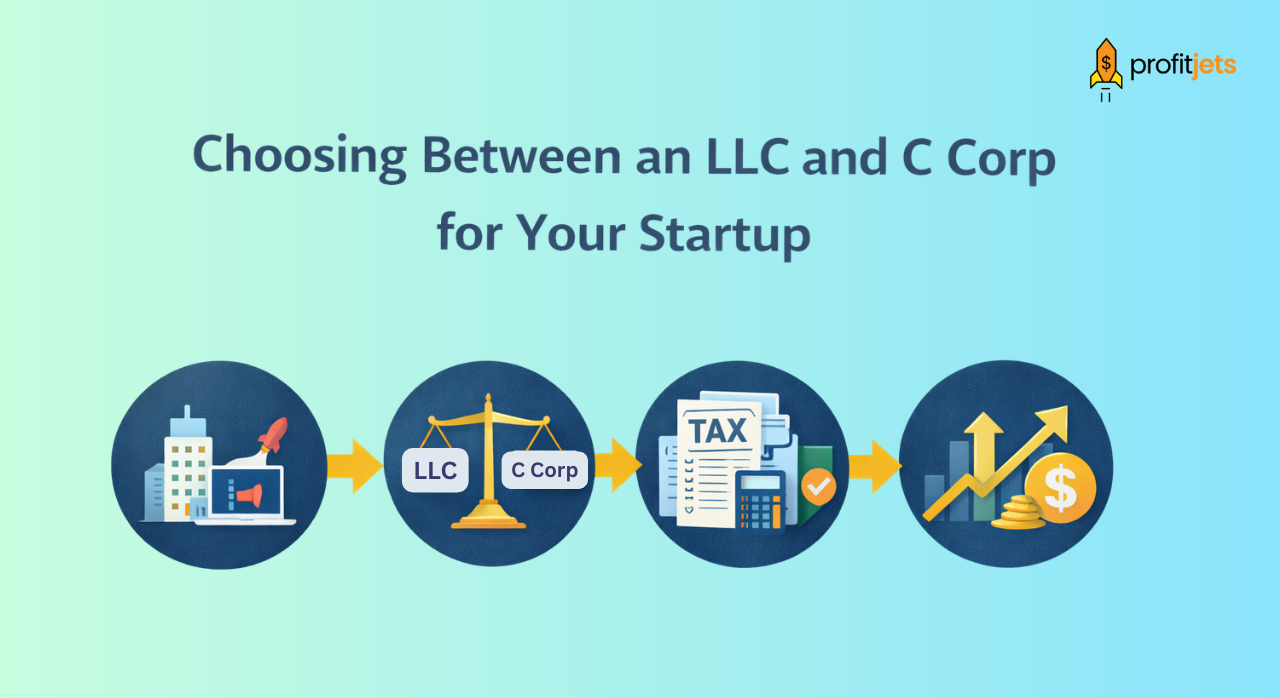
LLC and C Corp are the two most common legal structures founders consider when starting a company. Starting a new venture comes with a barrage of decisions, and one of the first major choices is selecting the right entity structure for your startup. Should you form an LLC or a C Corp? This decision impacts everything from how you pay taxes to how easily you can raise funding. In this guide, we break down LLC and C Corp in a founder-friendly way, comparing their differences in taxation, compliance, investor appeal, scalability, and ease of setup. We also touch on special considerations for Indian founders expanding to the US, and global startup structures including UAE or multi-entity setups. By the end, you will have a clearer understanding of which entity structure fits your startup and how Profitjets can support you with entity setup, compliance, and long-term growth.
Understanding the Basics: LLC and C-Corporation
Before diving into detailed comparisons, let’s clarify what we mean by an LLC and a C-Corp:
LLC (Limited Liability Company): An LLC is a flexible business structure that provides personal liability protection (like a corporation) while allowing pass-through taxation (profits pass through to owners’ personal tax returns by default). Owners of an LLC are called members, and an LLC can have one or multiple members. LLCs are governed by state laws and an operating agreement among members, giving lots of flexibility in how you organize the business. The paperwork and ongoing formalities are generally lighter than a corporation – for example, LLCs aren’t typically required to hold formal board meetings or issue stock certificates.
C-Corp (C Corporation): A C-Corp is the standard corporate entity, a completely separate legal and taxable entity from its owners (shareholders). A C-Corp pays its own corporate income tax on profits, and any dividends to shareholders can be taxed again on the individual level (this is the infamous “double taxation”). C-Corps have a more rigid structure: they issue shares of stock, must have a board of directors and officers, follow bylaws, and maintain corporate formalities like board minutes. The “C” refers to subchapter C of the U.S. Internal Revenue Code under which these corporations are taxed. This structure is highly familiar to investors and required if you ever plan to go public on a stock exchange. Notably, Delaware C-Corps have become the de facto standard for venture-funded startups in the U.S., thanks to Delaware’s business-friendly laws and strong legal infrastructure (over 60% of Fortune 500 companies are incorporated in Delaware).
Both LLCs and C-Corps provide limited liability protection. This means as a founder, your personal assets (house, savings, etc.) are generally protected from business debts or lawsuits, as long as you keep the business affairs separate and comply with basic rules. In other words, if the company goes under or faces legal claims, your personal risk is limited to what you’ve invested in the business.
So, LLC vs C-Corp – how do you choose? It boils down to key differences in taxation, compliance, fundraising capability, and your long-term vision for the company. Let’s compare these aspects side by side.
LLC vs C-Corp: Quick Comparison Table
To get an overview, here’s a quick comparison of an LLC and a C-Corp across the key dimensions that matter to startups:
|
Factor |
LLC (Limited Liability Company) |
C-Corp (C Corporation) |
|
Taxation |
Pass-through taxation by default (profits/losses pass to owners’ personal taxes). No corporate income tax at entity level. Note: Owners pay tax on all profits, even if retained in the business (possible “phantom income”). Can elect to be taxed as S-Corp or C-Corp if desired. |
Separate entity pays corporate income tax (21% federal in the U.S.) on profits. Potential double taxation: profits taxed at corporate level, and again if distributed as dividends to shareholders. However: no personal tax for owners on profits that are reinvested (retained) in the business. |
|
Compliance & Formalities |
Fewer ongoing formalities. No requirement for a board of directors, shareholder meetings, or complex bylaws (though an operating agreement is advisable). Simpler annual filings (often just an annual fee/report to state). |
More formal governance. Requires a board of directors, annual shareholder meetings, recorded meeting minutes, bylaws, stock issuance and record-keeping. Annual reports and franchise tax filings required in states like Delaware. Higher administrative upkeep to maintain good standing. |
|
Investor Preference |
Typically not favored by venture capital and institutional investors. Many VCs are unwilling or even unable (for legal/tax reasons) to invest in LLCs. LLCs can’t issue preferred stock easily, and issuing ownership to many investors is complex. Suited for small number of owners using personal funds or simple angel investments. |
Widely preferred by investors and VCs. Allows issuance of preferred shares, convertible notes, SAFEs, stock option plans, etc. Clear equity structure with shares makes due diligence easier. Many accelerators/VCs require a Delaware C-Corp before investing (e.g. Y Combinator insists on it). |
|
Scalability & Growth |
Flexible structure can work for small businesses or even larger ones, but scaling with an LLC can get complicated. Adding new members or equity incentives requires amending the operating agreement. No stock options (you’d give direct membership interests, which can complicate taxes for recipients). Harder to go public or issue multiple classes of shares. Often ideal for small teams, side projects, or businesses content to stay private and closely held. |
Designed to scale. You can have unlimited shareholders, create new stock classes (for example, separate classes for founders vs investors), and easily bring on co-founders, investors, or issue stock options to employees. Suitable for high-growth startups planning for large teams, multiple funding rounds, or even an IPO. Continuity is strong – the corporation isn’t affected if a founder leaves or sells shares (company lives on). |
|
Ease of Setup & Costs |
Generally cheaper and easier to start. Filing Articles of Organization with a state is straightforward (often online) and typically costs a few hundred dollars or less. Less paperwork overall; an LLC can be formed in days. Ongoing costs: minimal state fees (e.g., in Delaware, a flat annual LLC franchise tax ~$300). Tax filing can be simpler (single-member LLCs file on owner’s return; multi-member file a partnership return). |
Formation involves filing a Certificate of Incorporation, creating bylaws, issuing initial stock, and meeting initial corporate formalities – usually requires more legal paperwork upfront. Popular in Delaware (about $90 filing fee). Ongoing: annual reports and franchise taxes (Delaware C-Corps pay a franchise tax, minimum $225 annually, more if many shares). Accounting costs higher – a C-Corp must file its own corporate tax return (Form 1120) each year. Overall maintenance is more involved and potentially a few thousand dollars a year more expensive than an LLC for a small company. |
(Note: S-Corporation is another term you might hear – an S-Corp is not a separate legal entity type, but a tax-election that certain small corporations or LLCs can choose for pass-through taxation. In this article, we’ll focus on the primary entity choices of LLC vs C-Corp to avoid confusion.)
As you can see, each structure has its pros and cons. Next, we’ll dive deeper into these factors and discuss how they play out for startups, including real-world scenarios and special cases. Keep in mind, there’s no one-size-fits-all answer – the right choice depends on your startup’s goals, funding plans, and where you’ll operate.
Taxation: Pass-Through vs Double Taxation
One of the biggest differences between an LLC and a C-Corp is how they are taxed. Here’s what you need to know in plain language:
LLC Taxation: By default, an LLC is a pass-through entity, meaning the company itself does not pay income tax as a separate entity. Instead, profits (or losses) “pass through” to the owners’ personal tax returns. For a single-member LLC, this means you simply report business income/expenses on a Schedule C as part of your personal return. For a multi-member LLC, the LLC files an informational partnership tax return and issues K-1 forms to each member to report their share of profit/loss. The advantage is you avoid the corporate tax layer – income is taxed only once, at the individual level. However, a potential drawback is “phantom income”: LLC members pay tax on all the LLC’s profits even if those profits are retained in the business bank account and not taken out as cash distributions. For example, if your LLC made $50k in profit this year and you left it all in the company to reinvest, you still owe personal income tax on that $50k. This requires planning to make sure you set aside money for your tax bill. On the flip side, if the LLC incurs a loss, that loss can often be used to offset your other personal income (say, from a day job), which could lower your overall taxes in the early years.
C-Corp Taxation: A C-Corporation is a separate taxpayer in the eyes of the law. The corporation must file its own tax return (Form 1120 in the U.S.) and pay corporate income tax on any profits (21% federal tax rate in the U.S. currently, plus any state taxes). If the corporation then distributes profits to owners as dividends, those dividends are taxable income for the owners individually. This is the classic “double taxation” – taxed once at the corporate level and again at the shareholder level. Double taxation sounds like a worst-case scenario, but here are a couple of important nuances for startups:
In the early years, many startups have little to no profits (often intentionally, as they reinvest revenue into growth). If your C-Corp isn’t profitable yet, it may pay $0 in corporate tax – and it likely isn’t issuing dividends either. So the double-tax issue is essentially moot until you become profitable. By the time you’re making substantial profits, you might have the financial heft (or tax planning strategies) to manage the tax impact.
A C-Corp can also retain earnings (keep profits in the company) to reinvest in growth. Retained earnings are only taxed at the corporate level initially, not to the individual owners. For a high-growth startup, this can be efficient: you pay 21% corporate tax on the profit that year, but you don’t pay personal tax on it since you didn’t take it out as dividends. In contrast, with an LLC or other pass-through, the owners would pay personal income tax on the profits even if all the money stayed in the business.
There are also special tax benefits exclusive to C-Corps. For example, U.S. C-Corp stock may qualify as Qualified Small Business Stock (QSBS), which, if you hold the shares for 5+ years and meet the criteria, can let you (or your investors) exclude up to $10 million in capital gains from taxes when you sell the stock at a profit. This is a huge potential tax break for founders and early investors on a successful exit – but QSBS only applies to C-Corp stock (not LLC interests).
In summary, LLCs offer simpler, one-layer taxation, which can save taxes in certain situations (and make filing easier), whereas C-Corps involve that extra tax layer but bring other benefits and strategies into play. For many small, profit-generating businesses, avoiding double tax is appealing. But for startups planning to plow money back into the company for years, the tax differences may be less significant in the short term. It really depends on your business’s financial trajectory.
Global Note: If you’re a non-U.S. founder (for example, based in India or Europe) considering a U.S. LLC, be aware that pass-through taxation can create complications. As a foreign owner of a U.S. LLC, you might be required to file U.S. tax returns and pay U.S. taxes on the LLC’s income, even if you don’t live in the US, and potentially get taxed again on that income in your home country. This scenario can turn into a tax and compliance headache (imagine dealing with the IRS and your local tax authorities). In contrast, if you own a U.S. C-Corp as a foreigner, the tax obligations generally stay at the company level in the U.S., and you personally might only deal with local taxes on any salary or dividends you receive. This is one reason many international founders opt for a C-Corp over an LLC when incorporating in America.
Compliance and Legal Formalities
Another big difference is the level of compliance, paperwork, and formalities required to maintain each type of entity.
LLC compliance tends to be simpler and more flexible: – To form an LLC, you file a short document (often called Articles of Organization) with the state and pay a fee. Ongoing, most states require an annual report or fee to keep the LLC active, but the requirements are usually minimal (e.g., pay a flat fee and update any address or agent information). – LLCs aren’t obligated to have a board of directors, hold formal annual meetings, or keep extensive corporate records. You should have an Operating Agreement that outlines how the LLC is run (especially if there are multiple members), but this is an internal document. – There’s a lot of operational flexibility. The LLC can be managed directly by its members or by appointed managers. You don’t need to draft corporate bylaws or stock certificates. For example, you could run an LLC almost like a simple partnership or proprietorship in day-to-day function, just with the legal protection wrapper around it.
– Compliance is mostly about taxes and licenses: ensuring you file any required partnership tax return (if multi-member) and local business licenses. If you have employees, you’ll handle payroll compliance similar to any business.
C-Corp compliance is more involved and standardized: – Forming a C-Corp involves filing a Certificate (or Articles) of Incorporation with the state (e.g., Delaware). This document outlines key details like number of authorized shares. You’ll also need to create Bylaws (the rules for governing the corporation) and typically hold an initial board meeting (or write resolutions) to appoint directors, issue stock to founders, etc. – C-Corps must adhere to ongoing formalities:
– Board of Directors and Annual Meetings: A C-Corp is required to have a board that oversees major decisions. You should hold board meetings (or at least document board decisions with written consents) and keep minutes. Likewise, shareholders (even if just you and co-founders) should have at least an annual meeting to elect directors, etc. In practice, many small startups handle this on paper via “unanimous written consents” to avoid actual meetings, but the record-keeping is important to maintain the liability shield. – Stock records: The company needs to track its shareholders and stock issuance. If you bring on a new co-founder or investor, you issue them shares (often documented with stock purchase agreements, share certificates, cap table updates, etc.). If someone leaves, you might transfer or cancel shares. All this needs proper paperwork.
– State filings: In states like Delaware, a corporation must file an Annual Report and pay a Franchise Tax each year. The franchise tax in Delaware for a startup can range from a few hundred dollars and up, depending on share count and an involved calculation (though Delaware offers a method to minimize it for startups with a high number of authorized shares). – More extensive tax filings: A C-Corp files its own tax return annually. If you operate in multiple states, you might need to file state corporate tax returns or register as a “foreign corporation” in states where you do business. By contrast, an LLC might also need to register in other states if operating there, but compliance tends to be a bit easier as it’s often just a registration and paying that state’s LLC fee.
In short, LLCs are low-maintenance – you focus on running the business with minimal red tape. C-Corps are higher-maintenance – they require a bit of bureaucracy and disciplined record-keeping. This is one reason why an LLC can be attractive to a small business owner who doesn’t want to deal with corporate formalities. On the other hand, the standardized compliance of C-Corps is part of what makes investors comfortable; they know the entity will have a clear paper trail and governance structure.
Tip: If the compliance requirements of a C-Corp feel daunting, remember you don’t have to do it all alone. Professional firms like Profitjets can handle much of the heavy lifting from maintaining corporate books and minutes to filing annual reports and tax returns, so that you remain in good standing with minimal stress. In fact, Profitjets offers full compliance management services, ensuring your filings (federal, state, and even multi-country) are done accurately and on time, so you can focus on building your startup rather than drowning in paperwork.

Fundraising and Investor Preference
If your startup might seek outside investment – whether from angel investors, venture capital (VC) funds, or accelerators – the choice between LLC and C-Corp becomes crucial. Here’s the reality:
Investors (VCs and many angels) overwhelmingly prefer C-Corps. The Delaware C-Corp is considered the gold standard for startups planning to raise money. Why? A few reasons:
Standardized ownership structure: C-Corps issue shares of stock. It’s very clear what percentage of the company each shareholder owns. Investors can get preferred stock (with special rights like liquidation preferences, anti-dilution, etc.) which LLCs can’t offer in the same way. This aligns with how investors structure deals.
Legal and tax considerations for investors: Many venture funds have their own investors (LPs) and legal restrictions. If they invest in an LLC, they could receive pass-through income or losses on a K-1 form, which can complicate their taxes (especially if some of a fund’s LPs are non-profits or foreign entities). Some funds are actually barred from investing in pass-through entities for this reason. A C-Corp neatly avoids that issue – the VC just holds stock and potentially pays capital gains tax when they sell, with no K-1 flow-through during holding.
Due diligence and familiarity: C-Corps, particularly Delaware C-Corps, have a century’s worth of legal precedence. Investors know what to expect. They don’t have to comb through a custom LLC operating agreement wondering what the provisions mean. With a C-Corp, they can rely on well-understood default rules of Delaware law plus a standard set of financing documents. This reduces legal friction in doing the deal. As one guide put it, investors don’t want to do extra homework just to figure out your entity’s setup – they prefer the familiarity of a C-Corp.
Ability to scale ownership: When raising multiple rounds of funding, a C-Corp can authorize new shares, create stock option pools for employees, and manage a cap table that might eventually include hundreds of stakeholders. This is far easier with a corporation. An LLC with many members gets unwieldy; and every new investor would become a member of the LLC (essentially a partner for tax purposes), which they often won’t want to be.
LLCs and fundraising: It’s not that an LLC can never raise money – some do, especially from friends and family or certain angel investors. But it’s rare for a high-growth startup LLC to raise institutional VC. If you start as an LLC and an investor is interested, they will almost certainly require you to convert to a C-Corp (usually Delaware) as a condition of investment. Major accelerators like Y Combinator explicitly require startups to be a Delaware C-Corp to join their program, for instance. Converting an LLC to a C-Corp later is doable (and fairly common when LLC-founded startups “get serious”), but it comes with legal costs and potential tax considerations. Legal fees for such a conversion can range from $5,000 to $15,000+ depending on complexity, not to mention the time and paperwork involved.
Investor signals: Choosing a C-Corp from the outset might also send a signal that you’re aiming to build a scalable, investable business. On the flip side, if you form an LLC, it might signal that you plan to stay small or are unsure about your fundraising plans (which is not necessarily bad – but something to be aware of in how you present your company).
Bottom line: If you have ambitions to raise venture capital or onboard sophisticated investors, a C-Corp is usually the way to go from day one. It will save you the hassle of converting later and ensure you don’t turn off potential investors. If you’re absolutely certain you’ll never seek outside investors beyond maybe one or two individuals who are okay with an LLC, then an LLC could suffice. But many founders keep the door open for future funding, and thus lean towards the C-Corp to be safe.
(A quick note for completeness: sometimes early-stage startups compromise by starting as an LLC for ease, and then converting to a C-Corp when they’re on the verge of raising money. This can work, but remember the conversion costs and time involved. It’s often smoother to just start as a C-Corp if funding is on your horizon.)
Ownership, Scalability, and Long-Term Vision
Think about where you want your startup to be in 5 or 10 years. Your entity structure can either accommodate that vision or hinder it. Let’s compare LLC vs C-Corp on some long-term considerations:
Number of Owners & Equity Structure: Both LLCs and C-Corps can technically have multiple owners (an LLC can have unlimited members, and a C-Corp can have unlimited shareholders). But how ownership is represented differs:
An LLC’s ownership is typically expressed in percentage interests or units. You might say, “Alice owns 50%, Bob owns 50%” or allocate units that equate to those percentages. If you want to bring in a new co-founder or investor, you need to carve out a portion of that pie for them, which usually means amending the operating agreement and issuing a new membership interest. LLCs are not designed to have rapidly fluctuating ownership; each change may need unanimous consent of members unless your operating agreement says otherwise.
A C-Corp’s ownership is sliced into shares of stock. Startups often authorize a large number of shares (like 10 million) but only issue a portion of those to founders initially, leaving room to issue more to others. It’s straightforward to issue new shares to a new stakeholder (as long as you stay within your authorized amount or increase it via a board/shareholder approval if needed). You can also create different classes of shares (common stock for founders/employees, preferred stock for investors with special rights, etc.), which an LLC cannot do in the same way.
If you plan to have co-founders, early employees with equity, and multiple investment rounds, a C-Corp’s share structure handles this smoothly. With an LLC, giving equity to an employee means making them a member/partner, which not only is unfamiliar to many (imagine telling a new engineer that they have to receive a K-1 for their tiny sliver of LLC ownership), but it also could give them access to financial info and involve them in tax filings. Most employees would much rather have stock options in a corporation than become an LLC partner.
Equity Incentives (Stock Options/ESOP): Startups often use stock options or equity grants to attract talent. C-Corps have a well-established mechanism for this: you create a stock option plan and can grant employees the right to buy shares in the future (options) or give them restricted stock, etc. There are standard IRS rules and tax advantages (like the 83(b) election on stock grants, and favorable ISO option tax treatment if done right). In an LLC, you don’t have stock, so you can’t grant stock options. LLCs can grant something called “profits interests” to mimic equity-like incentives, but these are more complex and less understood by employees. Also, giving someone a piece of an LLC means they may owe taxes on the LLC’s profits (even if they haven’t received cash – again that phantom income issue) and may remain a partner for tax purposes even after leaving the company. Bottom line: if you want to distribute equity widely (to employees, advisors, etc.), C-Corp is far better suited.
Scalability and Growth: A C-Corp is built to scale – you can grow the shareholder base, raise successive rounds (Series A, B, etc.), expand to new states or countries (often by having subsidiaries under the main corporation), and even one day list on a stock exchange or get acquired by a big company (most acquirers will also prefer to buy a corporation’s shares or assets, not deal with an LLC structure). A Delaware C-Corp in particular is prepared for these possibilities, as Delaware law is very flexible for mergers, stock issuance, and so on.
An LLC can certainly grow too, and some large companies are LLCs or started as LLCs. (Fun fact: Snap (Snapchat’s company) was famously an LLC before it went public and had to convert to a corporation just ahead of the IPO.) But growing as an LLC can introduce friction. For instance, every new member might need to sign onto the operating agreement. If you had dozens of members, coordinating votes or changes gets complex. And if you ever wanted to take the company public, you’d have to convert to a corporation first, since public stock markets only deal in corporate stock.
Business Type and Use Case: Consider the nature of your startup. Is it a bootstrapped SaaS or consultancy with steady profits and no plans for massive scale? LLC could be perfectly fine and save you some hassle. Is it a high-growth SaaS or tech startup aiming for national/global reach and big financing? Then C-Corp is likely best. In many cases, a small local business (say a consulting agency, a boutique product studio, etc.) might lean LLC, whereas a startup aiming to be the next big tech company goes C-Corp. In fact, many SaaS startups choose Delaware C-Corps to scale their SaaS platforms and meet investor expectations.
Real-World Examples: To illustrate, let’s look at two hypothetical startup scenarios: – Three friends start a web design agency. They have no outside investors and split ownership equally. They expect to make profit each year and distribute it among themselves. They choose an LLC to keep things simple – one layer of tax, less paperwork, and they run the business like a partnership. This saves them money on accounting and compliance (one of them can handle the bookkeeping, and they avoid the extra costs of corporate filings). In fact, by avoiding the complexity of a C-Corp, they estimate saving a few thousand dollars per year in admin and accounting expenses. The LLC structure fits their needs since they value simplicity over rapid scaling.
Two co-founders are building a SaaS product with plans to raise capital. They incorporated a Delaware C-Corp from day one and split the founder stock between them. Eighteen months later, they secured a $2 million seed investment from a VC fund. Because they already had a C-Corp with a clean share structure, the due diligence and investment process was smooth – the investors get preferred stock, and the founders’ ownership and option pool for employees were already set up in the cap table. The C-Corp choice signaled their ambition and made it easy to bring in investors. Later, as they hire employees, they grant stock options as incentives, which the team understands and appreciates.
These scenarios show how different goals lead to different optimal structures. One isn’t “better” in an absolute sense – it depends on what you as a founder need for your business.
When to Choose LLC vs When to Choose C-Corp
To summarize the points above, here’s a quick guide on when each structure tends to make sense for a startup:
Consider an LLC if : – You’re a solo founder or a small founding team and don’t plan to raise venture capital or significant outside funding in the foreseeable future. – You want to keep things simple in terms of taxes and administration. For example, you prefer to report business income on your personal taxes and avoid the formalities of corporate governance. – Your business is expected to generate profits early and you intend to distribute earnings to owners (so pass-through taxation would prevent double-tax on those payouts). – You value operational flexibility. You don’t want to deal with boards, bylaws, or issuing stock. Perhaps your startup is more of a steady small business, consultancy, or a family-run venture. – Examples where LLC shines: A consulting agency, a small e-commerce or SaaS that is bootstrapped and generating revenue, a services business, or any venture where simplicity and direct control trump rapid expansion.
Consider a C-Corp if : – You plan to raise venture capital or bring on multiple investors. If pitching to VCs is on your roadmap, a Delaware C-Corp is almost a must. – You want to offer stock options or equity to employees and build a team with ownership stakes. C-Corp structure makes creating an option pool and issuing grants straightforward. – You’re building a scalable product (e.g., a tech startup, SaaS, fintech) with high growth potential, and you might expand to multiple markets or even go public someday. – You have multiple co-founders or early stakeholders who need a well-defined equity split, and you anticipate those shares might change hands (e.g., you may attract a co-founder, or someone might leave and sell their shares). – You’re considering an eventual IPO or acquisition. Acquirers and public markets expect a C-Corp structure, especially a U.S. C-Corp for a U.S. listing. – In short, if you have big ambitions and might intersect with the institutional finance world, C-Corp is likely the best foundation.
If you’re still on the fence, it’s wise to consult with a startup attorney or accountant. You can also lean on services like Profitjets, which offers startup entity consulting – they’ll look at your specific situation (business model, funding plans, etc.) and recommend the best structure. Profitjets can handle the entire setup process for either an LLC or C-Corp, ensuring that all paperwork is filed correctly, and can even help transition your company from one structure to another down the line if your needs change.
Delaware C-Corp Advantages (and Other Options)
You’ve probably noticed we’ve mentioned Delaware C-Corps repeatedly. That’s because in the U.S., Delaware is king for incorporations, especially for startups. Why do people make such a fuss about Delaware? Some key advantages:
Business-Friendly Legal Environment: Delaware’s courts (notably the Court of Chancery) specialize in corporate law and have a vast body of case law. This means legal disputes are resolved more predictably, and corporate lawyers/investors trust Delaware to handle complex issues. Delaware corporate law is also very flexible in allowing things like proxy voting, different share classes, etc., which startups and VCs often need.
Investor Familiarity: U.S. VCs are extremely familiar with Delaware C-Corps. Many will insist on Delaware because it simplifies their due diligence – they know the rules of the game. As noted, investor confidence is higher with Delaware entities. It’s the tried-and-true path, so you’re removing one potential concern by using the standard setup.
Efficient Administration: Delaware’s Secretary of State is quite efficient. You can incorporate in as fast as a day. You don’t need to be physically present. And Delaware allows a concept of “foreign corporation” registration easily if you operate elsewhere (meaning you can be a Delaware company doing business in, say, California or New York by registering there, which is common).
Privacy and Flexibility: Delaware doesn’t require listing the names of initial directors/officers on the public formation documents – only the incorporator (who can be a service) and a registered agent. This offers a bit of privacy to founders at the setup stage. It also has flexible rules around things like not requiring residency for directors, etc.
Established Infrastructure: Because so many companies are incorporated in Delaware (including 60%+ of Fortune 500 and countless startups), there’s an entire ecosystem of services, lawyers, and tools geared toward Delaware companies. From getting a Delaware registered agent, to standardized legal documents (you’ll often hear “Delaware standard” terms in term sheets), it’s easier to find support.
Tax considerations: Delaware does not tax out-of-state income for Delaware corporations (if your Delaware C-Corp isn’t actually operating in Delaware, you’re not paying state income tax there, just the franchise tax). This can simplify things if you’re operating nationwide or globally from a tax perspective.
Are there alternatives? Yes. Some startups incorporate in their home state (if not Delaware) to save a bit on fees or complexity. For example, if you’re a small business in California serving local clients, you might just incorporate in California. Some choose Wyoming as an alternative for simpler cases – Wyoming has low fees, no state income tax, and good privacy (it’s sometimes considered a cheaper Delaware for LLCs and small corps). However, for a globally ambitious startup, Delaware remains the top choice. It’s often not worth re-inventing the wheel, given that most serious investors will ask you to be in Delaware anyway.
For non-U.S. founders: you can indeed directly form a Delaware C-Corp even if you live in India, Europe, etc. There are no citizenship or residency requirements to owning a U.S. company. Many international founders do this to tap into the U.S. market and investment scene – in fact, thousands of Indian entrepreneurs have formed Delaware C-Corps to access U.S. investors and infrastructure. The process can be done remotely (through online services or providers like Profitjets that handle U.S. company formations). If Delaware is not suitable, some global founders consider incorporation in other friendly jurisdictions like Singapore or UAE for international holding companies – but those are different pathways with their own pros/cons, which we’ll touch on next.
Special Considerations for Indian Founders Incorporating in the U.S.
For founders based in India (or generally outside the U.S.) who are reading this, you might be wondering how LLC vs C-Corp plays out for you. Here are a few points tailored to Indian startup founders:
India vs US entity: In India, the typical startup incorporation is a Private Limited Company (which is somewhat analogous to a C-Corp in that it’s a separate legal entity with shareholders) or an LLP (Limited Liability Partnership) which has pass-through taxation but is taxed at the entity level in India. If your market and investors are primarily in India, you’ll likely start with an Indian Pvt Ltd company. However, many Indian founders with global ambitions consider incorporating in the U.S. (Delaware C-Corp) either from the start or via a “flip”. A Delaware flip is when an Indian company’s shareholders set up a Delaware C-Corp and swap their shares, making the Delaware company the new parent and the Indian company a subsidiary. This is often done to attract U.S. venture capital and position the startup for international scale.
Why incorporate a U.S. C-Corp as an Indian founder? A few reasons:
Access to U.S. investors and markets: As noted, U.S. VCs strongly prefer a Delaware C-Corp. If you’re aiming to raise from them, they might require you to be a U.S. entity. Also, if your customers are in the U.S. (say you’re building a SaaS for a global audience), being a U.S. company can make it easier to transact (setting up U.S. banking, Stripe/PayPal, etc. in the company’s name).
Legal infrastructure: The U.S. offers a stable legal framework and certain benefits (like the QSBS tax benefit on exit for a Delaware C-Corp, which could be advantageous if you have U.S. investors).
Global credibility: Fair or not, having a Delaware-incorporated company can sometimes add credibility in the eyes of international partners or customers. It’s seen as a signal that you’re aiming big.
Managing a U.S. entity from India: If you do set up a U.S. C-Corp, remember you will have compliance obligations in the U.S. and still have to manage things in India if you keep an Indian subsidiary. For example, you might have to comply with RBI regulations (FEMA/ODI) for your Indian entity to be owned by a foreign company. You’ll also handle Indian taxes/payroll for the Indian subsidiary and U.S. taxes for the U.S. parent. It’s a multi-entity, cross-border structure now. This complexity is manageable with the right help, but it’s important to be aware: you can’t ignore Indian compliance just because you flipped to a U.S. parent. You’ll need to do things like annual filings in both countries, transfer pricing agreements for any inter-company services, etc.. For instance, if your U.S. parent is funding your Indian operations, you’ll have to properly document that (as equity or debt) and follow RBI’s rules.
LLC vs C-Corp specifically for Indian founders: Generally, if you’re going through the trouble of setting up a U.S. entity as an Indian founder, you’d lean toward a Delaware C-Corp (not an LLC). That’s because the main reason to do it is to raise money or expand globally, which calls for the C-Corp structure. An LLC could expose you personally to U.S. tax filings, as discussed, and investors won’t invest directly into an LLC with foreign owners due to tax complexity. One scenario an LLC might be used is if you’re an Indian freelancer or small business just opening an LLC for ease of invoicing U.S. clients (some do that). But for a startup scenario, a C-Corp is usually more appropriate if you’re thinking cross-border.
Indian regulations: Keep in mind the Indian government has rules on sending money abroad to invest in companies, and on Indian residents owning foreign companies. Many Indian startups engage experienced advisors to handle the “flip” process properly, ensuring compliance with the Companies Act and FEMA (Foreign Exchange Management Act) guidelines. It’s not as simple as just opening a company online – you’ll likely need permissions or filings for moving your ownership overseas. Again, this is something firms like Profitjets (with multi-country support) or other cross-border specialists can assist with, making sure you don’t run afoul of any regulations during your incorporation or fundraising.
TL;DR for Indian founders: If your startup is India-focused and not raising abroad, you might just stick with an Indian entity (Pvt Ltd). But if you are eyeing U.S. investors or global markets, setting up a Delaware C-Corp (with your Indian entity as a subsidiary) is a proven route. It gives you the best of both worlds – a global holding company and a local operating company. Just be prepared for the additional compliance. The good news is that, with expert help, many Indian startups have successfully made this transition and unlocked access to U.S. capital and opportunities.
(Fun fact: Several Indian SaaS startups that went through Y Combinator or raised from U.S. VCs initially incorporated in the U.S. even if their teams were in India. It’s become a common play in the startup ecosystem to the point that it’s almost a rite of passage for globally-minded Indian startups.)
Global and Multi-Entity Considerations (Including UAE)
In today’s world, startups aren’t confined to one country. You might be starting in the U.S. but planning to expand to India, or launching in India but targeting customers in the US, Europe, or the Middle East. Choosing the “best entity structure” can sometimes mean having multiple entities. Here are some global considerations:
Multi-country structures: It’s not uncommon for a startup to have a parent company in one country and subsidiaries or branches in others. For instance, you might have a Delaware C-Corp as a parent company and an Indian Private Limited as your operating subsidiary (common for Indian SaaS companies going global), or maybe a holding company in Singapore with operating companies in India and the US, etc. Each country has its own entity types and rules. In the UAE, for example, you may decide to set up an entity in a UAE free zone or mainland to tap into Middle East markets. The UAE has its own flavors of LLCs (often just called LLCs in mainland, or free zone companies) and recently introduced corporate taxes (at 9%) for certain companies. You’d consider things like: UAE free zone companies can have 100% foreign ownership and no personal income tax, but might be limited to operating within the free zone or require local distributors for mainland. These are very specific local considerations.
- Compliance multiplies: Each entity you set up will come with its own compliance duties – annual filings, tax returns, maybe audits, payroll compliance, etc. A global startup needs to keep track of all these. For example:
- A U.S. C-Corp will file taxes in the U.S. and maintain Delaware (or home state) good standing.
- An Indian company will file with the Ministry of Corporate Affairs, GST returns if applicable, etc.
- A UAE company might need to do VAT filings and renew licenses annually.
- You also have to manage inter-company arrangements. If your U.S. entity funds your foreign subsidiary, you should set up proper inter-company agreements (loans or equity infusions) and possibly consider transfer pricing for any cross-border services.
All this can sound daunting, but it’s manageable with careful planning (many startups do it). It’s wise to have an international tax advisor or a firm like Profitjets that offers multi-country support, so nothing slips through the cracks. Profitjets, for example, can coordinate accounting and compliance across multiple jurisdictions, ensuring your U.S. and foreign entities both stay compliant with local laws – a lifesaver when you’re juggling requirements from the IRS to the GST to UAE’s authorities.
- Cross-border tax optimization: Sometimes, having entities in different countries can help optimize taxes or operations. A classic approach is to incorporate where it’s most beneficial for the type of business.
- Some software startups incorporate a holding company in a low-tax jurisdiction (like Delaware or Singapore) and keep profit there, while their cost centers (development teams, etc.) are in higher-tax countries (so the high-tax subsidiary shows minimal profit). This has to be done in accordance with laws and transfer pricing rules, obviously.
- If Middle East/North Africa is a big market, a UAE entity can be attractive because the UAE has been a no-tax or low-tax environment (though, as noted, a new corporate tax is being phased in above certain profit thresholds). The UAE also offers ease of doing international business (good banking, no currency controls, etc.).
- For scaling in Europe, one might open a subsidiary in the UK or EU. Each region might have an “optimal” entry structure.
- Global talent and holding IP: Some startups even set up an entity in a particular country to hold intellectual property (IP) or to hire remote teams. For example, you might have a U.S. C-Corp that owns the product IP, but you set up a Canadian or European subsidiary to hire engineers there and take advantage of R&D incentives or just to comply with local employment laws.
The key advice here is: Think ahead about where you will operate and raise funds. If all your business is local, stick to a local entity. If you know you’re going to be international, you may start with one entity and add others as needed. But architecting a sensible global structure early (with a holding company and subsidiaries) can save you from restructuring later.
Don’t panic about complexity – just get the right help. For instance, Profitjets specializes in multi-entity accounting and compliance. They can handle the bookkeeping, tax filings, and regulatory compliance for your startup across countries, whether it’s USA, India, UAE, or beyond. Instead of you trying to learn the laws of multiple lands, you can have an expert team coordinate it and keep your startup investor-ready and legally sound everywhere you operate.
Conclusion: Making the Right Choice for Your Startup’s Future
Choosing between an LLC and a C-Corp is a foundational decision that can influence your startup’s growth trajectory, funding prospects, and administrative burden. There’s a lot to consider – taxes, compliance, investor expectations, and the scope of your vision. To recap a few key points:
- An LLC offers simplicity, pass-through taxation, and flexibility, making it great for small teams, early profitability, and less formal operation. But it can become a hurdle if you need to attract institutional investors or scale with many equity stakeholders.
- A C-Corp (especially the Delaware C-Corp) is the startup standard for those aiming high – it smooths the path for raising capital, issuing stock to employees, and expanding globally. It does come with more paperwork and the notion of double taxation, though early-stage startups often don’t feel the tax pinch due to reinvestment and can leverage benefits like QSBS on the backend.
- If you’re an Indian or international founder, factoring in cross-border implications is crucial. Often, the Delaware C-Corp + local subsidiary model is used to capture the best of both worlds (global capital and local execution). But compliance multiplies, so plan for that or engage specialists.
- No matter what, your decision isn’t set in stone. Many businesses start as one type and switch to another as they evolve (LLC to C-Corp conversions are common when startups outgrow the LLC model). That said, switching has costs, so it’s worth making an informed choice upfront if you can.
At the end of the day, the “best” entity structure is the one that aligns with your startup’s goals and keeps hurdles out of your way. If you’re unsure, don’t hesitate to seek expert guidance. In fact, this is where Profitjets can be your ally. We provide tailored entity structuring support for startups – from choosing the right structure, handling the entire entity setup process, to managing ongoing compliance and tax filings in the US, India, or wherever you expand. Our team has experience preparing startups for investor readiness (clean financials, compliance checks) and offering multi-country support so you stay compliant across borders while you grow.
Ready to make your decision with confidence? Reach out to Profitjets for a free consultation on setting up the optimal structure for your startup. Whether you’re weighing LLC vs C-Corp, planning a cross-border expansion, or need help with compliance and filings, we’re here to help you navigate the journey. Choosing the right entity today can save you headaches tomorrow – and with the right partner by your side, you can focus on your passion (building your business) while we handle the paperwork.
Equip your startup for success and let us worry about the fine print. Contact Profitjets to get started on solid footing, and set your venture up for growth, investment, and global reach!